Romance in Relationships
The moment your partner surprises you with your favorite coffee on a busy morning, you feel something shift. That flutter in your chest, the sudden warmth spreading through your body, the smile you cannot suppress. Romance is not just the grand gestures we see in movies. It is the neural pathway that lights up when someone remembers the small details that matter to you. It is the dopamine surge when your partner reaches for your hand across the table. It is the oxytocin release when they hold you close after a difficult day.
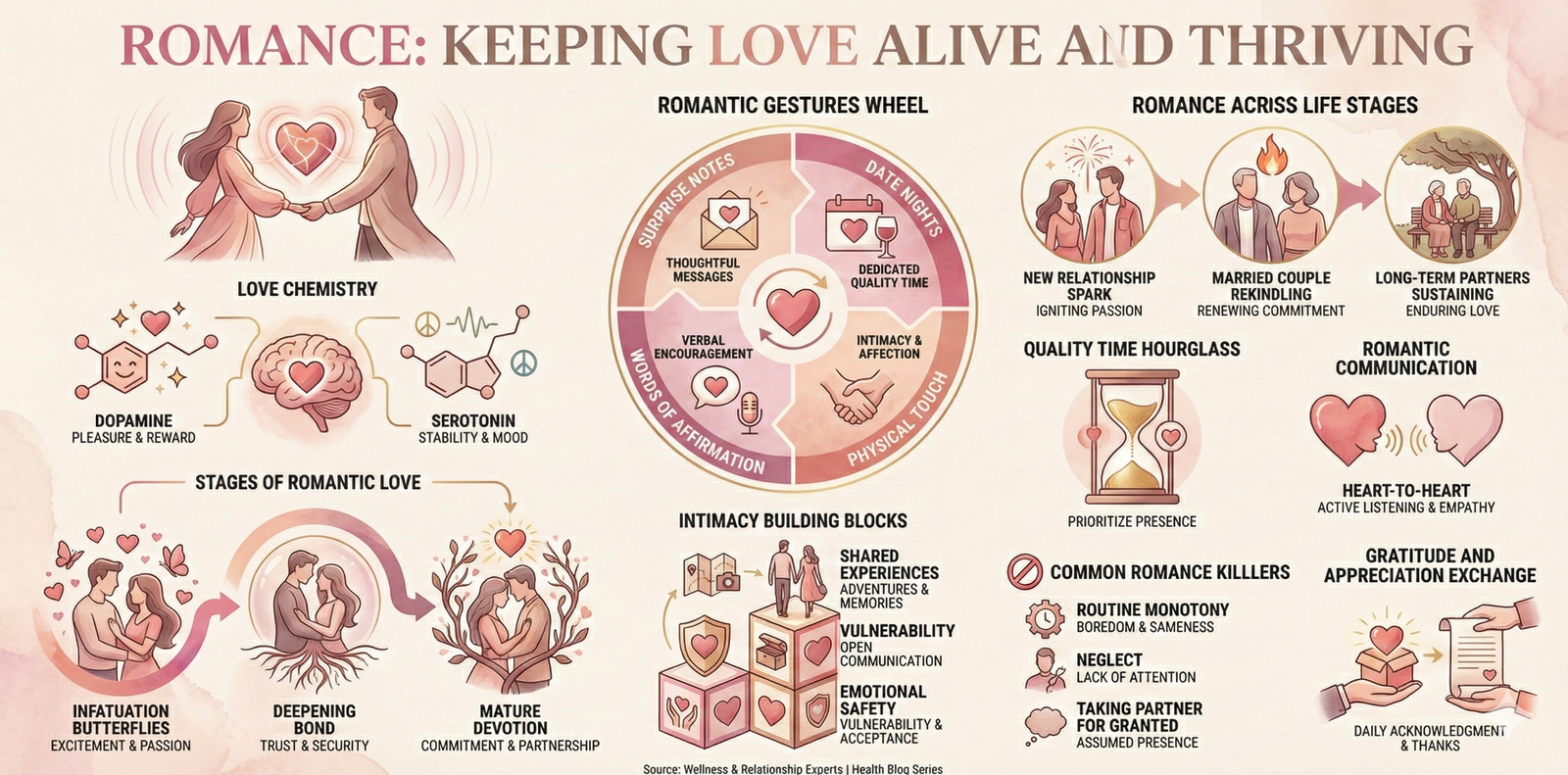
Most people believe <a href="/g/romantic-relationships.html">romantic relationships</a> naturally lose their spark over time. Research from 2024 challenges this assumption completely. Scientists at CU Boulder discovered a biological signature of desire that operates differently than we imagined. Understanding how your brain processes <a href="/g/intimacy.html">intimacy</a> and <a href="/g/connection.html">connection</a> changes everything about how you approach romance in your relationship.
Here is what makes romance truly work: it requires both the security of partnership and the thrill of novelty. You will discover in this guide why 13 percent of long-term couples maintain intense romantic love decades into their relationships, what neuroscience reveals about desire and attachment, and the exact practices that keep passion alive when responsibilities threaten to overwhelm connection.
The Neuroscience of Romantic Love
Your brain experiences romance as a complex neurochemical cascade. When you meet someone who attracts you, your brain's reward center floods with dopamine, creating sensations similar to cravings for sugar or other pleasurable substances. A 2024 study published in Current Biology by researchers at CU Boulder identified this as a biological signature of desire that plays a critical role in keeping love alive.
The activation pattern of love generates in specific brain regions. Research from Aalto University published in Cerebral Cortex in August 2024 found that love activates the basal ganglia, the midline of the forehead, the precuneus, and the temporoparietal junction. Interestingly, love for children generated the most intense brain activity, closely followed by romantic love, with unique activation deep in the brain's reward system in the striatum area.
Understanding emotional intelligence helps you recognize these biological responses. Your behavioral activation system puts loved ones on a pedestal during early romance. Australian researchers from ANU, University of Canberra, and University of South Australia measured how this system operates by surveying 1,556 young adults in 2024. The findings suggest that our brains are wired to idealize romantic partners, particularly in the early stages of dating.
Harvard Medical School research led by biological anthropologist Helen Fisher studied 166 societies and found evidence of romantic love in 147 of them. In 2005, Fisher's team published groundbreaking fMRI images of the brains of individuals in the throes of romantic love. This work established that romantic love is not merely a cultural construct but a fundamental human experience with deep biological roots.
Surprising Insight: Surprising Insight: Your brain processes romantic love using the same reward pathways activated by survival needs like food and water. This explains why love can feel both essential and overwhelming.
The chemistry of romance involves multiple neurotransmitters working together. Oxytocin, known as the love hormone, provokes feelings of contentment, calmness, and security, which are associated with mate bonding. Vasopressin links to behaviors that produce long-term, monogamous relationships. Together, these chemicals create the foundation for lasting romantic relationships that extend beyond initial attraction.
Your mental wellness directly impacts your capacity for romantic connection. When stress levels rise, cortisol can interfere with oxytocin production, making it harder to feel close to your partner. This is why stress reduction practices become essential for maintaining romance in demanding life circumstances.
The Neurochemistry of Romance
🔍 Click to enlarge
Why Romance Matters in 2025 and Beyond
Romance is not a luxury in relationships. It serves critical psychological and physiological functions. The Harvard Study of Adult Development found that the happiest, healthiest seniors were those who had long romantic partnerships. Those who were healthiest at age 80 were those most satisfied in their relationships at age 50. This longitudinal research demonstrates that romantic connection predicts longevity and life satisfaction.
The biggest predictor of happiness and fulfillment in life is love and the quality of relationships. Having someone to rely on helps your nervous system relax, helps your brain stay healthier for longer, and reduces both emotional and physical pain. This connection between romance and health outcomes makes maintaining romantic connection an investment in your overall wellness practices.
Research involving participants from 50 different countries indicates that relationship satisfaction and commitment reach higher levels in face-to-face relationships compared to online connections. Couples who met online experience less satisfaction with their marriages than those who met in person, according to 2025 research. This suggests that the quality of romantic connection depends partly on how relationships begin and develop.
Almost one in four young adults are now engaging with AI chat technologies to replicate romantic interactions, according to a 2025 study published in the Journal of Social and Personal Relationships. However, AI technology use was associated with negative individual wellbeing. This highlights the irreplaceable value of human romantic connection for emotional wellbeing.
Romance impacts mental health significantly. Young adults who have romantic relationships are happier, feel more satisfied with their lives, have fewer problems with mental and physical illness, show greater positive affect, and have better levels of self-esteem than single people. The protective effects of romantic connection extend across multiple dimensions of wellbeing.
Recent research from 2025 challenges traditional beliefs about gender differences in romantic relationships. A study titled Romantic Relationships Matter More to Men than to Women found that males had fallen in love significantly earlier than females, while females experienced romantic love more intensely. Understanding these patterns helps couples navigate relationship building with greater awareness of different needs and timelines.
Standards and Context for Healthy Romance
Not medical advice. Romance exists on a spectrum of healthy expression. Cleveland Clinic identifies 12 signs of healthy romantic relationships, with the foundation being similar values and goals. The healthiest relationships keep the door open for self-reflection, build off past mistakes, and allow everyone to confront conflict together in a safe, constructive and helpful way.
Healthy romance requires clear personal boundaries. These boundaries come down to determining what you are comfortable doing with your time, energy, body and space, while being respectful of your partner's autonomy. Without boundaries, romance can become overwhelming or lead to codependency rather than genuine connection.
Mayo Clinic Health System emphasizes that positive relationships can be as important to health and wellbeing as nutrition and physical fitness. Maintaining a strong social network as you age contributes to a longer, healthier life. Romance within committed relationships serves as a key component of this protective social support.
Romance differs from infatuation or obsession. Cleveland Clinic distinguishes between different types of love, including familial or romantic love, infatuation, deep friendship, and long-term consummate love. True romance combines passion with intimacy and commitment, forming what psychologist Robert Sternberg called consummate love in his triangular theory of love.
Cultural context shapes romantic expression. A large-scale cross-cultural study involving 117,293 participants from 175 countries examined romantic love experiences, mate preferences, and physical attractiveness across cultures. While romantic love appears universal, its expression varies significantly based on cultural norms, family relationships, and social expectations.
| Healthy Romance | Unhealthy Pattern | Impact on Wellbeing |
|---|---|---|
| Mutual respect and equality | Power imbalances or control | Supports self-worth and autonomy |
| Open communication about needs | Guessing or silent expectations | Reduces conflict and resentment |
| Maintains individual identity | Complete fusion or codependency | Preserves personal growth |
| Constructive conflict resolution | Avoidance or destructive fights | Builds trust and understanding |
| Physical affection by mutual consent | Pressure or obligation | Enhances intimacy and safety |
| Supports partner's goals | Jealousy of partner's success | Increases relationship satisfaction |
| Balances togetherness and autonomy | Excessive dependency or distance | Maintains healthy attachment |
| Celebrates differences | Demands conformity | Encourages authenticity |
Required Tools and Resources for Cultivating Romance
Romance thrives with the right foundation and resources. You do not need expensive dinners or elaborate vacations, though those can be enjoyable. Research consistently shows that small, daily gestures matter more than grand displays.
- Protected time for connection - Regular dates and quality time together without distractions from work, children, or devices
- Emotional availability - Capacity to be present and attuned to your partner's emotional state through <a href="/g/active-listening.html">active listening</a>
- Physical touch practice - Daily hugs, hand-holding, and kisses that release oxytocin and maintain physical connection
- Communication skills - Ability to express desires, boundaries, and appreciation clearly using <a href="/g/emotional-expression.html">emotional expression</a>
- Novelty and surprise - Willingness to try new experiences together and break routines that lead to stagnation
- Conflict resolution tools - Methods for addressing disagreements constructively through <a href="/g/conflict-resolution.html">conflict resolution</a> strategies
- Self-awareness practices - <a href="/g/mindfulness.html">Mindfulness</a> and <a href="/g/self-compassion.html">self-compassion</a> that help you understand your own needs
- Appreciation habits - <a href="/g/gratitude-practice.html">Gratitude practice</a> specifically focused on noticing and expressing what you value in your partner
- Sexual communication - Openness about desires, boundaries, and preferences in physical intimacy
- Personal growth commitment - Investment in your own development through <a href="/g/self-care-practices.html">self-care practices</a> that make you a better partner
These resources work together synergistically. Time management skills help you protect space for romance despite busy schedules. Emotional intelligence enables you to read your partner's needs and respond appropriately. Self-love prevents you from seeking validation through romance while allowing you to give more freely.
How to Apply Romance: Step by Step
Cultivating romance requires intentional practice. Psychotherapist Esther Perel explains how good and committed sex draws on two conflicting needs: our need for security and our need for surprise. Watch her insights on balancing these paradoxical requirements.
- Step 1: Create a weekly romance ritual - Schedule one non-negotiable evening each week dedicated solely to romantic connection, treating it with the same importance as work meetings or doctor appointments
- Step 2: Practice daily micro-connections - Implement the six-second kiss recommended by the Gottman Institute, hold hands for at least a few moments each day, and offer genuine compliments about specific things you appreciate
- Step 3: Introduce novelty systematically - Every month, try one completely new experience together, whether a cooking class, hiking trail, museum visit, or activity neither of you has done before
- Step 4: Develop your emotional availability - Spend 10 minutes each day practicing <a href="/g/present-moment-awareness.html">present moment awareness</a> with your partner, putting away phones and making eye contact while sharing your day
- Step 5: Cultivate individual growth - Pursue personal interests and <a href="/g/personal-empowerment.html">personal empowerment</a> separately from your partner, creating the differentiation that therapist David Schnarch identifies as essential for desire
- Step 6: Express appreciation specifically - Replace generic thank yous with detailed appreciation that names exactly what your partner did and why it mattered to you
- Step 7: Maintain physical affection outside the bedroom - Dr. Kory Floyd's research shows that holding hands, hugging, and touching release oxytocin causing a calming sensation, so double the length of time you kiss, hug, and use sensual touch
- Step 8: Address conflicts constructively - Use <a href="/g/understanding.html">understanding</a>-focused conflict resolution where you first seek to fully understand your partner's perspective before defending your own position
- Step 9: Communicate desires openly - Schedule quarterly relationship check-ins where you discuss what is working romantically, what you miss, and what new experiences you want to explore together
- Step 10: Build intimacy through vulnerability - Share fears, dreams, and insecurities gradually, creating the deep knowing that Dr. Brené Brown identifies as essential for true intimacy
These steps build on each other progressively. Start with daily micro-connections before adding weekly rituals. Establish communication patterns before introducing more complex practices around desire and vulnerability. The sequence matters because trust and safety must precede risk and revelation.
The Paradox of Desire in Long-Term Love
Long-term romantic relationships face a fundamental paradox. We seek both security and surprise, familiarity and mystery, closeness and autonomy. Esther Perel explains that in long-term relationships, we often expect our beloved to be both best friend and erotic partner, but these roles can conflict.
Desire thrives on novelty, mystery, and risk. Once a couple becomes comfortable and familiar with each other, the element of surprise and excitement diminishes, leading to a decline in passion. Yet we also need the security and trust that comes from deep familiarity. This creates the central challenge of maintaining romance over decades.
Research by Dr. Bianca Acevedo shows that about 13 percent of long-term couples maintain intense romantic love complete with butterflies, desire, and deep emotional connection associated with new relationships. These partnerships show a more mature love characterized by both intensity and stability. What distinguishes these couples from others?
The answer lies in intentional effort. Couples whose romantic life thrives even after years of commitment put in deliberate work to make it function. They never stop dating, share new and fun experiences, and help each other achieve meaningful goals. They understand that romance requires continuous cultivation, not just initial attraction.
Differentiation becomes crucial for sustained desire. Therapist David Schnarch suggests in Passionate Marriage that what couples actually need is not more of each other, but more of themselves. Each person needs to develop a healthy relationship with their dreams, visions, goals, and self-fulfillment. This separateness paradoxically increases desire by maintaining each partner as a distinct individual worth pursuing.
Erotic desire is cultivated through imagination, playfulness, novelty, curiosity, and mystery. Desire thrives when individuals take ownership of their desires and maintain a sense of self. This requires balancing work-life balance with relationship needs, pursuing personal empowerment alongside partnership, and maintaining self-respect within intimacy.
The Desire Paradox in Long-Term Relationships
🔍 Click to enlarge
Small Gestures That Matter More Than Grand Displays
Romance does not require expensive gifts or elaborate surprises. A 2015 study published in Sociology surveyed over 5,000 participants and found that day-to-day gestures like making a cup of tea, thoughtful acts, and even warm smiles matter much more than expensive gifts or external validation.
Psychology Today identifies three habits that keep love alive based on evidence. First, long-term marital happiness depends on both automatic emotional resonance between partners and the conscious effort to handle emotions positively. Second, emotional connection is the glue in relationships, with small interactions and moments for quality time building into a deep sense of trust and intimacy. Third, successful couples prioritize these moments even when life becomes demanding.
The Gottman Institute recommends specific micro-gestures based on decades of relationship research. Dr. Michael Stysma suggests doubling the length of time you kiss, hug, and use sensual touch to improve your marriage. The famous six-second kiss, longer than the typical peck but shorter than passionate making out, creates connection without necessarily leading to sex.
Physical touch releases oxytocin even in brief encounters. According to Dr. Kory Floyd, holding hands, hugging, and touching can release oxytocin causing a calming sensation. This neurochemical response explains why couples who maintain regular physical affection report higher relationship satisfaction regardless of sexual frequency.
Appreciation expressed verbally strengthens romantic bonds. Replace vague compliments with specific observations. Instead of you are wonderful, try I noticed how you made time to help me with that project even though you had your own deadline, and it showed me how much you care about reducing my stress. This specificity activates gratitude practice and reinforces desired behaviors.
These small gestures accumulate into what researcher John Gottman calls emotional bank accounts. Each positive interaction deposits goodwill that buffers against inevitable conflicts and stressors. Couples with full emotional bank accounts weather difficulties more easily because they have built reserves of positive feeling and trust through micro-habits.
Navigating Romance Across Life Stages
Romance evolves as relationships progress through different phases. Research from 2025 identifies four stages of romantic relationships, starting with flirtationship, which involves the first sparks of attraction and exploring common interests. The second stage involves testing for relationship potential by spending increased time together with a focus on communicative activities.
Early romance floods the brain with neurochemicals that create infatuation. This phase typically lasts 12 to 18 months, during which partners idealize each other and overlook incompatibilities. Understanding this biological timeline helps couples transition from infatuation to deeper love without interpreting the shift as relationship failure.
The transition to committed partnership often coincides with reduced novelty. Couples take on more responsibilities as years go on, serving as a unified financial team, parents, caregivers of elderly relatives, and so on. These roles can crowd out romantic connection if not actively protected through daily routines and life balance.
For couples with children, romance requires deliberate scheduling. Relationship therapists encourage couples to try to date one night a week, treating this time as non-negotiable. Without protected romantic time, parenting skills can overshadow partnership, reducing the relationship to functional coordination rather than romantic connection.
Long-term couples face the challenge of maintaining desire amid deep familiarity. Relationships can grow stale when routine and habit set in. Growth is the key to keeping a relationship alive through learning something new together, taking vacations, or finding activities to experience together. This aligns with research showing that novel experiences activate the same brain regions involved in early romantic attraction.
Romance in later life takes on different characteristics. Mayo Clinic Health System notes that maintaining healthy relationships is important as we age, with positive relationships contributing to longer, healthier lives. Romance for older couples often emphasizes companionship, mutual support, and shared meaning alongside physical intimacy, creating what researchers call mature romantic love.
Each life stage requires adaptation of romantic practices. Young couples might focus on adventure and discovery. Mid-life partners might emphasize appreciation and teamwork amid responsibilities. Older couples might prioritize contentment and legacy. All stages benefit from communication, emotional expression, and intentional connection.
Communication as the Foundation of Romance
Honest and thoughtful conversations about sexual desires, curiosities, and boundaries create a safe space for exploration. Encouraging open and honest conversations about fantasies and desires can deepen connection and enhance intimacy. This vulnerability requires trust built over time through consistent active listening and non-judgment.
Marriage counselors emphasize that emotional connection is the glue in our relationships. Small interactions and moments for quality time build into a deep sense of trust and intimacy that keep couples happy and together. These moments require presence and attention, making mindfulness a crucial skill for romantic communication.
Effective romantic communication involves both speaking and listening. Research on emotional intelligence shows that couples with high levels of emotional closeness experience greater partner satisfaction, improved communication, and reduced conflict. This closeness develops through repeated cycles of vulnerability, acceptance, and understanding.
Conflict itself is not the enemy of romance. The healthiest relationships keep the door open for self-reflection, build off past mistakes, and allow everyone to confront conflict together in a safe, constructive and helpful way. How couples manage disagreements predicts relationship outcomes more than the frequency of disagreements. Constructive conflict resolution actually deepens intimacy.
Quarterly relationship check-ins provide structured opportunities for communication about romance. Schedule these conversations when both partners are relaxed and unhurried. Discuss what is working romantically, what you miss from earlier in the relationship, what new experiences you want to explore together, and how you can better support each other's needs for both connection and autonomy.
Communication about desire requires courage. Many people feel shame or fear around expressing what they want romantically or sexually. Creating safety for these conversations involves starting with appreciation, using I statements rather than accusations, focusing on specific behaviors rather than character judgments, and responding to vulnerability with curiosity rather than defensiveness.
The Romance Communication Cycle
🔍 Click to enlarge
Practice Playbook for Daily Romance
Implementing romance requires specific practices you can start today. These evidence-based strategies translate research into action, creating the conditions where romance naturally flourishes.
Morning connection rituals set the tone for the day. Before checking phones or discussing logistics, spend two minutes in physical contact. This might be cuddling, a longer kiss, or simply holding each other. This practice activates oxytocin release and reminds you that you are partners, not just housemates managing tasks. Connect this to your morning rituals for lasting impact.
Novelty injection combats the familiarity that dulls desire. Every month, try one completely new experience together. This activates the same brain regions involved in early romantic attraction. New experiences do not need to be expensive: cooking a cuisine neither of you has tried, exploring a neighborhood in your city you have never visited, or learning a skill together through online tutorials all provide sufficient novelty.
Appreciation expression strengthens romantic bonds through specificity. Each evening, tell your partner one specific thing you appreciated about them that day. The specificity matters: I appreciated how you noticed I was stressed and suggested I take a walk while you started dinner activates gratitude more powerfully than generic thanks. This builds appreciation as a consistent practice.
Weekly date nights protect romantic time from life's demands. Treat this time as non-negotiable as any important meeting. Alternate who plans the date to share the mental load and surprise each other. Dates do not require expensive outings: walking while talking without distractions, cooking a special meal together, or having a picnic in your living room all create romantic connection.
Physical affection outside the bedroom prevents touch from becoming exclusively sexual. Hold hands while watching television. Hug for at least 20 seconds when reuniting after time apart. Kiss goodnight even when too tired for sex. These non-sexual touches maintain physical connection and oxytocin flow, preventing the touch starvation that erodes romance over time.
Differentiation practices maintain individual identity within partnership. Pursue personal interests, maintain friendships outside the relationship, and develop yourself through personal growth activities. This separateness paradoxically increases desire by maintaining each partner as a distinct individual with their own life, interests, and experiences to share.
Surprise gestures activate the novelty that sustains desire. Leave unexpected notes, send midday messages expressing desire or appreciation, bring home their favorite treat without prompting, or create small surprises that show you think about them when apart. These gestures work because they demonstrate that your partner occupies your thoughts even during separate activities.
Sensual focus practices help couples experiencing desire discrepancy. Developed by sex therapist Dr. William Masters and Virginia Johnson, sensate focus involves touching without the goal of orgasm, reducing performance pressure while increasing awareness of pleasure. This shifts attention from outcome to process, often rekindling desire through present moment awareness.
Science and Studies Behind Romance
The evidence base for romance practices comes from multiple research traditions. Neuroscience reveals the biological mechanisms of attraction and bonding. Longitudinal relationship studies identify patterns that predict satisfaction. Clinical research tests interventions that help struggling couples. Together, these fields provide a comprehensive understanding of what makes romance thrive.
Key research findings include studies showing that dopamine plays a critical role in maintaining desire, that specific brain regions activate differently for various types of love, and that small daily gestures matter more for relationship satisfaction than grand romantic displays. Research also demonstrates that about 13 percent of couples maintain intense romantic love long-term through intentional practices.
The following sources informed this guide and provide evidence for the strategies and insights presented:
- ScienceDaily 2025 - Dating trajectories and relationship stages research identifying four distinct phases of romantic development
- Nature Humanities and Social Sciences Communications 2024 - Bibliometric analysis mapping decade of romantic love research
- Journal of Social and Personal Relationships 2025 - Study on AI and romantic relationships showing engagement patterns among young adults
- Frontiers in Psychology 2025 - Love and Rejection Messages Theory examining couple functioning dynamics
- Psychology Today 2025 - Three evidence-based habits that keep love alive in long-term relationships
- Psych Central - Comprehensive guide on keeping romance alive year-round with practical strategies
- University of Colorado Boulder Current Biology 2024 - Dopamine and biological signature of desire in pair-bonding
- Aalto University Cerebral Cortex 2024 - Brain regions activated by different types of love including romantic love
- Harvard Medical School - Neuroscience of love including Helen Fisher's groundbreaking fMRI studies
- NIH/PMC Systematic Review - Well-being and romantic relationships in adolescence and emerging adulthood
- Dr. Bianca Acevedo Research - Study showing 13% of long-term couples maintain intense romantic love
- Gottman Institute - Evidence-based strategies to rekindle passion including six-second kiss and sensual touch
- Esther Perel TED Talk - The secret to desire in long-term relationships balancing security and surprise
- NIH/PMC 2025 - Sex differences in romantic love from evolutionary perspective
- Nature Scientific Data 2025 - Cross-cultural study with 117,293 participants from 175 countries on romantic love
- Cleveland Clinic - Twelve signs of healthy romantic relationships and relationship wellness
- Mayo Clinic Health System - Importance of maintaining healthy relationships for longevity and wellbeing
- Sociology Journal 2015 - Study of 5,000+ participants showing day-to-day gestures matter more than expensive gifts
- Dr. Kory Floyd Research - Physical touch and oxytocin release in romantic relationships
- David Schnarch Passionate Marriage - Differentiation theory and the importance of individual identity in desire
Your First Micro Habit for Romance
The Six-Second Kiss
Today's action: Before you leave home in the morning and when you reunite in the evening, kiss your partner for at least six seconds. Set a timer on your phone if needed until this duration feels natural.
Research from the Gottman Institute shows that the six-second kiss is long enough to activate oxytocin release and create genuine connection, but short enough to fit into any schedule. This duration shifts the kiss from perfunctory peck to intentional intimacy. When practiced consistently, this micro habit creates two guaranteed moments of romantic connection daily, building the foundation for deeper intimacy. The physical act triggers neurochemical bonding while the intentionality signals to your partner that romance remains a priority despite busy schedules.
Track your six-second kiss streak and discover personalized micro habits for deepening romance with the Bemooore app. Our AI mentor learns your relationship patterns and suggests small actions that create meaningful connection. Build consistency through daily reminders and celebrate milestones as you strengthen your romantic bond.
Quick Assessment: Discover Your Romance Style
Understanding your natural approach to romance helps you cultivate it more effectively in your relationship. These questions reveal your romance style and what practices might work best for your unique needs and preferences.
How do you naturally express romantic feelings to your partner?
Your primary expression style reveals which romance practices will feel most natural and authentic to you. Understanding this helps you leverage your strengths while also expanding your romantic repertoire.
What best describes your biggest challenge in maintaining romance?
Your primary challenge points to specific strategies that will help you overcome obstacles to romance. Identifying your barrier is the first step to addressing it effectively.
When you think about ideal romance, what matters most to you?
Your romantic priorities reveal what aspects of romance deserve your focus and energy. Different people need different balances of intimacy, passion, novelty, and security.
Take our comprehensive wellbeing assessment to understand your unique approach to love, relationships, and connection. Get personalized insights for deepening romance.
Discover Your Relationship Profile →Common Romance Challenges and Solutions
Even healthy relationships encounter obstacles to romance. Understanding common challenges and evidence-based solutions helps you navigate difficulties without interpreting them as relationship failure.
Desire discrepancy affects most couples at some point. One partner wants more physical intimacy while the other feels pressured or disconnected. Research suggests this often reflects different needs for emotional connection before physical intimacy. Solutions include sensate focus exercises, scheduled intimacy that removes pressure while protecting time, and communication about what makes each partner feel desired beyond sex.
Time scarcity threatens romance when work, children, and responsibilities consume all available energy. Couples report wanting romance but feeling too exhausted to pursue it. Solutions involve treating romantic time as non-negotiable, reducing decision fatigue through routine date nights, and focusing on quality over quantity through micro-habits that take minutes rather than hours.
Familiarity reduces novelty over time. Partners know each other so well that mystery disappears, and with it, some element of desire. Solutions include maintaining individual identities through separate interests and friendships, introducing structured novelty through monthly new experiences, and cultivating mystery by not sharing every thought and feeling immediately.
Technology creates both connection and disconnection. Phones interrupt intimate moments, work emails invade home life, and social media provides unrealistic relationship comparisons. Solutions include device-free zones in bedroom and during meals, designated technology sabbaticals for quality time, and curating social media to reduce comparison and increase contentment.
Unresolved conflict erodes romantic connection. Resentments accumulate when couples avoid difficult conversations or engage in destructive fighting patterns. Solutions involve learning conflict resolution skills, addressing issues when they are small rather than allowing them to fester, and remembering that the goal is understanding rather than winning.
Mental health challenges impact romantic capacity. Anxiety, depression, and stress interfere with the neurochemical systems that support desire and connection. Solutions include addressing mental health through mental health support, understanding that reduced romantic interest may reflect illness rather than relationship problems, and adjusting expectations during difficult periods while maintaining baseline connection.
Building Romance Through Shared Meaning
The deepest romance develops when couples create shared meaning beyond daily logistics. This involves developing a life narrative together, supporting each other's dreams, and building something larger than the relationship itself.
Shared meaning emerges through conversations about values, purpose, and legacy. What matters most to you as a couple? What do you want to create together? How do you want to contribute to the world? These discussions move beyond managing households to building lives with intention and life satisfaction.
Rituals create shared meaning through repeated symbolic actions. Anniversary traditions, holiday celebrations, and even daily routines become containers for meaning when approached intentionally. Your evening routines might include a ritual where you light a candle and share one thing you are grateful for about each other, transforming routine into romance.
Supporting each other's growth creates romance through investment in each other's becoming. When you help your partner pursue meaningful goals, you signal that you love who they are becoming, not just who they have been. This forward-looking orientation maintains desire by ensuring your partner continues evolving as an individual worth pursuing.
Creating together builds romance through collaboration. This might involve renovating your home, raising children with shared values, building a business, or pursuing creative projects together. The act of co-creation generates intimacy through shared challenges, mutual support, and the satisfaction of building something neither could create alone.
Spiritual or philosophical alignment deepens romance for many couples. Whether through formal religious practice, nature connection, meditation practice, or philosophical inquiry, exploring meaning together creates intimacy at the level of ultimate concerns. This dimension of holistic wellness impacts relationship satisfaction profoundly.
Romance and Personal Growth
Your capacity for romance depends significantly on your relationship with yourself. Self-love is not selfish but essential for healthy romantic connection. When you accept yourself, you can accept your partner more fully. When you nurture yourself, you have more to give.
Personal boundaries protect romance by preventing resentment. When you clearly communicate your needs for alone time, personal space, or individual pursuits, you create the differentiation that sustains desire. Healthy personal boundaries allow you to choose connection rather than feel obligated to it.
Self-awareness through mindfulness practice helps you understand your romantic needs and triggers. Notice when you feel most connected to your partner. Notice what creates distance. Notice your patterns in conflict. This awareness allows you to communicate needs clearly and take responsibility for your contribution to relationship dynamics.
Personal development makes you a more interesting partner. When you pursue personal growth through learning, challenges, and new experiences, you bring fresh energy and perspectives to your relationship. Stagnation in individual growth often precedes stagnation in romantic connection.
Emotional regulation through stress reduction and anxiety management protects your capacity for romance. When chronic stress elevates cortisol, it interferes with oxytocin production and reduces desire. Managing your stress through meditation practices, breathing techniques, and self-care practices protects your romantic capacity.
Physical health impacts romantic connection. Physical fitness, good nutrition, adequate sleep optimization, and managed energy levels all support the vitality that fuels desire. Taking care of your body demonstrates self-respect while maintaining the physical capacity for intimacy.
Next Steps for Deepening Romance
You now understand the neuroscience, research, and practices that cultivate lasting romance. Knowledge becomes transformation only through action. Start with one micro habit today rather than attempting to overhaul your entire relationship at once.
Begin with the six-second kiss practice. Set a phone reminder for morning and evening. Track your consistency for one week before adding another practice. This foundation of daily physical connection creates the safety for deeper vulnerability and desire.
Schedule your first dedicated date within the next seven days. Alternate who plans to share the mental load. Protect this time as fiercely as you would protect an important work commitment. Notice how protecting romantic time impacts your connection over the following week.
Have a conversation with your partner about romance using the communication framework outlined here. Share what you appreciate about your romantic connection. Express one thing you miss or want more of. Ask what would make them feel more romanced. Listen without defending or problem-solving immediately.
Explore related aspects of relationship wellness through our comprehensive guides on intimacy, communication, emotional intelligence, and partnership. Each dimension supports and enhances romantic connection.
Consider whether deeper support would help. If romance has been absent for months or years, couples therapy provides tools and accountability for rebuilding connection. If individual challenges like anxiety, depression, or trauma impact your capacity for intimacy, individual therapy addresses these obstacles.
Remember that romance is not a destination but a practice. Some weeks will flow easily. Others will challenge you with competing demands and fatigue. What matters is returning to intentional connection repeatedly, building the relationship through micro-habits that compound over time into lasting passion, intimacy, and love.
Your romantic relationship impacts every dimension of your happiness, health, and overall life satisfaction. Investing in romance is investing in your wellbeing, your partner's wellbeing, and the foundation that supports everything else you build together.
Research Sources
This article is based on peer-reviewed research and authoritative sources. Below are the key references we consulted:
Related Glossary Articles
Take the Next Step
Ready to improve your wellbeing? Take our free assessment to get personalized recommendations based on your unique situation.
- Discover your strengths and gaps
- Get personalized quick wins
- Track your progress over time
- Evidence-based strategies