Collaboration
Collaboration is the art of working together toward shared goals, combining diverse skills and perspectives to achieve more than any individual could alone. In today's interconnected world, collaboration isn't just a nice-to-have—it's essential for innovation, productivity, and personal fulfillment. Whether in the workplace, in families, or in creative projects, the ability to work effectively with others transforms what's possible. Research shows that high-performing teams are up to 25% more productive than their less collaborative counterparts, while employees who engage in collaborative work report significantly improved performance and job satisfaction. Collaboration builds trust, sparks creativity, and creates deeper human connections.
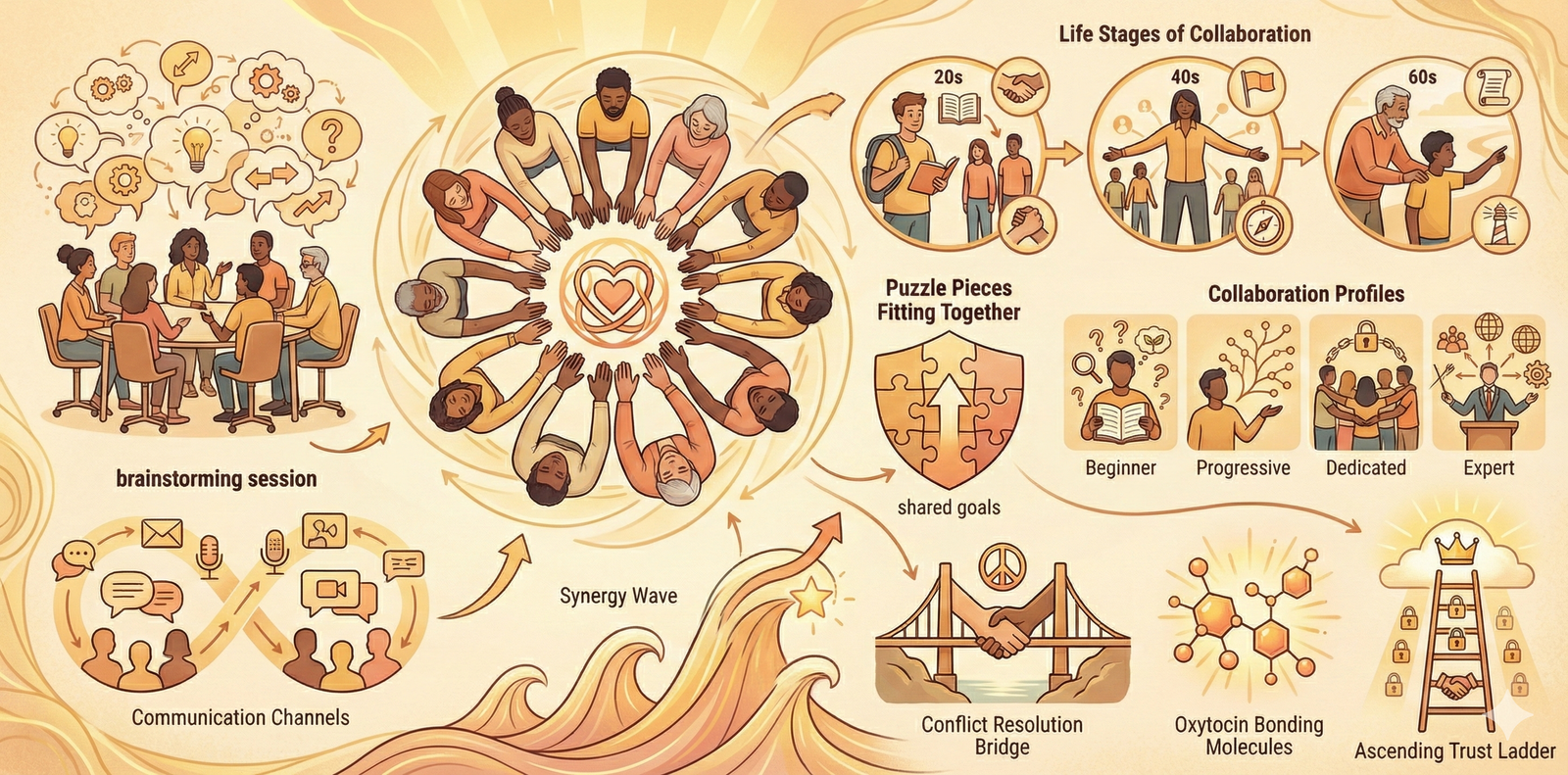
The magic of collaboration happens when people feel psychologically safe to share ideas, take risks, and be vulnerable.
When collaboration works well, team members experience greater job satisfaction, faster problem-solving, and breakthrough innovations that individual effort alone cannot produce.
What Is Collaboration?
Collaboration is the intentional process of working with others to achieve shared objectives by combining knowledge, skills, and perspectives. True collaboration goes beyond simple cooperation—it requires mutual respect, clear communication, shared accountability, and a commitment to collective success. In collaborative environments, team members see each other's strengths, fill gaps where others have weaknesses, and create synergy that multiplies impact. Office workers spend approximately 42% of their time collaborating with others, making this skill critical to modern professional life. Collaboration occurs everywhere: in workplaces across teams and departments, in families making decisions together, in creative groups producing art or music, and in communities solving problems.
Not medical advice.
The foundation of collaboration rests on several pillars: clear communication where ideas flow freely, psychological safety where people feel valued and understood, shared vision that gives everyone purpose, and mutual respect that honors different perspectives. When these elements exist, collaboration becomes not just efficient but deeply satisfying. Teams that collaborate effectively report higher engagement, lower turnover, and better decision-making. The collaborative mindset recognizes that we're stronger together than apart.
Surprising Insight: Surprising Insight: 64% of office workers waste at least three hours per week due to collaboration inefficiencies, with 20% losing six or more hours. Yet when collaboration is optimized, productivity increases by 30-39% and innovation rates climb significantly higher.
The Collaboration Foundation Model
Shows how psychological safety, clear communication, shared vision, and mutual respect create the foundation for effective collaboration.
🔍 Click to enlarge
Why Collaboration Matters in 2026
In an increasingly complex and interconnected world, no single person or department has all the answers. Remote work, distributed teams, and global challenges require seamless collaboration across boundaries. Organizations that master collaboration outcompete those that don't, and individuals with strong collaboration skills earn more, advance faster, and experience greater job satisfaction. The future belongs to those who can bring diverse perspectives together and create something meaningful.
Collaboration directly impacts your wellbeing. Research shows that 78% of workers believe workplace friendships enhance job satisfaction, and 72% feel more motivated when they have friends among colleagues. Collaboration creates belonging, reduces loneliness, and gives work deeper meaning. When you're part of a team that trusts and values you, you show up more fully and contribute more authentically.
As organizations adopt AI and automation, the distinctly human skills become more valuable. Collaboration, creativity, emotional intelligence, and the ability to work with diverse perspectives cannot be automated. These are precisely the skills that create competitive advantage in 2026 and beyond. Teams that collaborate effectively navigate change faster, adapt more quickly, and maintain stronger cultures through transitions.
The Science Behind Collaboration
Neuroscience reveals that our brains are wired for collaboration. Mirror neurons allow us to understand others' actions and emotions, while the prefrontal cortex enables complex social coordination. When we collaborate, our brains synchronize—literally aligning our neural patterns. This neural sync improves learning, creativity, and problem-solving. Additionally, collaboration triggers the release of oxytocin, the bonding hormone, which increases trust and reduces stress. Teams with high psychological safety show better error detection, more balanced decision-making, and superior learning rates—all measurable improvements in brain function and team intelligence.
The psychology of collaboration is grounded in Social Identity Theory and Maslow's Hierarchy of Needs. When people see themselves as part of a valued group, they contribute more fully and perform at higher levels. Collaboration satisfies fundamental human needs for belonging, esteem, and self-actualization. Poor communication remains the most common cause of team breakdowns, highlighting how critical clear dialogue is to successful collaboration. Understanding these psychological principles helps us build teams that thrive.
Brain Benefits of Collaboration
Shows neural synchronization, oxytocin release, and cognitive improvements that occur during collaborative work.
🔍 Click to enlarge
Key Components of Collaboration
Psychological Safety
Psychological safety—the belief that you can take interpersonal risks without fear of negative consequences—is foundational to collaboration. In psychologically safe teams, members speak up with ideas and concerns, admit mistakes quickly, ask for help, and take creative risks. This safety enables the vulnerability necessary for authentic connection. Leaders create psychological safety by encouraging questions, admitting their own mistakes, and responding non-defensively to feedback. Without psychological safety, collaboration remains surface-level and teams underperform significantly.
Clear Communication
Effective collaboration depends on transparent, respectful communication where ideas flow freely in all directions. Clear communication means expressing thoughts explicitly, listening to understand rather than to respond, asking clarifying questions, and addressing conflicts directly. When communication is clear, misunderstandings decrease, decisions happen faster, and team members feel heard. Active listening—fully focusing on understanding the other person—is a collaboration skill that transforms team dynamics and builds deeper connections.
Shared Vision and Purpose
Collaboration is most powerful when everyone understands and believes in the shared purpose. A clear vision answers the "why" behind the work, giving meaning and direction. When team members connect their individual efforts to a larger purpose, engagement and motivation increase dramatically. Shared vision also creates alignment—people self-organize around common goals rather than requiring constant management. The most collaborative teams share a compelling vision that inspires each member.
Mutual Respect and Inclusion
Collaboration thrives when diverse perspectives are genuinely valued. Mutual respect means recognizing others' expertise, honoring their viewpoints, and creating space for different working styles. Inclusive collaboration actively seeks out voices that might otherwise be quiet, ensuring women, minorities, introverts, and other perspectives shape decisions. Research shows that diverse teams make better decisions and innovate more. Respect requires curiosity about differences, openness to being influenced, and commitment to equitable contribution.
| Team Type | Avg Productivity Increase | Employee Satisfaction |
|---|---|---|
| Highly Collaborative Teams | 25-39% above baseline | 87% satisfied |
| Moderately Collaborative | 12-18% above baseline | 62% satisfied |
| Low Collaboration (Siloed) | 0-5% baseline | 41% satisfied |
How to Apply Collaboration: Step by Step
- Step 1: Clarify the shared purpose: Have a conversation about why the work matters and what you're collectively trying to achieve. Write it down and revisit it regularly.
- Step 2: Establish psychological safety: Create explicit norms where mistakes are learning opportunities, questions are encouraged, and diverse viewpoints are actively sought. Model vulnerability as a leader.
- Step 3: Implement regular communication: Schedule consistent check-ins, create forums for ideas, and establish clear channels for feedback. Ask "How can I better understand your perspective?"
- Step 4: Define clear roles and responsibilities: Help each person understand what they own, where others are responsible, and how efforts interconnect. Avoid ambiguity about who decides what.
- Step 5: Practice active listening: During conversations, focus entirely on understanding—not on planning your response. Use phrases like "Tell me more about that" and "I want to make sure I understand correctly."
- Step 6: Celebrate diverse perspectives: Actively invite different viewpoints, especially from quieter team members. Show how differing opinions improve decisions. Thank people for challenging ideas respectfully.
- Step 7: Address conflicts directly and respectfully: When tension arises, talk about it promptly. Use "I" statements, focus on interests rather than positions, and seek solutions everyone can support.
- Step 8: Create team rituals: Regular ceremonies—whether virtual coffee chats, planning sessions, or celebration moments—build connection and reinforce shared identity. Rituals create belonging.
- Step 9: Measure and reflect: Track collaboration indicators like communication patterns, conflict resolution, and innovation outcomes. Ask team members what's working and what could improve.
- Step 10: Model collaborative behavior consistently: As a team member or leader, show collaboration in action. Share credit generously, acknowledge others' contributions, and demonstrate the behaviors you want to see.
Collaboration Across Life Stages
Young Adulthood (18-35)
In young adulthood, collaboration often centers on building your first professional teams, group projects, or startup partnerships. The focus is on learning how to navigate different personalities, developing communication skills, and finding your collaborative style. This stage is ideal for practicing the fundamentals: how to give and receive feedback, how to voice disagreement respectfully, and how to contribute meaningfully to group goals. Building strong collaborative habits early creates advantages throughout your career and personal life.
Middle Adulthood (35-55)
Middle adulthood often involves leading collaborative efforts—managing teams, mentoring others, or coordinating across departments. The challenge shifts from personal collaboration to creating collaborative cultures. This stage emphasizes building psychological safety, developing others' potential, and modeling vulnerability. Many people realize that collaboration skills were their greatest limitation or greatest asset in career advancement. Strengthening collaboration at this stage multiplies impact across entire organizations and enables meaningful legacy-building.
Later Adulthood (55+)
In later adulthood, collaboration often becomes even more valuable. Accumulated wisdom, patience developed over decades, and perspective on what truly matters make experienced adults powerful collaborators. Whether mentoring younger colleagues, serving on boards, engaging in community projects, or supporting family decisions, collaborative participation adds richness and meaning. Many find their greatest impact comes from helping others succeed together rather than individual achievement. Collaboration can deepen significantly when ego concerns decrease and genuine care for others' development becomes primary.
Profiles: Your Collaboration Approach
The Connector
- Opportunities to bring people together and build relationships
- Recognition that relationship-building is valuable work, not a distraction
- Permission to invest time in team cohesion and informal connection
Common pitfall: Sometimes prioritizing harmony over honest feedback, avoiding difficult conversations to maintain relationships.
Best move: Leverage your natural ability to build trust while learning to have direct conversations. Use your relationship-building skills as the foundation for addressing real issues constructively.
The Task Master
- Clear goals, deadlines, and measurable outcomes
- Appreciation for efficiency and results-orientation
- Understanding that collaboration helps accomplish more in less time
Common pitfall: Sometimes undervaluing the relationship and process aspects of collaboration, pushing toward results without bringing people along.
Best move: Recognize that sustainable high performance requires shared ownership and psychological safety. Use your results-focus to motivate teams and celebrate collective wins.
The Creative
- Space for innovative ideas and experimental thinking
- Collaboration partners who can turn ideas into action
- Permission to think differently and challenge conventional approaches
Common pitfall: Sometimes struggling with implementation details or feeling frustrated when ideas are modified during execution.
Best move: Find collaborators whose strengths complement your creativity—detail-oriented people who execute and refine your visions. Value their contributions equally to your ideation.
The Analyzer
- Time to process information and think things through
- Data and evidence to inform decisions
- Respect for different decision-making speeds and styles
Common pitfall: Sometimes perceived as slow or hesitant, potentially delaying team decisions or collaboration.
Best move: Communicate your thinking timeline early. Share what analysis you need to move forward. Partner with faster-moving team members who help translate insights into action.
Common Collaboration Mistakes
One major mistake is confusing consensus with collaboration. True collaboration doesn't require everyone to agree on everything—it requires respectful input, transparent decision-making, and commitment to the chosen direction even if not your first preference. Another common error is assuming collaboration means more meetings. Effective collaboration is about the quality of interaction, not quantity. Some teams have fewer meetings but much deeper connection because those conversations matter.
A third pitfall is collaboration without accountability. When everyone is responsible, sometimes no one is. Clear roles and personal accountability within a collaborative framework create both connection and results. Finally, many underestimate how much time it takes to build psychological safety. Leaders sometimes expect teams to be vulnerable immediately. Trust develops through consistent, safe behavior over time—you cannot rush it.
Another critical mistake is insufficient listening. Teams talk and talk but don't really listen to understand. Real collaboration requires dedicated listening time where you're fully present to understand another person's perspective, even when different from your own. Listening is collaboration's most underestimated superpower.
Collaboration Pitfalls and Solutions
Shows common collaboration mistakes and how to transform them into strengths.
🔍 Click to enlarge
Science and Studies
Recent research demonstrates collaboration's impact on organizational performance, employee wellbeing, and innovation. These studies highlight the concrete benefits of investing in collaborative culture.
- Harvard Business Review research: High-performing teams are 25% more productive than their less collaborative counterparts.
- Zoom Report (2025): 73% of employees who engage in collaborative work report improved performance, with 60% saying it sparks their innovation.
- McKinsey Study: Organizations with above-average collaboration show significantly higher employee engagement and 39% greater productivity improvements.
- Psychology Today: Workplace friendships enhance job satisfaction (78% of workers) and motivation (72% feel more motivated with colleagues they consider friends).
- Communication Studies: Poor communication is the most common cause of team failures, making clear dialogue the cornerstone of functional collaboration.
Your First Micro Habit
Start Small Today
Today's action: Ask one person today: 'What's one thing I could understand better about your perspective?' Then listen without interrupting for at least 2 minutes. Do this with one person per day.
This tiny habit builds your listening muscles, makes others feel valued, and creates the foundation for genuine collaboration. It takes 2 minutes but plants seeds of deeper connection.
Keep quitting habit apps after a missed day? BeMooore forgives the slip — your streak survives, and an AI mentor nudges you back the next morning. Free on iOS.
Quick Assessment
How would you describe your current collaboration experience?
Your answer reveals where you experience most fulfillment in group settings and where growth opportunities exist.
What's your greatest challenge with collaboration?
This identifies the specific collaboration skill that would create the most positive change in your life.
Which collaboration outcome matters most to you?
This reveals what you value most in collaboration—your collaboration personality and what fulfills you.
Take our full assessment to get personalized recommendations.
Discover Your Style →Next Steps
Start building collaboration today. If you're a team leader, create one space where people can bring their full selves and be heard—perhaps a meeting where everyone must share something true about their current experience. If you're an individual contributor, practice listening deeply to one colleague. Both actions plant seeds of stronger collaboration.
Collaboration is not a luxury—it's fundamental to human flourishing and organizational success. When you invest in genuine collaboration, you create cultures where innovation flourishes, people belong, and work becomes meaningful. The world's greatest achievements came through collaboration. So can your dreams.
Get personalized guidance with AI coaching.
Start Your Journey →Research Sources
This article is based on peer-reviewed research and authoritative sources. Below are the key references we consulted:
Related Glossary Articles
Frequently Asked Questions
How do I collaborate with people I don't naturally connect with?
Start by finding common ground in shared goals or values. Ask genuine questions to understand their perspective. Often, forced collaboration reveals unexpected connections. Focus on respect and shared purpose rather than personal friendship. Collaboration can thrive between people with different personalities when both are committed to the work.
What if I'm naturally introverted—is collaboration harder for me?
Introverts often make excellent collaborators because they listen well, think deeply before speaking, and build one-on-one connections. Collaboration isn't about constant socializing—it's about genuine connection and shared purpose. Adapt collaboration to your style: smaller group meetings, one-on-ones, written feedback, and thinking time before brainstorms. Your strengths are valuable.
How do you handle conflict in collaboration?
Conflict is normal and healthy in collaboration. Address it promptly, privately if possible. Use "I" statements ("I feel concerned about..." rather than "You always..."). Listen to understand the other person's underlying needs and concerns. Focus on the issue, not the person. Seek solutions where both people's important needs are addressed. Many teams find that working through conflict together actually strengthens collaboration.
Can you collaborate with someone you don't trust?
Not really—at least not at the deep level where collaboration becomes powerful. However, you can build trust gradually through consistent, safe behavior. Start with smaller collaborative efforts where you can observe reliability. Be trustworthy yourself: follow through on commitments, admit mistakes, and respect confidentiality. Trust is earned through repeated positive interactions over time.
How much time should collaboration take?
Quality matters more than quantity. Some teams collaborate effectively with weekly check-ins; others need daily connection. The right amount is whatever lets you stay aligned, understand each other, and make shared decisions. Efficient collaboration often requires upfront investment in clarity—clear communication, shared purpose, defined roles—that saves time later through fewer misunderstandings and rework.
Take the Next Step
Ready to improve your wellbeing? Take our free assessment to get personalized recommendations based on your unique situation.
- Discover your strengths and gaps
- Get personalized quick wins
- Track your progress over time
- Evidence-based strategies