How to Make Lasting Change
You've felt it before—that moment when you realize something has to shift. Whether it's your habits, your mindset, or your circumstances, change is one of the most powerful forces in personal transformation. But here's the truth most people don't understand: lasting change doesn't come from willpower or dramatic overhauls. It comes from understanding how change actually works in your brain and body. When you grasp the psychology behind transformation, you unlock the ability to reshape your entire life, one small step at a time. This guide reveals the science of change and gives you actionable strategies proven to work.
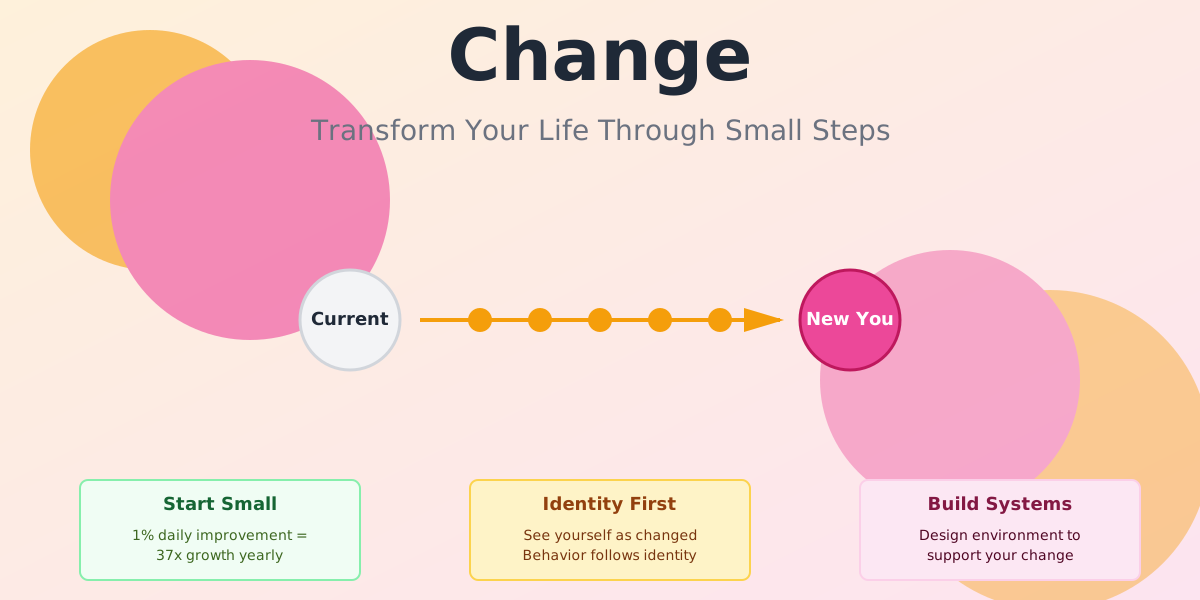
Ready to discover how small changes can lead to remarkable results?
Let's explore the mechanisms of transformation that psychologists have researched for decades.
What Is Change?
Change is the process of becoming different—shifting from one state, behavior, or belief to another. In psychology, change is understood as a deliberate or spontaneous transition that involves replacing existing patterns with new ones. It's not just about doing something differently; it's about becoming someone different. Change can be external (moving to a new city) or internal (shifting your mindset), sudden or gradual, wanted or unwanted. The most powerful changes are those you consciously choose and actively cultivate, grounded in a clear understanding of why the change matters to you.
Not medical advice.
Change exists on a spectrum. It can range from tiny adjustments in daily routines—like drinking water before your morning coffee—to profound life transformations that reshape your identity and relationships. Psychologists have discovered that the most sustainable changes share common characteristics: they align with your values, they build momentum through small wins, and they're supported by systems and environments that reinforce the new behavior.
Surprising Insight: Surprising Insight: Research shows that 92% of people fail to achieve their New Year's resolutions, not because they lack willpower, but because they rely on motivation instead of systems. Success comes from designing your environment and habits to make change automatic.
The Change Cycle: How Transformation Unfolds
A cyclical diagram showing the stages of personal change: awareness (recognizing the need), intention (deciding to change), action (implementing new behaviors), reinforcement (building consistency), and integration (making it your identity). The cycle includes feedback loops showing how success strengthens commitment and how setbacks trigger reflection and recalibration.
🔍 Click to enlarge
Why Change Matters in 2026
In 2026, change has become a constant in our lives. Technology evolves, careers shift, relationships transform, and personal values deepen. The ability to adapt—to embrace change rather than resist it—has become one of the most valuable skills for happiness, success, and resilience. People who master the psychology of change report higher life satisfaction, greater career achievement, and stronger relationships. They're not afraid of transformation; they navigate it intentionally. This is why understanding how to make change work for you, rather than against you, is essential for thriving in the modern world.
Change also matters because avoiding it comes with a cost. Research consistently shows that people who resist necessary change experience chronic stress, missed opportunities, and stagnation. Conversely, those who embrace deliberate change—even when it's uncomfortable—experience growth, resilience, and fulfillment. In 2026, your ability to change determines your ability to succeed.
Moreover, change is deeply connected to your wellbeing. When you're growing, learning, and moving toward your values, your brain releases dopamine, serotonin, and other neurochemicals that enhance mood and motivation. This is why small improvements in daily life—better sleep, consistent exercise, meaningful conversations—can cascade into profound shifts in your overall happiness and health.
The Science Behind Change
Behavior change happens through well-defined stages that psychologists call the Transtheoretical Model. This framework identifies five key stages: precontemplation (not thinking about change), contemplation (considering change), preparation (planning to change), action (actively changing), and maintenance (sustaining the change). Understanding where you are in this cycle helps you apply the right strategies at the right time. Someone in the contemplation stage needs different support than someone in the action stage, and this is why generic advice often fails—it doesn't meet people where they actually are.
Your brain is fundamentally a habit machine. It creates neural pathways through repetition; these pathways become stronger with each reinforcement. When you want to change a behavior, you're essentially rewiring these neural highways. This process takes time—typically 66 days to form a new habit, though it varies depending on complexity. The good news: this rewiring is absolutely possible at any age. Your brain maintains neuroplasticity throughout your life, meaning you can always learn new patterns and create new identities.
Neural Pathways and Habit Formation
A visual representation of how neural pathways strengthen through repetition. Shows weak initial connections becoming stronger with each repetition cycle. Includes the neurochemical cascade (dopamine, serotonin, cortisol) that reinforces or inhibits behavior changes. Demonstrates how environmental cues trigger automatic responses once a pathway is established.
🔍 Click to enlarge
Key Components of Change
Identity-Based Motivation
The most powerful driver of lasting change is a shift in identity. When you change from "I'm trying to exercise" to "I'm an active person," your behavior naturally aligns with that identity. This is because your brain automatically makes decisions that are consistent with how you see yourself. Identity-based change is stronger than goal-based change because identity is stable and self-reinforcing. Every action becomes a vote for the type of person you want to be.
Environmental Design
Your environment is far more powerful than willpower. If you want to eat healthier, fill your home with healthy food and remove junk food. If you want to read more, keep your favorite book visible on your nightstand. When you design your physical and social environment to support your desired change, you make the new behavior the path of least resistance. This principle works across all domains: from fitness (gym clothes ready the night before) to finances (automatic savings transfers) to relationships (scheduling regular calls with important people).
Progressive Overload and Small Wins
Change doesn't require dramatic action. In fact, tiny incremental changes create the most sustainable transformation. Start small—one pushup, one page read, one honest conversation—and build from there. Each small win triggers a neurochemical reward response that motivates the next action. This compound effect means that a 1% improvement daily results in a 37x improvement over a year. The key is consistency over intensity: doing something slightly better every day beats periodic heroic efforts.
Social Support and Accountability
Humans are social creatures, and change happens faster with support. Whether it's a partner, a friend, a community, or a coach, external accountability dramatically increases the likelihood of success. Sharing your goals makes them real. Having someone to check in with creates motivation beyond self-discipline. Research shows that people who commit to their goals publicly and have regular accountability increase their follow-through rate from 10% to 65%.
| Strategy | Typical Timeline | Effectiveness Rate |
|---|---|---|
| Willpower alone | Days to weeks | 10-20% |
| Goal-setting without systems | Weeks to months | 25-35% |
| Environment design + small steps | Weeks to months | 65-75% |
| Identity-based + environment + accountability | 2-3 months | 80-90% |
| Identity-based + systems + community | 3+ months | 90%+ |
How to Apply Change: Step by Step
- Step 1: Identify your why: Get clear on the deeper reason you want to change. Connect to a value (health, family, growth, legacy) rather than just a surface goal. Write this down and return to it when motivation fades.
- Step 2: Assess where you are in the change cycle: Are you in precontemplation, contemplation, preparation, action, or maintenance? This determines what support you need right now.
- Step 3: Design your environment first: Before relying on willpower, change your surroundings to make the desired behavior easier and undesired behavior harder. Remove friction from what you want; add friction to what you don't.
- Step 4: Start stupidly small: Choose a change so tiny that it feels embarrassingly easy. One minute of meditation. One healthy meal. Ten minutes of learning. The goal is to establish the behavior, not to achieve the outcome.
- Step 5: Anchor to an existing habit: Attach your new behavior to a habit you already have. After morning coffee, meditate. After brushing teeth, do pushups. This piggybacks on established neural pathways.
- Step 6: Track your progress visually: Use a calendar, app, or journal to mark each day you succeed. Seeing the chain of completed days creates psychological momentum and makes progress tangible.
- Step 7: Expect the 66-day threshold: Most new habits solidify around 66 days of consistent practice. Know this going in so you don't quit at day 21 thinking it's not working. Consistency matters more than intensity.
- Step 8: Create accountability: Tell someone about your change. Schedule weekly check-ins. Join a community of people working on similar changes. Share your wins and struggles.
- Step 9: Celebrate small wins: Your brain needs dopamine hits to sustain motivation. Acknowledge every successful day. Celebrate milestones. Make the new behavior feel rewarding from day one.
- Step 10: Build an identity around the change: Stop saying "I'm trying to exercise" and start saying "I'm becoming an athlete." Stop saying "I'm cutting back on sweets" and start saying "I'm someone who nourishes their body." Let identity drive behavior, not the other way around.
Change Across Life Stages
Young Adulthood (18-35)
In young adulthood, change often involves exploring identity, building foundational habits, and developing resilience. This is the ideal time to establish the habits that will serve you for decades: exercise routines, learning practices, relationship patterns. Young adults often have the energy and neuroplasticity to change easily, though they may lack the patience to see long-term results. The challenge is staying consistent when motivation fades. Focus on building identity-based habits now; they compound exponentially over time.
Middle Adulthood (35-55)
Middle adulthood brings change driven by life circumstances: career shifts, relationship evolution, health awareness. Many people in this stage want to change but feel stuck in established patterns. The advantage is deeper self-knowledge and clarity about what matters. The challenge is overcoming years of entrenched habits and competing responsibilities. Change in middle adulthood requires more intentional design—you can't rely on energy; you must use systems. Create environmental structures that support your change even when you're exhausted.
Later Adulthood (55+)
In later adulthood, change often focuses on legacy, health, relationships, and meaning. Some people believe they're too old to change; research proves this wrong. Your brain remains neuroplastic; change is possible at any age. Later adulthood brings wisdom and perspective that can accelerate change. Many people report that changes made in their 60s, 70s, and 80s feel more sustainable because they're grounded in clarity about what truly matters. Focus on changes that align with your legacy and reflect your deepest values.
Profiles: Your Change Approach
The Cautious Analyzer
- Research and evidence to justify the change
- Time to process before committing
- Clear step-by-step plans with milestones
Common pitfall: Analysis paralysis: spending so much time planning that you never actually begin. Getting stuck in the contemplation stage indefinitely.
Best move: Set a decision deadline. Give yourself one week to research, then commit to a 30-day trial. You can always adjust after you gather real experience, not theoretical knowledge.
The All-or-Nothing Enthusiast
- Big, inspiring goals and meaning
- Immediate visible progress
- Momentum and quick wins
Common pitfall: Starting too ambitiously and burning out. Swinging from zero effort to maximum effort, then crashing when life gets busy.
Best move: Deliberately start smaller than you think you should. Commit to one tiny habit for 30 days before expanding. Use your enthusiasm to design systems, not just take action.
The Social Connector
- Community and shared experience
- Accountability partners and group support
- Social motivation and celebration
Common pitfall: Depending on others for motivation instead of building internal drive. Abandoning the change if your support system changes.
Best move: Build both internal and external accountability. Have personal reasons for the change and a community to share it with. Join groups aligned with your change goals.
The Systems Optimizer
- Clear frameworks and measurements
- Data tracking and progress visualization
- Optimization and continuous improvement
Common pitfall: Getting lost in tracking and optimization, losing sight of the actual change. Perfecting the system instead of living the change.
Best move: Remember that what gets measured gets managed, but not everything that matters can be measured. Balance quantitative tracking with qualitative reflection. Track 2-3 key metrics, not dozens.
Common Obstacles and How to Overcome Them
Motivation Crashes
Motivation is unreliable; it comes and goes. Instead of waiting for motivation, design your life so the right behavior is the default. Use habit stacking, environmental cues, and identity-based thinking to maintain action even when motivation fades. The goal is to reach the 66-day threshold where behavior becomes automatic and motivation becomes less important.
Setbacks and Relapse
You will have setbacks. Missing one day doesn't erase progress; what matters is returning to the behavior the next day. Research on habit formation shows that occasional lapses don't significantly impact long-term success, but extended lapses do. If you miss a day, don't use it as an excuse to quit. Instead, reflect on what triggered the lapse, adjust your environment, and recommit immediately.
Conflicting Identities
Sometimes change fails because it conflicts with how you see yourself. You might want to be healthier but identify as "not an exercise person." The solution is to deliberately choose a new identity that encompasses both aspects. You're not choosing between identities; you're evolving into a more complete version of yourself that includes the new behavior.
Internal Links to Related Topics
- <a href='/g/habit-formation.html'>Habit Formation</a> - Build lasting routines through behavioral science
- <a href='/g/resilience.html'>Resilience</a> - Develop strength to navigate change
- <a href='/g/growth-mindset.html'>Growth Mindset</a> - Believe in your ability to develop new skills
- <a href='/g/goal-setting.html'>Goal Setting</a> - Create clear targets for change
- <a href='/g/motivation.html'>Motivation</a> - Understand what drives sustained effort
- <a href='/g/self-discipline.html'>Self-Discipline</a> - Build the capacity for consistent action
- <a href='/g/behavioral-change.html'>Behavioral Change</a> - Applied psychology of transformation
- <a href='/g/personal-growth.html'>Personal Growth</a> - Holistic development framework
- <a href='/g/stress-management.html'>Stress Management</a> - Navigate the challenge of transition
- <a href='/g/mindfulness.html'>Mindfulness</a> - Build awareness for intentional change
- <a href='/g/identity.html'>Identity</a> - Understand how self-perception drives behavior
- <a href='/g/neuroplasticity.html'>Neuroplasticity</a> - Your brain's ability to rewire itself
- <a href='/g/emotional-regulation.html'>Emotional Regulation</a> - Manage emotions during transformation
- <a href='/g/confidence-building.html'>Confidence Building</a> - Build belief in your change capacity
- <a href='/g/decision-making.html'>Decision Making</a> - Make clear choices about what to change
- <a href='/g/commitment.html'>Commitment</a> - Deepen your resolve for transformation
- <a href='/g/accountability.html'>Accountability</a> - Use external support for success
- <a href='/g/community.html'>Community</a> - Find people supporting the same changes
- <a href='/g/adaptation.html'>Adaptation</a> - Adjust to new circumstances
- <a href='/g/learning.html'>Learning</a> - Acquire new skills for transformation
- <a href='/g/success.html'>Success</a> - Achieve your transformation goals
- <a href='/g/authenticity.html'>Authenticity</a> - Ensure change aligns with your values
- <a href='/g/self-improvement.html'>Self-Improvement</a> - Continuous enhancement framework
Key Takeaways
- Change is a learnable process that follows predictable stages, not a mysterious event that happens to lucky people.
- Your brain is designed to form habits through repetition; neuroplasticity means you can rewire your neural pathways at any age.
- Identity-based motivation is more powerful than goal-based motivation. Shift from 'I want to change' to 'I am becoming...' and let identity drive behavior.
- Environment design trumps willpower. Change your surroundings to make desired behavior easier and undesired behavior harder.
- Start absurdly small. A 1% improvement compounds into 37x improvement over a year. Consistency beats intensity.
- The first 66 days are critical. Push through to the point where behavior becomes automatic and motivation matters less.
- Progress isn't linear. Expect plateaus and setbacks; they're part of the process, not signs of failure.
- Social support and accountability increase success from 10% to 65%. Share your goals and commit publicly.
- Small wins create psychological momentum. Celebrate every day of success; your brain needs dopamine hits.
- Change is available to you at any age and stage of life. It requires clear intention, good design, and persistent consistency.
Reflection Questions: Assess Your Change Readiness
When you think about making a significant change, what is your typical first response?
How important is your environment in determining your success?
When changing your identity, what resonates most?
Your journey of change begins with a single decision: to see change not as something that happens to you, but as something you intentionally create. The strategies in this guide—identity-based motivation, environmental design, small consistent steps, social support—work because they align with how your brain actually functions. Start today. Not dramatically. Just start with one tiny change that moves you toward the person you want to become. That's how transformation begins.
Related Glossary Articles
Take the Next Step
Ready to improve your wellbeing? Take our free assessment to get personalized recommendations based on your unique situation.
- Discover your strengths and gaps
- Get personalized quick wins
- Track your progress over time
- Evidence-based strategies