Meditation
Meditation is a mental practice of focused attention and present-moment awareness that reduces stress, sharpens <a href='/g/focus.html'>focus</a>, and builds lasting <a href='/g/emotional-resilience.html'>emotional resilience</a>. Backed by decades of neuroscience research from institutions like Harvard and Stanford, meditation physically changes your brain, increasing gray matter in regions responsible for <a href='/g/emotional-regulation.html'>emotional regulation</a>, <a href='/g/cognitive-function.html'>cognitive function</a>, and <a href='/g/self-compassion.html'>self-compassion</a>. Whether you are a complete beginner or a seasoned practitioner, this guide walks you through the types, techniques, and proven benefits that make meditation one of the most accessible tools for transforming your <a href='/g/mental-health.html'>mental health</a> and overall <a href='/g/happiness.html'>happiness</a>.
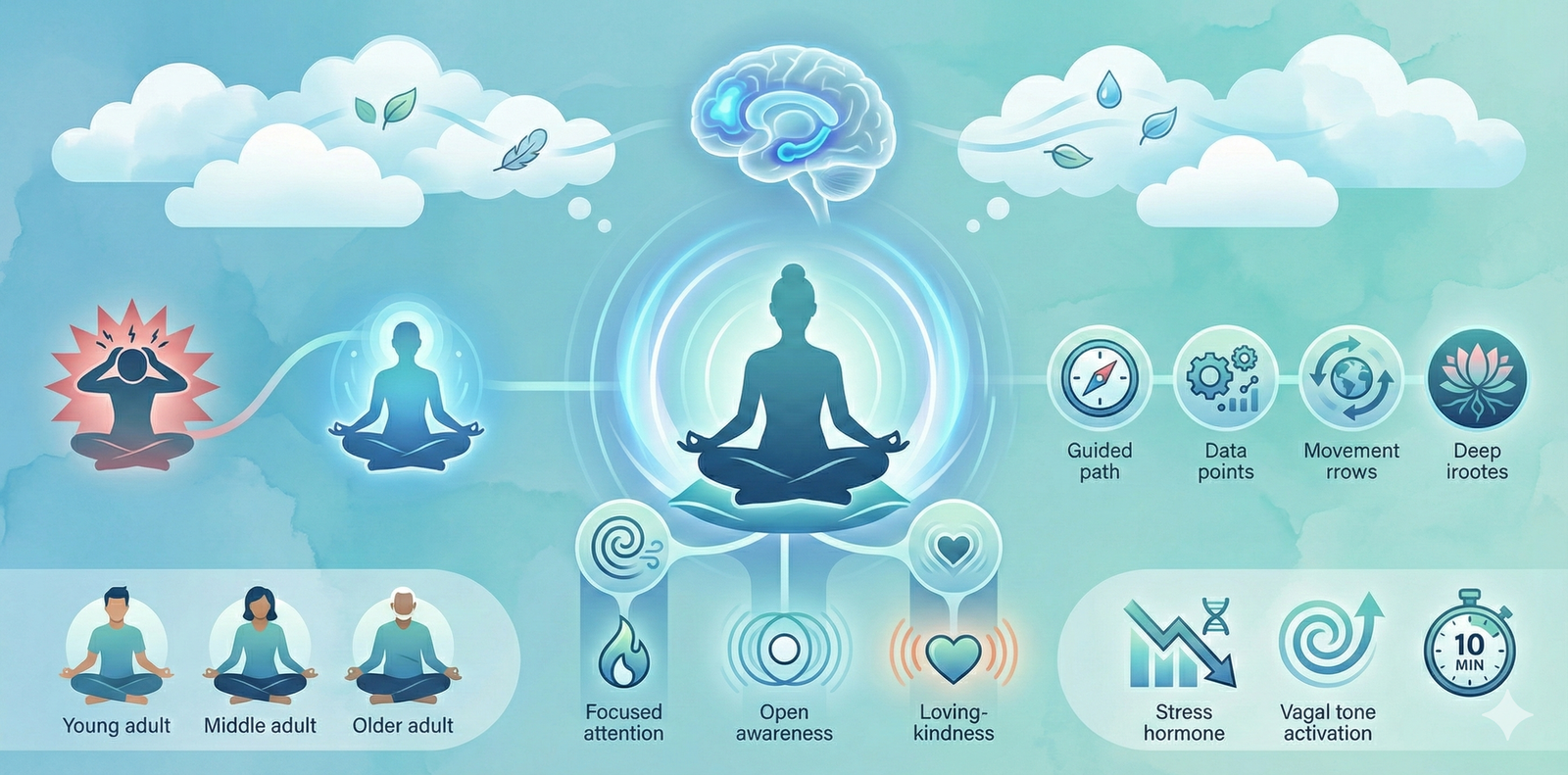
Ahead, you will discover exactly how meditation rewires your nervous system, the specific types best suited to your personality, and a micro habit so small you can start in the next sixty seconds.
You will also learn why leading organizations now integrate meditation into workplace holistic wellness programs, and how just ten minutes daily creates measurable change within weeks.
What Is Meditation?
Meditation is the deliberate practice of training your attention and awareness to achieve mental clarity, emotional calm, and a stable sense of presence. Unlike passive relaxation, meditation actively engages the brain's attention networks, teaching you to observe thoughts, sensations, and emotions without reacting to them. The word itself comes from the Latin meditari, meaning to think, contemplate, or plan, though modern secular practice emphasizes non-judgmental awareness over intellectual analysis. At its core, meditation creates a reliable gap between stimulus and response, giving you the power to choose how you engage with life rather than operating on autopilot. This practice forms a foundation for mindfulness, inner peace, and emotional wellbeing.
Not medical advice.
Meditation traditions span thousands of years across Buddhist, Hindu, Taoist, and Christian contemplative practices. Modern science has extracted the core mechanisms, validating them in clinical trials and creating secular programs like Mindfulness-Based Stress Reduction (MBSR) and Mindfulness-Based Cognitive Therapy (MBCT). Today, meditation is recommended by the National Institutes of Health (NIH), the American Psychological Association, and the National Center for Complementary and Integrative Health (NCCIH) as a complementary approach for anxiety management, depression management, chronic pain, and stress reduction. Its accessibility sets it apart: you need no equipment, no gym membership, and no special skills to begin experiencing benefits.
Surprising Insight: Surprising Insight: A 2025 Vanderbilt University study found that meditation stimulates the brain's glymphatic waste removal system in a pattern similar to deep sleep, suggesting that regular practice may help clear toxic proteins linked to neurodegeneration.
How Meditation Affects the Brain
Visual overview of the key brain regions changed by regular meditation practice
🔍 Click to enlarge
Why Meditation Matters in 2026
The global mental health landscape demands attention. Anxiety disorders affect roughly one in four adults worldwide, and rates of burnout, loneliness, and digital overwhelm continue to rise. Meditation addresses these challenges at their neurological root: it calms the overactive sympathetic nervous system, strengthens the parasympathetic response, and restores the brain's capacity for emotional regulation. Unlike many interventions, meditation is free, self-directed, and available anywhere, making it one of the most scalable wellness practices on the planet.
The average person now checks their phone over ninety times a day, creating unprecedented levels of attention fragmentation. Meditation directly counteracts this by training the brain's sustained attention networks. Research published in 2025 by Mount Sinai found that meditation induces measurable changes in deep brain areas associated with memory and emotional regulation, confirming that this ancient practice produces real physiological shifts that modern technology cannot replicate. Organizations from Google to the US military now invest in meditation programs for burnout prevention and cognitive performance.
For individuals pursuing life satisfaction, meditation is not an optional add-on but a foundational practice. It strengthens every dimension of wellbeing: health through reduced inflammation and blood pressure, wealth through improved decision-making and productivity habits, love through deeper connection and empathy, and happiness through cultivating gratitude, contentment, and peaceful mind.
The Science Behind Meditation
Neuroscience has moved well beyond asking whether meditation works. Thousands of peer-reviewed studies now illuminate exactly how it reshapes the brain. MRI research from Harvard Medical School demonstrates that eight weeks of mindfulness practice increases gray matter density in the prefrontal cortex (responsible for focus and concentration), the hippocampus (memory and learning), and the anterior insula (body awareness and empathy). Simultaneously, the amygdala, the brain's threat detection center, shows reduced volume and activity, explaining why meditators report less reactivity to stressful events. These structural changes persist even when practitioners are not actively meditating, suggesting lasting neural rewiring.
Beyond brain structure, meditation shifts your biochemistry. Regular practice lowers cortisol, the primary stress hormone, while increasing GABA (a calming neurotransmitter) and serotonin (linked to mood regulation). Heart rate variability, a key marker of cardiovascular cardiovascular health and stress resilience, improves significantly. A 2024 systematic review in PMC found that mindfulness-based meditation modulates immune function, reducing pro-inflammatory biomarkers and enhancing the activity of natural killer cells. The European Horizon Magazine reported that scientists are now decoding the molecular mechanisms behind these benefits, moving from correlation to causation in understanding how meditation affects brain health and longevity.
Meditation's Physiological Cascade
Step-by-step pathway from meditation practice to measurable health outcomes
🔍 Click to enlarge
Key Components of Meditation
Focused Attention (Concentration)
Focused attention meditation involves directing your awareness to a single anchor, typically the breath, a mantra, or a specific bodily sensation. Each time the mind wanders, you gently notice the distraction and return to the anchor. This seemingly simple action trains the anterior cingulate cortex and dorsolateral prefrontal cortex, the brain regions responsible for sustained concentration and cognitive control. Over time, this builds what neuroscientists call attentional stability, the ability to hold focus for extended periods without mental fatigue. Focused attention meditation is the most researched form and the recommended starting point for beginners because it provides a clear, measurable task.
Open Monitoring (Mindful Awareness)
Open monitoring meditation shifts from narrowing attention to broadening it. Rather than focusing on one object, you maintain a panoramic awareness of everything arising in your field of consciousness: sounds, sensations, thoughts, and emotions. The goal is not to engage with any particular experience but to observe the flow of mental activity without attachment or aversion. This practice develops metacognition, the ability to be aware of your own awareness, which is strongly linked to emotional intelligence and psychological flexibility. Research shows that open monitoring meditation reduces activity in the default mode network, the brain circuitry responsible for mind-wandering and self-referential rumination.
Loving-Kindness (Metta) Meditation
Loving-kindness meditation involves generating feelings of warmth, goodwill, and compassion, first toward yourself, then gradually extending to loved ones, neutral people, difficult people, and finally all beings. This practice activates brain regions associated with positive emotion while reducing amygdala reactivity. Stanford research found that just seven minutes of loving-kindness meditation increases feelings of social connection and reduces implicit bias. It is particularly effective for people struggling with self-criticism, self-worth challenges, or emotional healing after relationship difficulties.
Body Scan Meditation
Body scan meditation guides your attention systematically through different body regions, from the crown of the head to the tips of the toes, noticing sensations without trying to change them. This practice develops interoceptive awareness, your brain's ability to sense internal body signals, which is directly linked to emotional awareness and stress tolerance. Body scans are a core component of Mindfulness-Based Stress Reduction (MBSR) and are frequently recommended for sleep hygiene because they systematically release muscular tension and activate the relaxation response. Greater Good Science Center at UC Berkeley rates body scan meditation as one of the most accessible practices for absolute beginners.
| Meditation Type | Primary Focus | Best For |
|---|---|---|
| Focused Attention | Single anchor (breath, mantra) | Building concentration, beginners |
| Open Monitoring | Broad awareness of all experience | Emotional intelligence, metacognition |
| Loving-Kindness | Compassion and goodwill | Self-criticism, social connection |
| Body Scan | Systematic body awareness | Sleep improvement, tension release |
| Transcendental Meditation | Personal mantra repetition | Deep relaxation, stress reduction |
How to Apply Meditation: Step by Step
- Step 1: Choose a quiet, comfortable location where you will not be interrupted for the next five to twenty minutes. Turn off notifications and set a gentle timer.
- Step 2: Sit in a stable position, either on a chair with feet flat on the floor or cross-legged on a cushion. Keep your spine upright but not rigid, allowing a natural curve in your lower back.
- Step 3: Close your eyes gently or lower your gaze to a spot on the floor about three feet ahead. Rest your hands on your thighs or in your lap.
- Step 4: Take three slow, deep breaths to signal your nervous system to shift from alert mode into <a href='/g/breathing-techniques.html'>calm awareness</a>. Let each exhale be longer than the inhale.
- Step 5: Settle into natural breathing. Notice where you feel the breath most vividly: the nostrils, the chest rising, or the belly expanding. This becomes your anchor point.
- Step 6: When your mind wanders, and it absolutely will, simply notice the thought without judgment, label it gently as 'thinking,' and return attention to the breath. This moment of noticing is the actual practice.
- Step 7: If strong emotions or physical discomfort arise, observe them with curiosity rather than resistance. Notice where you feel the sensation in your body and breathe into that area.
- Step 8: After five minutes, experiment with broadening awareness to include sounds, body sensations, and the ambient environment while maintaining a soft connection to your breath.
- Step 9: When your timer sounds, resist the urge to jump up immediately. Sit for thirty seconds, notice how your body and mind feel compared to when you started, and take one deep breath.
- Step 10: Carry the quality of attention from your formal practice into your next activity. Notice the transition point where meditative awareness meets <a href='/g/daily-routines.html'>daily routines</a>, bridging the gap between practice and life.
Types of Meditation Practice
Beyond the four key components, several specialized meditation forms address specific goals. Transcendental Meditation (TM) uses a personally assigned mantra repeated silently for twenty minutes twice daily. Zen meditation (zazen) emphasizes seated stillness and breath counting within a structured community setting. Yoga nidra, sometimes called 'yogic sleep,' guides practitioners through progressive relaxation while maintaining awareness, making it powerful for deep sleep and recovery. Movement-based practices like walking meditation and tai chi integrate meditative awareness with gentle physical activity, ideal for people who find seated stillness challenging.
Visualization meditation involves mentally constructing calming or empowering images, such as a peaceful landscape or achieving a personal goal. This type engages the brain's visual cortex in ways that overlap with actual experience, making it popular among athletes and performers for mental toughness training. Sound-based meditation uses singing bowls, chanting, or ambient sounds as the anchor object, offering a rich sensory alternative for people who struggle with breath-focused practice. Each of these approaches activates overlapping but distinct neural networks, which is why many experienced practitioners blend multiple types into a personal daily practice.
Meditation for Stress and Anxiety
Meditation is one of the most studied interventions for anxiety relief and stress reduction. A landmark meta-analysis from Johns Hopkins Medicine reviewed over 3,500 studies and concluded that meditation reduces anxiety with an effect size comparable to antidepressant medication. The mechanism is straightforward: meditation downregulates the hypothalamic-pituitary-adrenal (HPA) axis, reducing cortisol production and breaking the cycle of chronic stress. Simultaneously, it strengthens prefrontal cortex function, giving you more cognitive control over worry spirals and catastrophic thinking patterns.
For people experiencing anxiety disorders, Mindfulness-Based Stress Reduction (MBSR) is the most evidence-supported meditation program. Developed by Jon Kabat-Zinn at the University of Massachusetts Medical Center, MBSR combines body scans, seated meditation, and gentle yoga over eight weeks. Clinical trials show it reduces anxiety symptoms, improves coping strategies, and enhances quality of life. Stanford researchers also found that a six-minute guided meditation delivered through virtual reality significantly lowered anxiety in parents of hospitalized children, demonstrating that even brief meditation produces measurable anxiety management benefits.
Meditation Across Life Stages
Young Adulthood (18-35)
Young adults navigate identity formation, academic pressure, early career challenges, and the social comparison amplified by digital platforms. Meditation provides early intervention for stress response patterns before they calcify into chronic conditions. Younger brains demonstrate greater neuroplasticity, meaning meditation practice yields faster structural changes and more rapid benefit onset. Many young adults respond best to app-guided meditation with clear progress tracking, framing the practice around tangible outcomes like improved focus for studying, better sleep optimization, or reduced social anxiety before deeper contemplative benefits emerge. Universities including Harvard, Stanford, and Oxford now offer meditation programs integrated into student academic wellbeing services.
Middle Adulthood (35-55)
Middle adulthood brings peak responsibility: career demands, family obligations, financial pressures, and emerging health concerns. Meditation becomes increasingly valuable for processing accumulated stress and addressing existential questions about meaning and purpose. Physical benefits grow more apparent and motivating during these years: improved cardiovascular health, better sleep quality, reduced inflammation markers, and measurable blood pressure reduction. Many practitioners in this stage appreciate meditation as a form of burnout prevention and discover that consistent practice enhances their leadership capacity, communication skills, and emotional intelligence in both professional and personal relationships.
Later Adulthood (55+)
Older adults often discover that meditation addresses aging-related concerns with remarkable effectiveness. Managing chronic pain, processing grief and loss, navigating retirement transitions, and finding meaning and legacy significance all become accessible through contemplative practice. Research from the NIH indicates that meditation may support cognitive health by maintaining gray matter volume and neural connectivity that typically decline with age. The practice also demonstrates particular strength for older adults experiencing depression, loneliness, or existential anxiety. Gentle forms like body scan and loving-kindness meditation accommodate physical limitations while delivering full psychological benefit, and community meditation groups provide valuable belonging and social connection.
Profiles: Your Meditation Approach
The Eager Beginner
- Clear, simple instructions with immediate guidance
- Short guided sessions building from two to ten minutes
- Visible progress markers and gentle encouragement
Common pitfall: Expecting dramatic mental silence or mystical experiences, then abandoning practice after a few frustrating sessions.
Best move: Start with a five-minute guided breath meditation daily for thirty consecutive days. Track consistency rather than quality. The habit matters more than the experience.
The Analytical Thinker
- Understanding the neuroscience and mechanisms behind meditation
- Objective metrics like heart rate variability or mood tracking
- Permission to approach meditation as a trainable skill
Common pitfall: Over-analyzing every sensation during practice, turning meditation into an intellectual exercise rather than experiential presence.
Best move: Read the research beforehand to build confidence, then deliberately set analysis aside during practice. Track data outside the session, not during it.
The Restless Mover
- Movement-based meditation options like walking meditation or tai chi
- Variety in practice styles to prevent boredom
- Understanding that restlessness is not failure but part of the process
Common pitfall: Jumping between different meditation apps and styles every week without developing depth in any single approach.
Best move: Commit to one core practice for ninety days minimum. Supplement with movement meditation throughout the day. Short sessions three times daily may work better than one long sit.
The Experienced Practitioner
- Deepening instruction from qualified teachers or retreat settings
- Integration of meditation insights into daily life and relationships
- Community connection with other serious practitioners
Common pitfall: Becoming attached to special meditative states or using practice as spiritual bypassing to avoid genuine emotional work.
Best move: Pair deepening practice with psychotherapy or a teacher who challenges you. Longer retreats accelerate growth but only when integrated with real-world application.
Building a Sustainable Meditation Practice
The single greatest predictor of meditation success is consistency, not duration or technique. Research consistently shows that five minutes daily delivers more lasting neural change than occasional forty-minute sessions. The key is anchoring your practice to an existing habit: meditate immediately after brushing your teeth in the morning, during your lunch break, or before your evening routine. This habit stacking approach leverages existing neural pathways rather than building entirely new behavioral chains, dramatically improving adherence.
Environmental design matters. Designate a specific physical spot for meditation, even if it is just a particular chair or cushion corner. Your brain creates location-based associations that make entering meditative states easier over time. Remove friction by keeping your timer app readily accessible and eliminating common barriers like phone notifications. Track your practice with a simple calendar marking system: the visual chain of completed days creates powerful motivation through what behavioral scientists call the 'consistency principle.' Many practitioners find that a morning ritual built around meditation becomes the most valued part of their day within just three weeks.
Common Meditation Mistakes
The most common mistake is expecting a specific meditative state. Beginners often believe success means achieving a perfectly quiet mind, and when thoughts continue arising, they conclude they are 'bad at meditation.' In reality, the practice happens in the moment you notice your mind has wandered and gently redirect attention. Every return to the anchor is a successful repetition, like a bicep curl for your brain. Thoughts are not the enemy; they are the training weight.
Inconsistent practice is the second major mistake. Meditation works through accumulated neurological change over weeks and months, not through single heroic sessions. Practicing ten minutes daily creates significantly more benefit than meditating for an hour once a week. Treat meditation like exercise: frequency and regularity matter far more than intensity. Building a consistent daily practice that you actually maintain is infinitely more valuable than an ambitious schedule you abandon after two weeks.
The third mistake is bringing an achievement mindset to practice. Many high performers approach meditation as another item to optimize and conquer. They set aggressive goals, track metrics obsessively, and feel frustrated when progress is not linear. True meditation requires releasing the need to accomplish anything. Paradoxically, the less you strive during practice, the more quickly benefits emerge. This does not mean being passive; it means bringing genuine acceptance and curiosity to whatever arises during each session.
The Meditation Progress Cycle
Illustrating the iterative process that builds meditation skill over time
🔍 Click to enlarge
Meditation and Emotional Wellbeing
Meditation is one of the most reliable pathways to emotional wellbeing because it changes how you relate to your inner experience. Instead of being swept away by emotions or suppressing them, you develop the capacity to observe feelings with awareness and self-compassion. This is the essence of emotional regulation: not controlling emotions, but expanding the space between feeling and reacting. Regular practitioners report greater emotional awareness, improved coping mechanisms, and a more stable baseline mood that is less vulnerable to external circumstances.
Loving-kindness meditation, in particular, strengthens the neural pathways for empathy, compassion, and forgiveness. Studies show that even short-term loving-kindness practice increases positive emotions, reduces negative self-talk, and enhances feelings of social connection. For anyone recovering from emotional healing challenges, meditation offers a gentle yet powerful container for processing difficult experiences at your own pace.
Science and Studies
The evidence base for meditation is extensive and growing rapidly. Below are key findings from leading institutions that establish meditation as a legitimate evidence-based practice for mental wellness and physical health.
- Harvard Medical School (Lazar et al.): Eight weeks of MBSR increases gray matter density in the hippocampus and prefrontal cortex while reducing amygdala volume.
- Johns Hopkins Medicine (Goyal et al., 2014): Meta-analysis of 3,515 participants found meditation reduces anxiety and depression with effect sizes comparable to antidepressant medication.
- Vanderbilt University (2025): Meditation stimulates the brain's glymphatic waste removal system, potentially clearing toxic proteins linked to neurodegeneration.
- Mount Sinai (2025): Intracranial EEG recordings show meditation induces changes in amygdala and hippocampus activity during practice.
- National Center for Complementary and Integrative Health (NCCIH): Meditation is rated as 'possibly effective' for anxiety, depression, insomnia, chronic pain, and high blood pressure, with growing evidence across multiple conditions.
Your First Micro Habit
Start Small Today
Today's action: Take one conscious breath right now. Close your eyes, inhale slowly through your nose for four counts, and exhale through your mouth for six counts. Notice exactly where you feel the breath in your body. Repeat this single conscious breath three times daily at existing anchors: when you first sit down in the morning, at the start of lunch, and before bed.
Three conscious breaths create the minimal neural pattern your brain needs to recognize meditation as a habit. You are building the pathway without requiring willpower, time, or special conditions. Within two weeks, your brain begins extending the practice naturally.
Keep quitting habit apps after a missed day? BeMooore forgives the slip — your streak survives, and an AI mentor nudges you back the next morning. Free on iOS.
Quick Assessment
How would you describe your typical mental state throughout the day?
Your baseline stress level shapes which meditation type will benefit you most and how quickly you will notice changes. Higher stress often leads to more dramatic early improvements.
What draws you most to the idea of meditation?
Your primary motivation helps determine the ideal meditation style. Anxiety responds best to body scan and MBSR, focus goals suit concentrated attention, and growth goals align with open monitoring and loving-kindness practice.
How do you typically respond when asked to sit still and do nothing?
Your relationship with stillness indicates where to start. Restless types benefit from movement-based or very short guided meditations, while those comfortable with stillness can explore longer unguided sessions.
Take our full assessment to get personalized meditation recommendations.
Discover Your Wellbeing Style →Next Steps
You now understand meditation's proven benefits, the key types of practice, and the neuroscience explaining why it works. The gap between knowing and doing closes with one simple step: your first practice today, however brief. Do not wait for perfect conditions, a quiet house, or a free hour. Start with three conscious breaths right now, then build from there. Connect meditation with your existing morning rituals or evening routines to create a sustainable habit that deepens naturally over weeks and months.
Explore related practices that complement and deepen your meditation journey: mindfulness for present-moment awareness throughout the day, breathing techniques like 4-7-8 breathing and box breathing for rapid calming, gratitude practice for cultivating positive emotion, and self-compassion for building a kinder relationship with yourself. Each of these practices multiplies the benefits of meditation and moves you closer to lasting inner peace, life satisfaction, and holistic wellbeing.
Get personalized guidance with AI coaching.
Start Your Journey →Research Sources
This article is based on peer-reviewed research and authoritative sources. Below are the key references we consulted:
Related Glossary Articles
Frequently Asked Questions
How long does meditation take to produce noticeable benefits?
Many practitioners notice subtle mood and stress changes within the first week of daily practice. Measurable neurological changes typically appear after eight weeks of consistent practice, as documented by Harvard brain imaging studies. The key factor is daily consistency rather than session length.
Is meditation religious or spiritual?
Modern secular meditation programs like MBSR and MBCT are entirely non-religious. While meditation has roots in Buddhist, Hindu, and Christian contemplative traditions, the core techniques of focused attention and open awareness work independently of any belief system. You can practice meditation as a purely evidence-based mental health tool.
What if I cannot stop my thoughts during meditation?
A busy mind is the normal starting point, not a sign of failure. The practice is not about stopping thoughts but about noticing when your mind has wandered and gently returning to your anchor. Each time you notice and redirect, you are strengthening your attention networks. Even experienced meditators have busy-mind sessions.
Can meditation replace therapy or medication?
Meditation is a complementary practice, not a replacement for professional mental health treatment. Research shows the best outcomes come from combining meditation with therapy and, when prescribed, medication. Always consult a healthcare provider before making changes to any treatment plan.
What is the best time of day to meditate?
The best time is whatever time you will practice consistently. Morning meditation before the day's demands begin works well for many people because willpower and quiet are both abundant. However, lunchtime or evening meditation can be equally effective. Consistency beats timing every time.
How long should a meditation session last?
Start with five minutes daily and gradually increase as the habit solidifies. Research shows that even brief sessions produce benefits when practiced consistently. Most evidence-based programs use fifteen to forty-five minute sessions, but beginners should prioritize building the daily habit over extending duration.
Do I need a meditation app or teacher?
Apps like Insight Timer, Headspace, and Calm provide helpful structure for beginners through guided sessions. A qualified teacher becomes valuable as you deepen your practice, particularly for navigating challenging experiences. However, meditation fundamentally requires nothing except your attention and a willingness to practice.
Take the Next Step
Ready to improve your wellbeing? Take our free assessment to get personalized recommendations based on your unique situation.
- Discover your strengths and gaps
- Get personalized quick wins
- Track your progress over time
- Evidence-based strategies