Leadership
Leadership is far more than holding a title or position of authority. It's the ability to inspire, influence, and guide others toward a shared vision while fostering trust, growth, and collaborative success. True leaders understand that their role extends beyond decision-making—they create environments where people feel psychologically safe, valued, and motivated to contribute their best efforts. Whether you're managing a team, launching a venture, or leading a community initiative, leadership skills determine your capacity to drive meaningful change and unlock the potential in those around you.
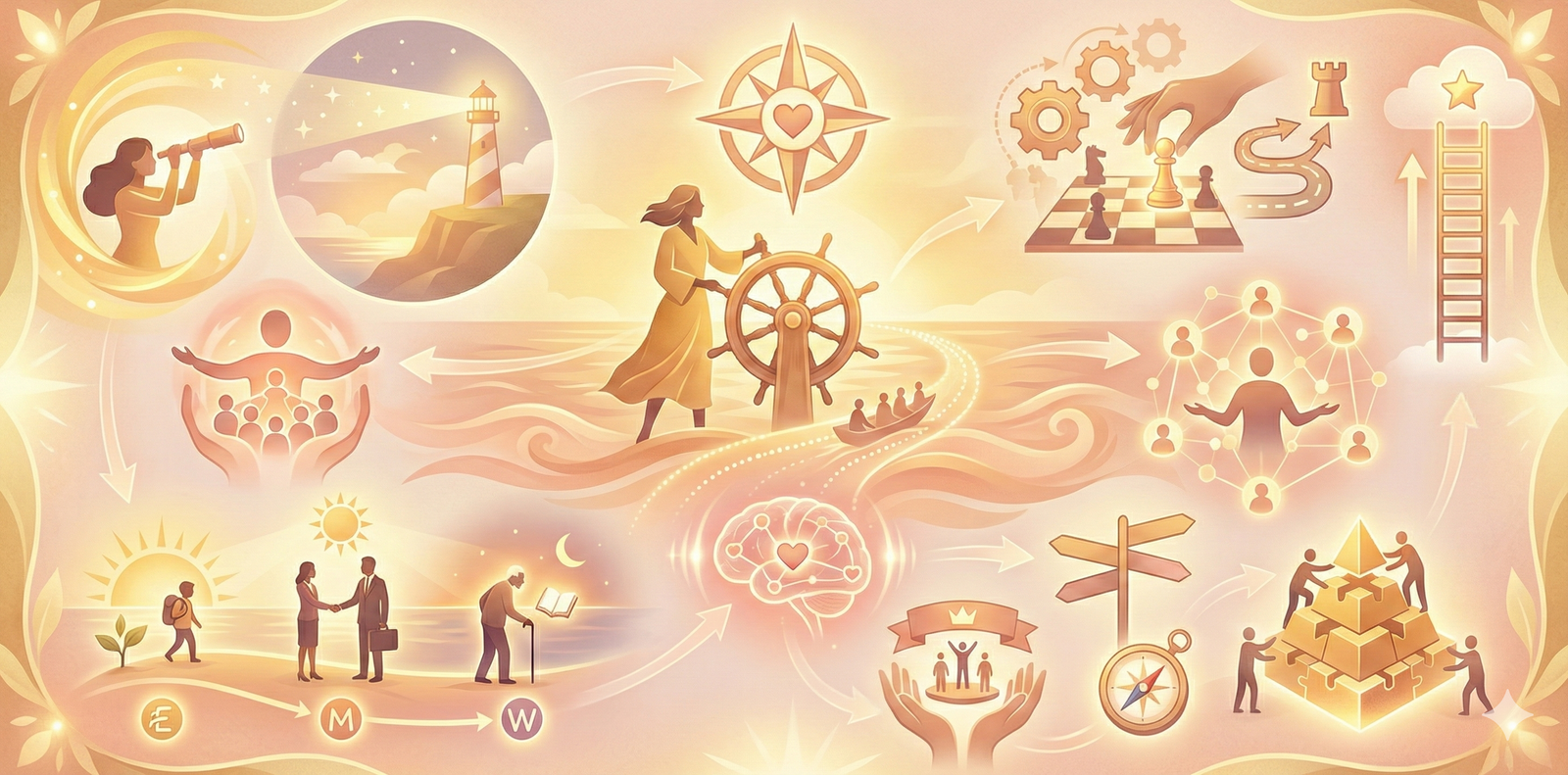
In 2026, leadership is evolving rapidly. Traditional autocratic approaches are giving way to collaborative, emotionally intelligent leadership styles that prioritize psychological safety and shared purpose over command-and-control authority.
The research is clear: people don't follow leaders because they have to—they follow because they want to. And that shift happens when leaders master the ability to inspire hope, build trust, and connect purpose to action.
What Is Leadership?
Leadership is the capacity to influence and guide a group of people toward achieving a common goal. It encompasses a constellation of skills, behaviors, and mindsets that enable individuals to provide direction, inspire commitment, facilitate effective decision-making, foster collaboration, and promote the growth and development of others. Leadership operates at multiple levels—from personal leadership (managing yourself with integrity and self-awareness) to team leadership (guiding small groups) to organizational leadership (steering entire enterprises through change). Modern definitions emphasize that leadership is not about power over others, but about power with others: enabling collective success through shared vision and mutual respect.
Not medical advice.
The distinction between authority and leadership is critical. You can have authority without being a leader—think of managers who command compliance but inspire little commitment. Conversely, you can be a leader without formal authority, influencing peers, colleagues, and communities through your integrity, competence, and vision. The most effective leaders recognize this distinction and build their influence on genuine connection rather than positional power.
Surprising Insight: Surprising Insight: Hope is the dominant attribute people seek in leaders, accounting for 56% of preferences for positive leaders—far exceeding trust (33%) and other qualities. This finding reshapes how we understand what makes leaders truly effective.
The Three Pillars of Leadership
Leadership effectiveness rests on three interconnected dimensions: vision clarity, emotional intelligence, and decision-making capability.
🔍 Click to enlarge
Why Leadership Matters in 2026
In an era of rapid change, distributed teams, and complex challenges, leadership has become more critical than ever. Organizations with strong leadership cultures report higher employee engagement, innovation, and retention. Teams led by emotionally intelligent leaders demonstrate 40% higher performance in coaching, engagement, and decision-making. The ability to provide clear direction while remaining adaptable—to inspire while empowering—separates thriving organizations from those struggling to retain talent and drive growth.
Leadership also directly impacts individual wellbeing. When people experience hopeful, trustworthy leadership, their stress levels decrease, engagement increases, and they're more likely to stay committed to their work. Conversely, poor leadership creates psychological unsafety, which triggers the brain's threat response and undermines performance. Leaders who understand the neuroscience of their influence—how their communication affects others' nervous systems—can intentionally create cultures of safety and possibility.
From a career perspective, developing leadership capability is one of the most powerful investments you can make. 70% of organizations report it is important or very important for leaders to master a wider range of effective leadership behaviors to meet current and future business needs. Whether you aspire to formal leadership roles or want to lead without authority, these skills compound throughout your career and increase your impact across every domain of life.
The Science Behind Leadership
Leadership is not merely a soft skill—it has deep roots in neuroscience, psychology, and organizational behavior. Brain imaging studies reveal that effective leaders activate specific neural pathways in those around them. The amygdala, your brain's emotional processing center, responds to a leader's presence and communication. When a leader communicates safety and clarity, the amygdala calms, allowing the prefrontal cortex (responsible for reasoning, planning, and complex decision-making) to activate. Conversely, when leadership creates uncertainty or threat, the amygdala triggers a stress response that narrows thinking and impairs performance.
Research from the NeuroLeadership Institute shows that leaders who understand the brain can accelerate change from weeks instead of years. This is because they work with neurobiology rather than against it. Emotionally intelligent leaders regulate their own nervous systems, recognize others' emotional states, and communicate in ways that promote psychological safety. Studies show that leaders with high emotional intelligence—particularly in empathy—demonstrate measurably better coaching, engagement, and decision-making outcomes. Empathy enables leaders to understand how decisions will affect others, fostering inclusive decision-making that considers diverse needs and perspectives.
Brain Systems Activated by Effective Leadership
Different leadership behaviors activate different neural networks, each with distinct outcomes for team performance and wellbeing.
🔍 Click to enlarge
Key Components of Leadership
Vision and Purpose
The foundation of leadership is clarity of purpose. Leaders articulate a compelling vision—a clear, inspiring picture of why the work matters and where it's heading. This connects individual effort to larger meaning. Simon Sinek's Golden Circle concept illustrates this: leaders who start with WHY (purpose) before HOW (methods) and WHAT (outcomes) inspire action far more effectively than those who lead with only strategy or tactics. People follow leaders whose purpose resonates with their own values and aspirations.
Emotional Intelligence
Emotional intelligence (EI) in leadership encompasses self-awareness, self-regulation, empathy, and social skill. Leaders with high EI recognize their own emotional triggers and biases, manage their reactions under pressure, and attune to others' emotional needs. This enables more thoughtful rather than reactive decision-making. Research shows that 71% of employers value emotional intelligence more highly than technical skills when evaluating candidates for leadership roles. Emotionally intelligent leaders create psychological safety—the shared belief that you can take interpersonal risks without fear of embarrassment or punishment—which directly correlates with team performance and innovation.
Strategic Decision-Making
Leadership requires the ability to synthesize information, weigh competing priorities, and make decisions under uncertainty. Effective leaders draw on both analytical thinking and intuitive wisdom. They seek input from diverse perspectives, consider long-term consequences, and make decisions aligned with organizational values. They also communicate decisions clearly, explaining the reasoning so teams understand not just what was decided, but why—building alignment and trust even when people might have chosen differently.
Communication and Influence
Leadership is fundamentally a communication challenge. Leaders must articulate vision, provide feedback, listen actively, and adapt their communication to different audiences and contexts. They influence through clarity, authenticity, and consistency—not through manipulation. Active listening is particularly powerful: leaders who listen deeply to their teams understand their concerns, foster trust, and gather critical information for better decision-making. Communication is also how leaders shape culture—the behaviors they model and reinforce determine what becomes normal.
| Leadership Competency | Primary Brain System | Team Impact |
|---|---|---|
| Clear Vision & Purpose | Prefrontal Cortex (Planning) | Direction, Engagement, Retention |
| Emotional Intelligence & Empathy | Limbic System (Emotion) | Trust, Psychological Safety, Innovation |
| Consistent Communication | Language Centers | Alignment, Clarity, Reduced Anxiety |
| Inclusive Decision-Making | Prefrontal Cortex (Analysis) | Better Solutions, Buy-In, Ownership |
| Resilience & Adaptability | Executive Function | Stability in Change, Modeling Strength |
How to Apply Leadership: Step by Step
- Step 1: Clarify Your Why: Before leading others, be clear about your own purpose. Why does this work matter to you? What difference do you want to make? This authenticity becomes the foundation of your ability to inspire others.
- Step 2: Develop Self-Awareness: Reflect on your emotional patterns, triggers, strengths, and growth edges. How do you respond under stress? What biases shape your thinking? Self-awareness is the prerequisite for emotional intelligence.
- Step 3: Practice Active Listening: In conversations with team members, focus on understanding their perspective before jumping to solutions. Ask genuine questions. Notice what they're not saying. This builds trust and reveals information you need to lead effectively.
- Step 4: Create Psychological Safety: Explicitly invite questions, concerns, and diverse viewpoints. Respond to challenges without defensiveness. Admit mistakes. Show that failure is information, not indictment. Teams with psychological safety innovate faster and perform better.
- Step 5: Communicate Vision Regularly: Share the larger purpose behind decisions and direction. Connect daily work to meaningful outcomes. Use stories to make vision tangible. Remind people why their contributions matter.
- Step 6: Make Inclusive Decisions: Gather input from people affected by decisions. Consider diverse perspectives. Explain your reasoning transparently. People support what they help create and understand.
- Step 7: Model Resilience: Demonstrate how to respond to setbacks with learning rather than blame. Show up consistently, even in difficulty. Let your team see you adapting and growing. Resilience is contagious.
- Step 8: Provide Developmental Feedback: Move beyond evaluation to coaching. Help people see their potential and how to develop toward it. Invest in growth. People stay and thrive with leaders who believe in them.
- Step 9: Regulate Your Nervous System: Manage your own stress so your team doesn't absorb it. Exercise, sleep, reflection—these aren't luxuries for leaders, they're necessities. Your calm presence creates psychological safety.
- Step 10: Build a Culture of Learning: Frame challenges as opportunities to learn and adapt. Celebrate experiments and failures that generated insight. Invest in development. Leaders create an environment where growth is expected and supported.
Leadership Across Life Stages
Young Adulthood (18-35)
Early in your career, focus on developing foundational leadership skills through strong peer relationships, mentorship, and taking initiative in projects. Lead without authority by being reliable, communicating clearly, and supporting colleagues. Build your emotional intelligence through feedback from trusted mentors. Develop a growth mindset and willingness to learn from both successes and failures. This is the time to explore different leadership approaches and discover your authentic style.
Middle Adulthood (35-55)
In middle career, you likely have formal leadership responsibilities—managing teams, driving projects, or stewarding organizational change. Deepen your emotional intelligence and impact by expanding your perspective beyond your immediate team. Develop systems thinking—understanding how your decisions ripple through the organization. Become a mentor to others, amplifying your impact. Navigate the balance between achievement and meaning, between driving results and sustaining your team's wellbeing. Many leaders find their most effective years are here, with experience, credibility, and perspective all mature.
Later Adulthood (55+)
In later career, leadership becomes increasingly about legacy and wisdom. Share what you've learned. Mentor the next generation deliberately. Transition to roles where your perspective and judgment are most valued. Some leaders shift to advisory or governance roles. Others go deeper in purpose-driven organizations. The most respected leaders at this stage are often those who've learned to let go of ego and status, focusing instead on helping others succeed and leaving organizations and communities stronger.
Profiles: Your Leadership Approach
The Visionary
- Clarity of purpose and long-term direction
- Freedom to think expansively and challenge status quo
- Recognition for innovative thinking
Common pitfall: Can get so focused on the big picture that they overlook implementation details and team morale
Best move: Partner with detail-oriented collaborators. Schedule regular check-ins on tactical execution. Remember that vision without progress demoralizes teams.
The Connector
- Strong relationships and team cohesion
- Understanding of individual strengths and aspirations
- Collaborative culture
Common pitfall: May avoid difficult conversations or decisions that could strain relationships, compromising accountability
Best move: Learn to deliver hard feedback with compassion. Remember that supporting people sometimes means having courageous conversations. Accountability strengthens relationships.
The Executor
- Clear goals and metrics for success
- Efficient processes and accountability systems
- Recognition for delivering results
Common pitfall: Can drive toward outcomes at the expense of team wellbeing or development, creating high turnover and burnout
Best move: Invest in team development and psychological safety. Sustainable results require sustainable pace. Slow down enough to ask, 'How are people doing?'
The Mentor
- Opportunities to develop others and watch them grow
- Time for coaching conversations and feedback
- Access to people at different career stages
Common pitfall: May hesitate to hold people accountable or make tough decisions, prioritizing harmony over growth
Best move: Growth sometimes requires discomfort. Help people stretch beyond their comfort zone. Accountability is an expression of belief in their potential.
Common Leadership Mistakes
One of the most common mistakes is confusing authority with leadership. Just because you have formal power doesn't mean people will genuinely follow or commit. The most authoritarian leaders often create compliance without commitment, resulting in people doing the minimum required rather than bringing their full capability. Effective leaders earn trust through integrity, consistency, and genuine interest in their team's growth—not through positional power.
Another widespread error is poor listening. Leaders who are too busy, too convinced they have the answer, or too emotionally triggered to truly listen miss critical information. They also fail to build the trust and psychological safety that enables teams to bring their best thinking. The antidote is disciplined listening—creating space for others to share, asking clarifying questions, and explicitly valuing what you hear.
Finally, many leaders neglect their own resilience and wellbeing. They run on stress and fumes, then wonder why they're not effective. Your physical health, sleep, relationships, and mental clarity directly impact your leadership capacity. Leaders who model sustainable pacing and self-care give permission for others to do the same, ultimately creating healthier, higher-performing organizations.
From Good Intentions to Effective Leadership
Common leadership intentions and how they can derail without awareness and practice.
🔍 Click to enlarge
Science and Studies
Decades of rigorous research have mapped the components of effective leadership and their measurable impact on organizational performance, team engagement, and individual wellbeing. Here's what the evidence shows:
- Gallup research found that people's primary need from leaders is hope (56% of mentions), followed by trust (33%), demonstrating that inspiration and safety are foundational to leadership effectiveness.
- Harvard Business School research shows that leaders who develop psychological safety in their teams experience significantly higher innovation rates, faster problem-solving, and lower turnover—with safety creating 3-4x better outcomes.
- The NeuroLeadership Institute documents that leaders who understand brain science can accelerate behavioral change from years to weeks, because they work with neurobiological principles rather than against them.
- Research in Emotional Intelligence shows that emotionally intelligent leaders deliver 40% higher performance in coaching, engagement, and decision-making compared to leaders lacking emotional skills.
- A 2024 global leadership study from Harvard Business Impact found that 70% of organizations believe it is increasingly important for leaders to master a broader range of behaviors to meet 2025+ business demands, reflecting the shift toward adaptive, inclusive leadership.
Your First Micro Habit
Start Small Today
Today's action: Tomorrow, in one conversation with someone on your team or in your circle, practice active listening. Ask one genuine question and listen to understand—not to respond. Notice what you learn that you didn't know before. Text a note summarizing what you heard back to them.
Active listening is the foundation of trust and effective leadership. This micro habit builds the neural pathways for attentive presence, shows people they matter, and reveals information essential for wise decision-making. Consistency compounds rapidly.
Keep quitting habit apps after a missed day? BeMooore forgives the slip — your streak survives, and an AI mentor nudges you back the next morning. Free on iOS.
Quick Assessment
Which aspect of leadership feels most natural to you right now?
Your natural strength is your leadership foundation. Build on it while developing the other three dimensions—the most effective leaders integrate all four.
What's your biggest leadership challenge at this stage?
Your challenge reveals your growth edge. This is where deliberate practice and mentorship will have the highest return—focus here first.
How do you typically respond when a team member challenges your decision?
Your response pattern shows how open you are to influence and growth—essential for building psychologically safe teams and making better decisions.
Take our full assessment to get personalized recommendations for your leadership development.
Discover Your Style →Next Steps
Start by getting clear on your current leadership reality. If you lead formally, gather feedback from your team on your strengths and growth edges. If you lead without authority, identify one area where you want to increase your influence and commit to one micro habit this week. Most importantly, find a mentor or trusted colleague who can provide ongoing feedback and perspective as you develop.
Remember: great leadership is not about perfection. It's about continuous learning, genuine commitment to others' growth, and the courage to lead with purpose even in uncertainty. Every leader started where you are. The ones who became exceptional were those who committed to the practice over decades, stayed curious about their impact, and never stopped developing themselves.
Get personalized guidance and daily practices to develop your leadership capacity with AI coaching.
Start Your Leadership Journey →Research Sources
This article is based on peer-reviewed research and authoritative sources. Below are the key references we consulted:
Related Glossary Articles
Frequently Asked Questions
Can leadership skills be learned, or are great leaders born?
Leadership is primarily learned. While some people have natural temperaments that lend themselves to leadership, the core competencies—emotional intelligence, clear communication, strategic thinking, and decision-making—are skills that develop through practice, feedback, and reflection. Research shows that leadership capability strengthens by using it intentionally.
How do I lead effectively when I don't have formal authority?
Lead through influence rather than position. Build credibility by being reliable, communicating clearly, and delivering results. Listen deeply and understand others' needs. Find areas where you can add value and take initiative. Support colleagues' goals. Influence flows from integrity, competence, and genuine interest in others' success—none of which require a title.
What's the difference between leadership and management?
Management is about directing tasks and resources efficiently. Leadership is about inspiring direction, creating meaning, and developing people. Great leaders are often skilled managers, but not all managers are leaders. You can manage without leading (getting compliance), or lead without managing (influencing without authority). The most effective organizations have leaders who also understand management.
How do I handle situations where my leadership style isn't working?
Start with curiosity rather than judgment. What feedback are you getting from your team or results? What might be misaligned? Often, the issue isn't your core style but its overuse—a strength applied inflexibly becomes a liability. Seek honest feedback from a mentor or coach. Experiment with adjusting your approach while staying true to your authentic style. Resilience includes the ability to adapt.
Is it possible to be a good leader while struggling with your own mental health or life challenges?
Yes, with important caveats. Self-awareness about your capacity is crucial—knowing when you're running on fumes and taking steps to restore yourself. Transparency about challenges (without oversharing) can actually deepen trust. Many effective leaders have faced significant adversity and use that wisdom in their leadership. The key is ensuring your challenges don't unconsciously harm your team. Seek support when needed. Your wellbeing enables your leadership.
Take the Next Step
Ready to improve your wellbeing? Take our free assessment to get personalized recommendations based on your unique situation.
- Discover your strengths and gaps
- Get personalized quick wins
- Track your progress over time
- Evidence-based strategies