Psychology
Psychology is the scientific study of the mind and behavior. It explores how thoughts, emotions, and actions shape your daily life, relationships, and overall wellbeing. By understanding psychological principles, you gain insight into why people think and behave as they do, enabling you to make better decisions, manage stress effectively, build stronger relationships, and create meaningful personal growth.
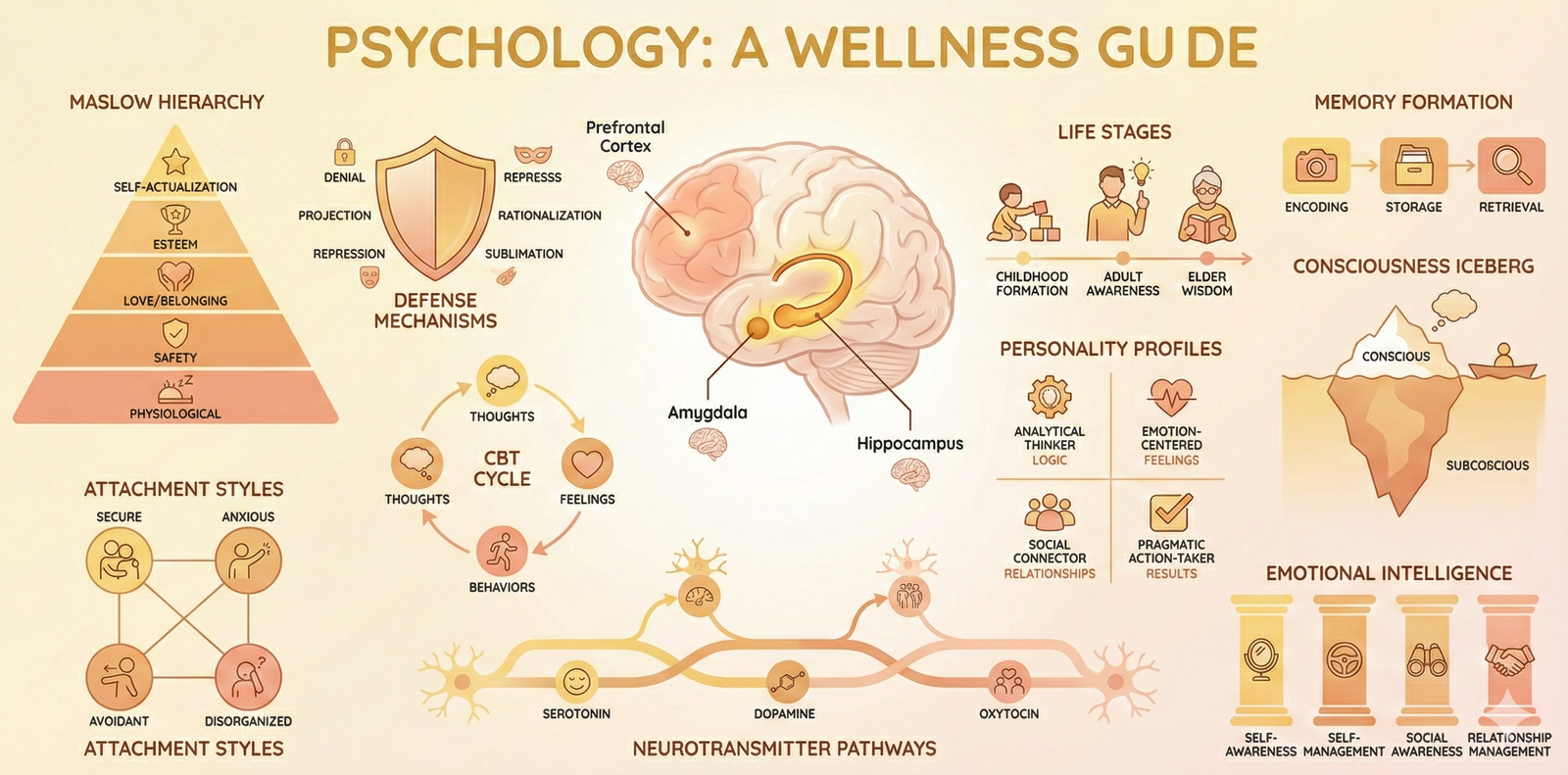
Many people think psychology is only for therapy or mental illness. In reality, psychology is about understanding yourself and others more deeply.
Positive psychology research shows that people who understand psychological principles report greater life satisfaction and resilience.
What Is Psychology?
Psychology comes from the Greek words 'psyche' (mind) and 'logos' (science or knowledge). The American Psychological Association defines psychology as the scientific study of how the mind works and how it affects behavior. Psychology integrates methods from natural sciences with insights about human experience, making it both a hard science and a human discipline.
Psychology uses the scientific method to understand behavior. Psychologists observe, measure, and test hypotheses through experiments, surveys, and longitudinal studies. This rigorous approach means psychological findings are based on evidence, not opinion. Psychology is recognized by the National Science Foundation as part of STEM disciplines, acknowledging its scientific rigor.
Surprising Insight: The mind is like an iceberg—what we see consciously is only the tip. Psychology helps us understand the vast depths beneath the surface.
The Four Core Goals of Psychology
Psychology has four fundamental goals that guide all research and practice:
- Step 1: {'text': 'Describe behavior and mental processes as they actually occur in natural settings and controlled experiments'}
- Step 2: {'text': 'Explain the causes and mechanisms behind why people think and behave in specific ways'}
- Step 3: {'text': 'Predict future behavior based on understanding underlying psychological principles'}
- Step 4: {'text': 'Influence or modify behavior to improve wellbeing, treat disorders, and enhance performance'}
These goals apply across all psychology specializations—from clinical to organizational to educational psychology. Understanding these goals helps you recognize when psychological knowledge can genuinely help you solve real-world problems.
The Science Behind Your Behavior
Your behavior doesn't happen randomly. It emerges from complex interactions between your brain, thoughts, emotions, and environment. Neuroscience reveals that personality traits, such as openness, conscientiousness, and empathy, correlate with specific patterns of brain activity. When you understand these connections, you can intentionally work with your neurobiology rather than against it.
Research on personality neuroscience shows that brain regions associated with reward processing, emotional regulation, and decision-making work together to create your unique behavioral patterns. For example, people with high conscientiousness show stronger activity in areas linked to planning and impulse control. This means you're not simply 'wired' one way—through practice and awareness, you can strengthen neural pathways that support your wellbeing goals.
Positive Psychology and Wellbeing
Positive psychology is the scientific study of a healthy and flourishing life. Rather than focusing solely on mental illness, positive psychology asks: 'What makes people thrive?' Research by pioneers like Martin Seligman shows that happiness and wellbeing are measurable, improvable outcomes.
Studies reveal remarkable findings about the power of positive emotions. Nuns who expressed more positive emotions in autobiographical essays lived on average 10 years longer than those expressing fewer positive emotions. Happier people show increased creativity, productivity, stronger social connections, and greater income. They also develop greater resilience—the ability to bounce back from adversity.
| Gratitude practice | Increased life satisfaction and happiness | 2-4 weeks regular practice | Strong (multiple meta-analyses) |
| Mindfulness meditation | Reduced stress and anxiety, improved focus | 4-8 weeks at 10-20 min daily | Strong (NIH-backed research) |
| Acts of kindness | Enhanced mood and social connection | 3-6 weeks of deliberate acts | Moderate-Strong |
| Journaling for meaning | Clarity on values, reduced depression symptoms | 4 weeks of regular reflection | Strong (peer-reviewed studies) |
| Strength-spotting | Increased confidence and engagement | 2-4 weeks of daily awareness | Moderate-Strong |
Cognitive Behavioral Approaches
Cognitive behavioral therapy (CBT) is one of the most researched and effective psychological interventions. CBT is based on a simple but powerful insight: your thoughts, feelings, and behaviors are connected. By changing unhelpful thought patterns, you can shift your emotions and actions.
Here's how it works in practice. Suppose you feel anxious before a presentation. Your thoughts might be 'I'll fail and embarrass myself.' This thought triggers physical anxiety (racing heart, shallow breathing) and avoidance behavior (wanting to skip the presentation). CBT teaches you to notice this thought pattern, examine whether it's actually true, and replace it with a more realistic perspective like 'I've prepared well, and I can handle questions.' This shift in thinking naturally reduces anxiety and improves your performance.
CBT has been extensively researched and proven effective for depression, anxiety, eating disorders, insomnia, chronic pain, and many other conditions. Sessions typically involve 8-12 weekly meetings and can be delivered in-person or online with equal effectiveness. The beauty of CBT is that it's skill-based—you learn tools you can use independently throughout your life.
How to Apply Psychology to Your Life
Understanding psychology isn't just intellectual—it's practical. Here are evidence-based steps to apply psychological principles for better wellbeing:
- Step 1: {'text': 'Observe your thoughts without judgment. Notice what thoughts precede difficult feelings. Are they factual or assumptions?'}
- Step 2: {'text': "Identify thought patterns. Common unhelpful patterns include catastrophizing ('This will be a disaster'), mind-reading ('They think I'm incompetent'), and all-or-nothing thinking ('If I'm not perfect, I've failed'). Recognizing these patterns is the first step to changing them."}
- Step 3: {'text': "Test your thoughts against evidence. Ask: What's the actual evidence this thought is true? What evidence contradicts it? What would a fair, balanced perspective be?"}
- Step 4: {'text': "Practice self-compassion. Psychology research shows self-criticism often backfires, increasing anxiety and depression. Self-compassion—treating yourself with the same kindness you'd offer a friend—actually increases motivation and resilience."}
- Step 5: {'text': "Build positive emotions intentionally. Don't wait for happiness to happen. Engage in activities you enjoy, spend time with people you care about, practice gratitude, and help others. These actions directly increase happiness and build your psychological resources."}
- Step 6: {'text': 'Understand your personality strengths. Personality assessments like the Big Five or CliftonStrengths help you recognize your natural talents. When you focus on your strengths and find ways to use them daily, engagement and satisfaction increase dramatically.'}
- Step 7: {'text': 'Develop healthy relationships. Psychology research consistently shows that the quality of your relationships is the strongest predictor of life satisfaction and longevity. Invest in meaningful connections and practice active listening and empathy.'}
- Step 8: {'text': 'Master emotional regulation. Learn techniques like deep breathing, progressive muscle relaxation, or mindfulness to manage intense emotions. These skills prevent emotions from controlling your decisions and actions.'}
Psychology and the Therapeutic Relationship
If you've considered therapy, you might wonder which type is best. Research reveals something surprising: the relationship between therapist and client is often more important than the specific therapy technique used. Studies show that common factors like empathy, warmth, genuineness, and a strong therapeutic alliance predict positive outcomes as well as or better than specialized treatment interventions.
When clients feel genuinely understood and respected by their therapist, they're more engaged, more likely to practice skills outside sessions, and more likely to achieve lasting change. The therapeutic alliance—a shared sense of working together toward meaningful goals—mediates the relationship between relationship quality and positive outcomes. This means finding a therapist you connect with is often as important as the specific therapy approach they use.
The Role of Personality in Psychology
Psychology recognizes that people have stable, measurable personality traits that influence how they perceive the world and interact with others. The Big Five personality model—openness, conscientiousness, extraversion, agreeableness, and neuroticism—provides a framework for understanding these differences.
Understanding your personality isn't about being 'typed' into a fixed box. Rather, it's about recognizing your natural tendencies so you can leverage them and compensate for areas where you naturally struggle. For example, if you're high in neuroticism (tendency toward negative emotions), you can practice emotional regulation skills. If you're low in conscientiousness, you can use systems and accountability to stay organized. Self-awareness plus intentional practice equals change.
Four Personality Profiles in Psychology
Psychology and Culture
Psychology varies across cultures. Individualistic cultures emphasize personal autonomy and self-expression, while collectivistic cultures emphasize family, community, and social harmony. What's considered healthy wellbeing in one culture might look different in another. Effective psychology respects these differences and tailors approaches to cultural contexts.
Modern psychology increasingly recognizes the importance of cultural competence—understanding how someone's cultural background shapes their values, communication style, and wellbeing. When psychological interventions respect cultural values and involve community, they're significantly more effective.
Common Psychology Myths Debunked
- {'anchor': 'We use only 10% of our brains', 'text': 'False. We use essentially all of our brain, most of the time. Most of the brain is almost always active.'}
- {'anchor': 'Learning styles (visual, auditory, kinesthetic) are scientifically proven', 'text': 'False. While people have preferences, research shows no evidence that teaching to learning style preferences improves outcomes.'}
- {'anchor': 'IQ is fixed from birth', 'text': 'Partially false. While some aspects are stable, neuroplasticity research shows the brain continues changing throughout life. Cognitive abilities can be developed.'}
- {'anchor': 'Venting anger always helps you feel better', 'text': 'False. Research shows that aggressively venting anger often increases anger and aggression. Healthy emotion regulation involves processing feelings more constructively.'}
- {'anchor': 'Therapy means something is wrong with you', 'text': 'False. Therapy is a tool for understanding yourself better and developing skills—like coaching for the mind. Healthy people benefit from psychological support.'}
Your First Micro Habit
Your First Micro Habit
Today's action: Thought awareness: For 2-3 minutes daily, notice one thought and ask 'Is this thought helpful or unhelpful? Is it actually true?' Write it down. That's it.
This tiny habit rewires your relationship with your thoughts. Instead of being controlled by automatic thoughts, you become their observer. Neuroscience shows this creates measurable changes in brain regions linked to self-awareness and emotional regulation. Within weeks, you'll notice you're less reactive and more intentional.
Use the Bemooore app to log your daily thought awareness practice. The app will track your progress and send reminders to build this powerful habit. Over time, you'll develop stronger psychological self-awareness and emotional control without relying on motivation or discipline.
Science and Research Behind Psychology
Modern psychology rests on decades of rigorous research across thousands of studies. Here are key research findings that shape contemporary practice:
- {'anchor': 'Cognitive Behavioral Therapy effectiveness', 'href': '/g/emotional-regulation.html', 'text': 'CBT reduces anxiety and depression symptoms in 60-80% of cases, with benefits lasting years after treatment ends.'}
- {'anchor': 'Positive psychology interventions', 'href': '/g/gratitude-practice.html', 'text': 'Three specific happiness interventions (gratitude practice, acts of kindness, best-possible-self visualization) produce lasting increases in wellbeing and decreases in depression.'}
- {'anchor': 'Neuroplasticity', 'href': '/g/brain-optimization.html', 'text': 'The brain continues forming new neural connections throughout life. Repeated practice literally rewires your brain, enabling lasting behavior change.'}
- {'anchor': 'Therapeutic alliance', 'href': '/g/emotional-connection.html', 'text': 'The quality of the client-therapist relationship is one of the strongest predictors of positive therapy outcomes, independent of therapy type.'}
- {'anchor': 'Emotional regulation', 'href': '/g/emotional-management.html', 'text': 'People who effectively regulate emotions show better physical health, stronger relationships, greater academic/professional success, and higher life satisfaction.'}
- {'anchor': 'Social connection', 'href': '/g/social-connection.html', 'text': 'Quality relationships are the strongest predictor of longevity and happiness. Social isolation is as harmful to health as smoking 15 cigarettes daily.'}
- {'anchor': 'Mindfulness and meditation', 'href': '/g/mindfulness.html', 'text': 'Regular mindfulness practice increases emotional regulation, reduces anxiety, improves attention, and produces measurable changes in brain structure.'}
- {'anchor': 'Self-compassion outcomes', 'href': '/g/self-compassion.html', 'text': 'Self-compassion (rather than self-criticism) increases motivation, resilience, and psychological wellbeing while reducing anxiety and depression.'}
Key Takeaways
- {'anchor': 'Psychology is the scientific study of mind and behavior', 'text': "It's evidence-based, rigorous, and recognized as a STEM discipline."}
- {'anchor': 'Understanding yourself and others matters', 'text': 'Psychological self-awareness directly improves decision-making, relationships, and wellbeing.'}
- {'anchor': 'Positive psychology works', 'text': 'Happiness and flourishing are measurable and improvable through specific, evidence-based practices.'}
- {'anchor': 'Behavior change is neurologically possible', 'text': 'Neuroplasticity means your brain adapts throughout life, enabling genuine personal transformation.'}
- {'anchor': 'Start small', 'text': 'A single micro habit—thought awareness for 2 minutes daily—begins rewiring your psychological responses.'}
- {'anchor': 'Relationships matter most', 'text': 'Quality connections are the strongest predictor of both happiness and longevity. Invest in meaningful relationships.'}
What's Next?
Psychology is a bridge between understanding yourself and creating lasting change. You now know what psychology is, why it matters, and how to apply it. The next step is practice. Start with your first micro habit—thought awareness. Notice how this small practice begins shifting your relationship with your own mind.
As you develop this habit, you'll naturally become more curious about other psychological principles. You might explore emotional regulation, relationship dynamics, or how to build unshakeable confidence. Each application of psychology compounds, creating a more intentional, resilient, and fulfilled life.
Remember: Understanding psychology doesn't require therapy, formal study, or years of practice. It requires curiosity, openness, and small, consistent steps toward greater self-awareness and intentional living.
What best describes your current relationship with understanding psychology and behavior?
Your experience level helps determine which psychological principles and practices will have the most immediate impact on your wellbeing.
When facing difficult emotions or challenging situations, what's your typical approach?
Understanding your starting point with emotional awareness helps identify which specific psychological skills would benefit you most.
How important is personal growth and self-understanding to you right now?
Your motivation for growth determines how deeply you'll engage with psychological principles and how much benefit you'll experience.
Take our full 50-question Wellbeing Assessment to understand your psychological profile and receive personalized recommendations for growth.
Discover Your Style →Related Glossary Articles
Frequently Asked Questions
Is psychology scientific?
Yes, absolutely. Psychology uses the scientific method—hypothesis testing, controlled experiments, longitudinal studies, and peer review. The NSF recognizes psychology as a STEM discipline. Modern psychology is evidence-based and continuously updated as new research emerges.
Do I need therapy to benefit from psychology?
No. Therapy is one application of psychology, but psychological principles apply to everyone—relationships, work, parenting, personal growth, and wellbeing. Many people benefit from understanding psychology without formal therapy.
How long does it take to see results from psychological interventions?
It varies. Some changes appear within days (improved mood from gratitude practice). More substantial changes typically take 4-8 weeks of consistent practice. The key is regular application, not intensity.
Is psychology different across cultures?
Yes. Psychology respects cultural context. Concepts like 'healthy independence' or 'emotional expression' vary across cultures. Effective psychology is culturally informed and tailored to respect individual and community values.
Can you change your personality through psychology?
Yes, within limits. You can't change your core personality type completely, but you can develop specific traits and skills. Neuroplasticity research shows the brain changes throughout life, enabling meaningful personal growth and behavior change.
What's the difference between psychology and psychiatry?
Psychologists hold a doctoral degree in psychology and provide therapy, behavioral interventions, and psychological assessment. Psychiatrists are medical doctors who specialize in mental health and can prescribe medications. Both approaches are valuable and often complementary.
How do I know if therapy is right for me?
Consider therapy if you're struggling with persistent emotional difficulties, behavioral patterns you want to change, relationship challenges, or life transitions. You don't need to be in crisis—many people use therapy for growth and self-understanding.
Can psychology help with physical health?
Yes, significantly. Psychology influences immune function, cardiovascular health, pain perception, and recovery. Positive emotions literally increase longevity—those expressing more positive emotions lived 10 years longer in landmark studies. Not medical advice.
Take the Next Step
Ready to improve your wellbeing? Take our free assessment to get personalized recommendations based on your unique situation.
- Discover your strengths and gaps
- Get personalized quick wins
- Track your progress over time
- Evidence-based strategies