Healthy Relationships
Relationships are the foundation of human wellbeing, serving as a primary source of joy, support, and meaning throughout our lives. Healthy relationships involve mutual respect, open communication, and emotional safety, creating spaces where both partners feel valued and understood. Research consistently shows that individuals in satisfying relationships report higher levels of happiness, reduced stress, better physical health, and greater life satisfaction compared to those in conflicted or isolated situations. The quality of your relationships directly influences your mental health, resilience, and ability to thrive in all areas of life.
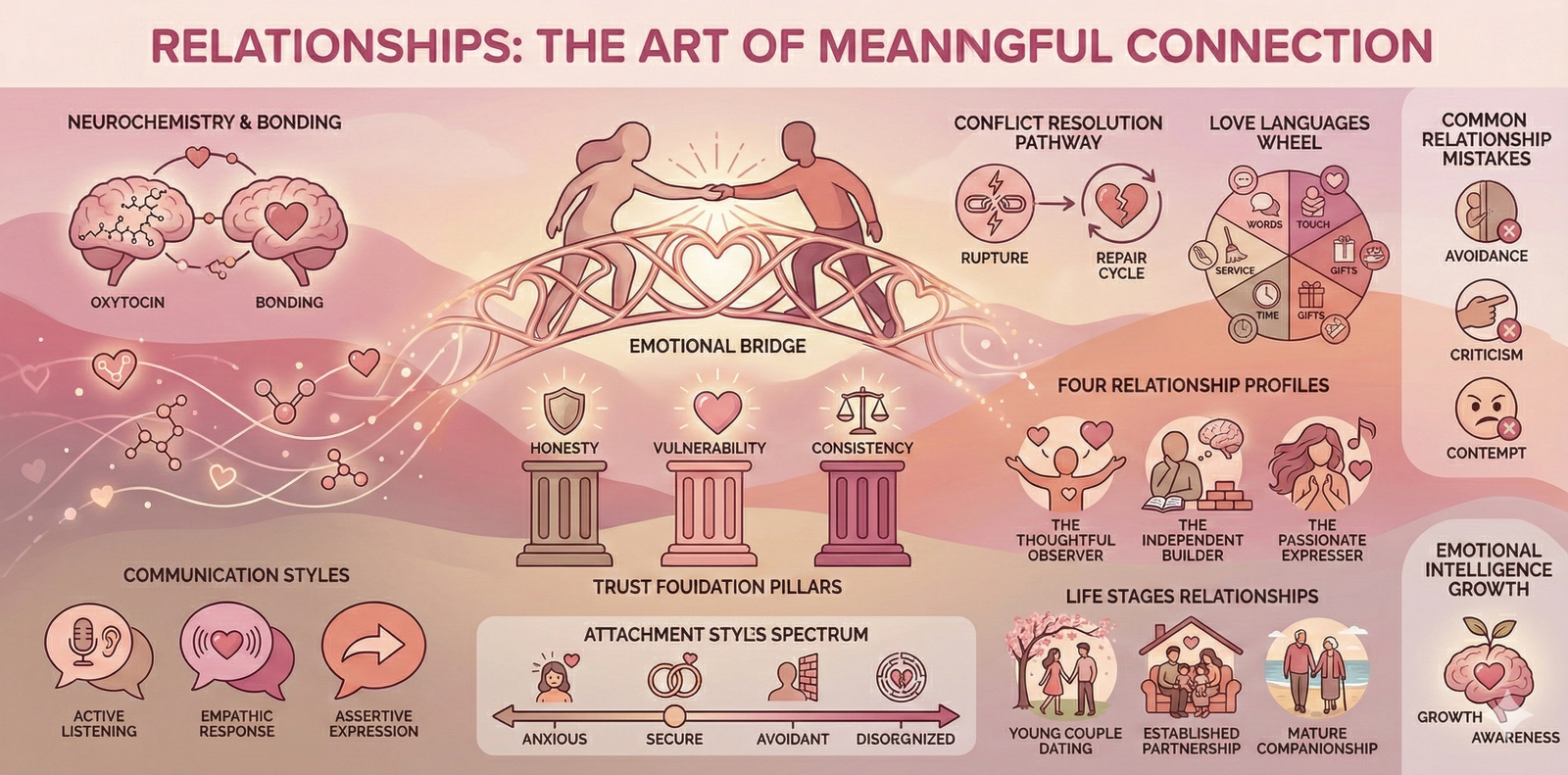
Building and maintaining healthy relationships requires intentional effort, emotional awareness, and commitment to understanding your partner's needs and perspectives. This journey involves developing communication skills, recognizing attachment patterns, and creating emotional safety for genuine connection to flourish.
Whether you're navigating romantic partnerships, deepening friendships, or strengthening family bonds, the principles of healthy relating remain consistent: authenticity, vulnerability, respect, and consistent care.
What Is Relationships?
Relationships are dynamic connections between two or more people characterized by ongoing interaction, emotional investment, and mutual influence. In the context of romantic partnerships, relationships involve a committed bond where partners share emotional intimacy, physical connection, shared goals, and a vision for their future together. A relationship extends beyond attraction or companionship—it's a space where individuals support each other's growth, navigate challenges collaboratively, and create meaning together. Healthy relationships involve reciprocal commitment, where both partners actively contribute to the wellbeing and satisfaction of the relationship.
Not medical advice.
At their core, relationships serve fundamental human needs for connection, belonging, and security. They provide context for developing trust, practicing vulnerability, and experiencing unconditional acceptance. The relational patterns you develop early in life influence how you approach partnerships throughout adulthood, shaping your expectations, communication style, and ability to create lasting bonds.
Surprising Insight: Surprising Insight: Mutual influence—where both partners allow each other's needs and perspectives to shape their behavior—is one of the strongest predictors of relationship stability and satisfaction, reducing anxiety about commitment and preventing small conflicts from escalating into chronic gridlock.
The Three Pillars of Healthy Relationships
Visual representation of the foundational elements that create lasting, satisfying relationships.
🔍 Click to enlarge
Why Relationships Matter in 2026
In an increasingly digital and fragmented world, the quality of our relationships has become more critical to wellbeing than ever before. The 2025 psychological research shows that individuals in satisfying relationships report significantly higher levels of happiness, life satisfaction, self-esteem, and overall life quality. Relationships provide emotional anchoring during personal crises, buffer against stress and anxiety, and offer purpose beyond individual achievement.
The modern landscape presents both challenges and opportunities for relationship building. While technology enables connection across distances, it also creates new communication complexities, attachment challenges, and expectations about constant availability. Understanding relationship fundamentals helps you navigate these contemporary dynamics with intention and authenticity. Moreover, research confirms that relationship satisfaction is one of the strongest predictors of psychological wellbeing, longevity, and resilience across the lifespan.
Building strong relationships in 2026 means being intentional about presence, vulnerable communication, and mutual growth. The couples and individuals who thrive are those who prioritize understanding their partners, manage conflict constructively, and continuously invest in emotional intimacy and connection.
The Science Behind Relationships
Attachment theory, pioneered by John Bowlby and Mary Ainsworth, reveals that early childhood bonds create an internal working model influencing how we approach relationships throughout life. Secure attachment—characterized by trust, comfort seeking, and confident exploration—leads to healthier adult relationships, stronger communication skills, and better emotional regulation. Insecure attachment patterns (anxious, avoidant, or disorganized) can manifest as relationship anxiety, fear of intimacy, or difficulty maintaining commitment, though these patterns are malleable through conscious relationship work and therapeutic support.
Contemporary neuroscience demonstrates that healthy relationships literally reshape our brain structure, reducing stress hormones like cortisol while increasing oxytocin (the bonding hormone). The quality of communication between partners predicts relationship satisfaction and longevity; couples who experience positive communication patterns—including mutual influence, responsive listening, and vulnerability expression—develop deeper intimacy and greater relationship stability. Research shows that emotional intimacy and sexual satisfaction mediate the relationship between communication quality and overall relationship satisfaction.
How Communication Shapes Relationship Satisfaction
The pathway from communication to intimacy to relationship satisfaction.
🔍 Click to enlarge
Key Components of Relationships
Emotional Intimacy
Emotional intimacy is the foundation of meaningful relationships, involving the sharing of innermost thoughts, fears, dreams, and authentic selves. It's created through consistent vulnerability, responsive listening, and mutual validation. Partners who develop emotional intimacy feel deeply understood, accepted, and safe being their true selves. This component requires courage—the willingness to reveal your vulnerabilities—and reciprocal engagement from your partner in truly hearing and honoring what you share.
Communication and Active Listening
Effective communication transcends exchanging information; it's about creating understanding, validating perspectives, and building connection. Active listening—giving your full attention, seeking to understand rather than respond, and reflecting back what you hear—is one of the most powerful relationship skills. Research confirms that couples who practice responsive communication experience higher satisfaction, greater sexual intimacy, and more successful conflict resolution. Poor communication patterns, including criticism, defensiveness, contempt, and stonewalling, are predictors of relationship deterioration.
Trust and Reliability
Trust is built through consistent actions, honesty, and reliable follow-through on commitments. It develops gradually as partners repeatedly demonstrate that they prioritize the relationship's wellbeing, honor agreements, and maintain confidentiality and emotional safety. Trust creates the secure base from which both partners can explore, grow, and face life's challenges together. Broken trust requires dedicated work to rebuild, involving accountability, transparency, and consistent trustworthy behavior over time.
Shared Values and Vision
Long-term relationship satisfaction is significantly influenced by alignment on core values, life goals, and vision for the future. This doesn't mean identical values, but rather compatibility in what matters most—whether regarding family, career, spirituality, finances, or lifestyle preferences. Couples who regularly discuss their evolving goals, dreams, and values maintain stronger bonds and navigate major life transitions more successfully than those who assume alignment without explicit conversation.
| Attachment Style | Key Characteristics | Relationship Patterns |
|---|---|---|
| Secure Attachment | Comfortable with intimacy and independence, trusting, responsive | Healthy communication, stable relationships, effective conflict resolution |
| Anxious Attachment | Desires closeness, fears abandonment, needs reassurance | Hypervigilance about partner satisfaction, difficulty with separation, emotional intensity |
| Avoidant Attachment | Values independence, uncomfortable with emotional closeness, self-reliant | Difficulty with vulnerability, avoids conflict through withdrawal, struggles with interdependence |
How to Apply Relationships: Step by Step
- Step 1: Assess your attachment history: Reflect on your early relationships and identify patterns that influence your current relational approach. Consider whether you lean anxious, avoidant, or secure in relationships.
- Step 2: Practice self-awareness: Develop emotional literacy by noticing your emotions, triggers, and reactions in relationships. This foundation enables conscious communication rather than reactive patterns.
- Step 3: Prioritize honest communication: Create regular spaces for vulnerable conversation with your partner. Share not just facts, but feelings, fears, and needs beneath surface issues.
- Step 4: Develop active listening skills: During conversations, focus entirely on understanding your partner's perspective before formulating your response. Reflect back what you hear to confirm understanding.
- Step 5: Establish emotional safety: Create conditions where both partners can express feelings without criticism or judgment. Respond to vulnerability with curiosity and validation rather than defensiveness.
- Step 6: Practice repair and reconciliation: When conflicts occur, address them promptly. Acknowledge impact, take responsibility for your part, and rebuild connection through genuine apology and changed behavior.
- Step 7: Maintain physical and sexual intimacy: Consistent physical affection, sexual connection, and non-sexual touch maintain bonding and satisfaction. Discuss sexual needs, boundaries, and preferences openly.
- Step 8: Navigate conflict constructively: Use disagreements as opportunities for deeper understanding rather than battles to win. Focus on issues rather than character attacks, and seek solutions benefiting both partners.
- Step 9: Support mutual growth: Encourage your partner's individual development, dreams, and friendships. Secure attachment involves supporting your partner's autonomy and independence.
- Step 10: Invest consistently: Relationships thrive with ongoing investment—quality time, thoughtful gestures, continued learning about your partner, and recommitment to the relationship regularly.
Relationships Across Life Stages
Young Adulthood (18-35)
During young adulthood, relationships serve as training grounds for intimacy skills, autonomy within partnership, and identity clarification. Young adults are developing their relational templates, learning how to communicate needs, navigate differences, and balance independence with interdependence. This period often involves dating exploration, serious partnerships, and possibly marriage or commitment ceremonies. The primary psychological task is developing secure relational patterns while maintaining individual identity and pursuing personal goals.
Middle Adulthood (35-55)
Middle adulthood brings deeper intimacy, established patterns of relating, and often increased life responsibilities alongside partnership. This phase may involve parenting, career development, and navigating long-term relationship challenges. Couples who have invested in communication skills experience renewed intimacy as children mature and parenting demands decrease. Midlife often involves relationship reassessment—recommitting to partnership or recognizing fundamental incompatibilities. The focus shifts from novelty to deepened understanding and appreciation of your partner.
Later Adulthood (55+)
Later adulthood relationships are characterized by long-standing patterns, shared history, and often increased interdependence due to aging. Couples who have maintained emotional connection and flexibility typically experience high satisfaction. This phase involves supporting each other through health changes, loss, and mortality awareness. Research shows married individuals in their later years report high relationship satisfaction and psychological wellbeing when they've maintained communication, physical affection, and mutual support throughout their partnership.
Profiles: Your Relationships Approach
The Communicator
- Frequent emotional check-ins and deep conversations
- Safe spaces to express fears and vulnerabilities
- Partners who actively listen and validate feelings
Common pitfall: Over-discussing issues can lead to analyzing rather than simply being together. Your partner may feel interrogated rather than connected.
Best move: Balance vulnerability discussions with presence and appreciation. Share what you love about your partner, not just what needs improvement. Create talk-free time together.
The Independent
- Respect for personal space and autonomy
- Partners who maintain their own lives and interests
- Low-pressure intimacy that doesn't feel suffocating
Common pitfall: Protecting independence can manifest as emotional distance, making partners feel rejected or unwanted. Avoidance of vulnerability can erode intimacy over time.
Best move: Intentionally create connection time. Practice small acts of intimacy—touch, shared activities, genuine interest in your partner's inner world. Vulnerability strengthens rather than threatens independence.
The Nurturer
- Opportunities to support and care for their partner
- Recognition of their emotional labor and contributions
- Partners who occasionally initiate support for them
Common pitfall: Giving excessively without receiving creates resentment and relationship imbalance. Caregiving without reciprocal support becomes one-directional and unsustainable.
Best move: Practice receiving as gracefully as you give. Express needs directly rather than waiting for partners to notice. Build relationships where both partners nurture and are nurtured.
The Planner
- Clarity about relationship direction and shared goals
- Structure and follow-through on commitments
- Partners who share vision for the future
Common pitfall: Over-planning can create pressure and rigidity, leaving little room for spontaneity, surprise, and organic connection. Partners may feel their needs are secondary to the plan.
Best move: Balance structure with flexibility. Schedule important conversations and time together, but also embrace unplanned moments. Allow relationships to evolve beyond initial plans.
Common Relationships Mistakes
One of the most common relationship mistakes is assuming you understand your partner's needs without asking. Partners often operate with different assumptions about what the other person wants, leading to unmet needs and resentment. The antidote is asking clarifying questions regularly, checking in about satisfaction, and updating your understanding as your partner evolves.
Another significant mistake is allowing small unresolved issues to accumulate without addressing them. What begins as minor frustration becomes chronic resentment when left unexamined. Regular relationship maintenance—discussing small frustrations, appreciating efforts, and reconnecting—prevents the erosion of goodwill. Successful couples treat relationship maintenance as essential as physical health maintenance.
A third critical mistake is losing individual identity within the relationship. While interdependence is healthy, complete fusion erodes the autonomy and personal growth that initially attracted partners to each other. Maintaining individual interests, friendships, and goals actually strengthens relationships by ensuring both partners remain vibrant, interesting, and fulfilled.
The Relationship Erosion Cycle and Recovery Path
How small unaddressed issues accumulate into relationship crisis, and the recovery pathway through conscious intervention.
🔍 Click to enlarge
Science and Studies
The scientific study of relationships has produced consistent findings about what creates lasting satisfaction and wellbeing. The Harvard Study of Adult Development, tracking individuals over 80+ years, shows that relationship quality is the single greatest predictor of long life and happiness. Attachment research demonstrates that secure relational foundations enable greater resilience, better health outcomes, and enhanced life satisfaction. Communication research reveals specific patterns (responsive listening, mutual influence, vulnerability expression) that predict relationship stability and growth.
- Bowlby's Attachment Theory demonstrates that early childhood bonds create lasting relational templates influencing adult partnership quality and emotional security.
- Harvard Study of Adult Development (80+ year longitudinal study) reveals that relationship quality is the strongest predictor of happiness, health, and longevity across the lifespan.
- Communication Research (PMC, 2023-2024) shows that couples practicing active listening, mutual influence, and vulnerable disclosure experience significantly higher satisfaction and sexual intimacy.
- Neuroscience Studies confirm that secure relationships reduce cortisol and increase oxytocin, literally reshaping brain structures associated with emotional regulation and resilience.
- Psychological Research (2025) identifies mutual influence—allowing partner's perspectives to shape your behavior—as one of the strongest predictors of relationship stability and reduced conflict escalation.
Your First Micro Habit
Start Small Today
Today's action: Choose one specific moment today to practice active listening with someone you care about. Put away distractions, make eye contact, and listen to understand rather than to respond. Reflect back what you hear: 'I hear you saying...' This single 5-minute conversation plants seeds for deeper connection.
Active listening immediately shifts relational energy from defended to open, from misunderstanding to understanding. Your partner feels genuinely seen, which builds trust and invitation for deeper sharing. This micro habit, practiced consistently, transforms communication patterns and relationship satisfaction.
Track your connection moments and build relational awareness with our app.
Quick Assessment
How would you describe your current relationship satisfaction?
Your response reflects your current relational state and readiness for growth. Deeper satisfaction is possible through intentional communication and understanding.
What feels most challenging in your current or desired relationships?
Your challenge area points toward your growth edge. Addressing this specific area through practice and support creates significant relationship improvement.
How do you typically show up when your partner is upset or struggling?
Your response style significantly impacts your partner's sense of emotional safety and your connection depth. Responsive presence builds intimacy; defensiveness erodes it.
Take our full assessment to get personalized recommendations.
Discover Your Style →Next Steps
Your next step is choosing one specific area where you'd like to strengthen your relationships. Whether it's improving communication, developing greater emotional intimacy, resolving a persistent conflict, or deepening connection with your partner, select the change that feels most important to you. Rather than trying to transform everything at once, focus your energy on one specific skill or pattern.
Begin practicing your chosen skill immediately. If it's active listening, do it in your next conversation. If it's vulnerability, share one thing you've been reluctant to express. If it's appreciation, tell your partner three specific things you value about them. Small consistent actions create lasting relational transformation more effectively than grand gestures. Track your practice and notice how your partner responds when you show up differently.
Get personalized guidance with AI coaching.
Start Your Journey →Research Sources
This article is based on peer-reviewed research and authoritative sources. Below are the key references we consulted:
Related Glossary Articles
Frequently Asked Questions
How long does it take to develop a healthy relationship?
Healthy relationships develop progressively. Trust and emotional intimacy typically deepen over 1-3 years of consistent positive interaction, though patterns become more secure with 5+ years of investment. Secure relationships continue evolving and deepening throughout decades together.
Can insecure attachment styles change in adult relationships?
Yes. Adult attachment is more flexible than childhood patterns. Through conscious relationship work, responsive partners, and sometimes therapy, individuals can develop more secure relational patterns. A secure partner provides a corrective emotional experience, and intentional communication practices rewire attachment circuitry.
What's the difference between healthy conflict and relationship-damaging conflict?
Healthy conflict focuses on specific issues, acknowledges both perspectives, and seeks mutual understanding and solutions. Relationship-damaging conflict involves personal attacks, contempt, defensiveness, and stonewalling. The tone, willingness to understand, and motivation toward resolution distinguish healthy from harmful conflict.
Is it normal to lose attraction or excitement in long-term relationships?
Novelty-based passion naturally transitions to deeper, more stable intimacy in long-term relationships. However, sustained attraction and satisfaction are possible through maintaining emotional connection, sexual intimacy, continued personal growth, and regular quality time. Couples who thrive balance routine with novelty.
How do I know if a relationship is worth saving versus ending?
Consider whether both partners are willing to work on the relationship, whether fundamental values align, whether you feel safe and respected, and whether the relationship contributes to your wellbeing. Professional therapy can help clarify these questions. Some relationships are worth saving; others require respectful ending for both partners' wellbeing.
Take the Next Step
Ready to improve your wellbeing? Take our free assessment to get personalized recommendations based on your unique situation.
- Discover your strengths and gaps
- Get personalized quick wins
- Track your progress over time
- Evidence-based strategies