Investment Basics
Investment is the act of allocating money or resources into financial instruments like stocks, bonds, or real estate with the goal of generating returns over time. Rather than letting your money sit idle, investing puts your capital to work, allowing compound growth to build your wealth systematically. Whether you're saving for retirement, a home, or financial independence, understanding investment fundamentals transforms how you approach personal finance and long-term security.
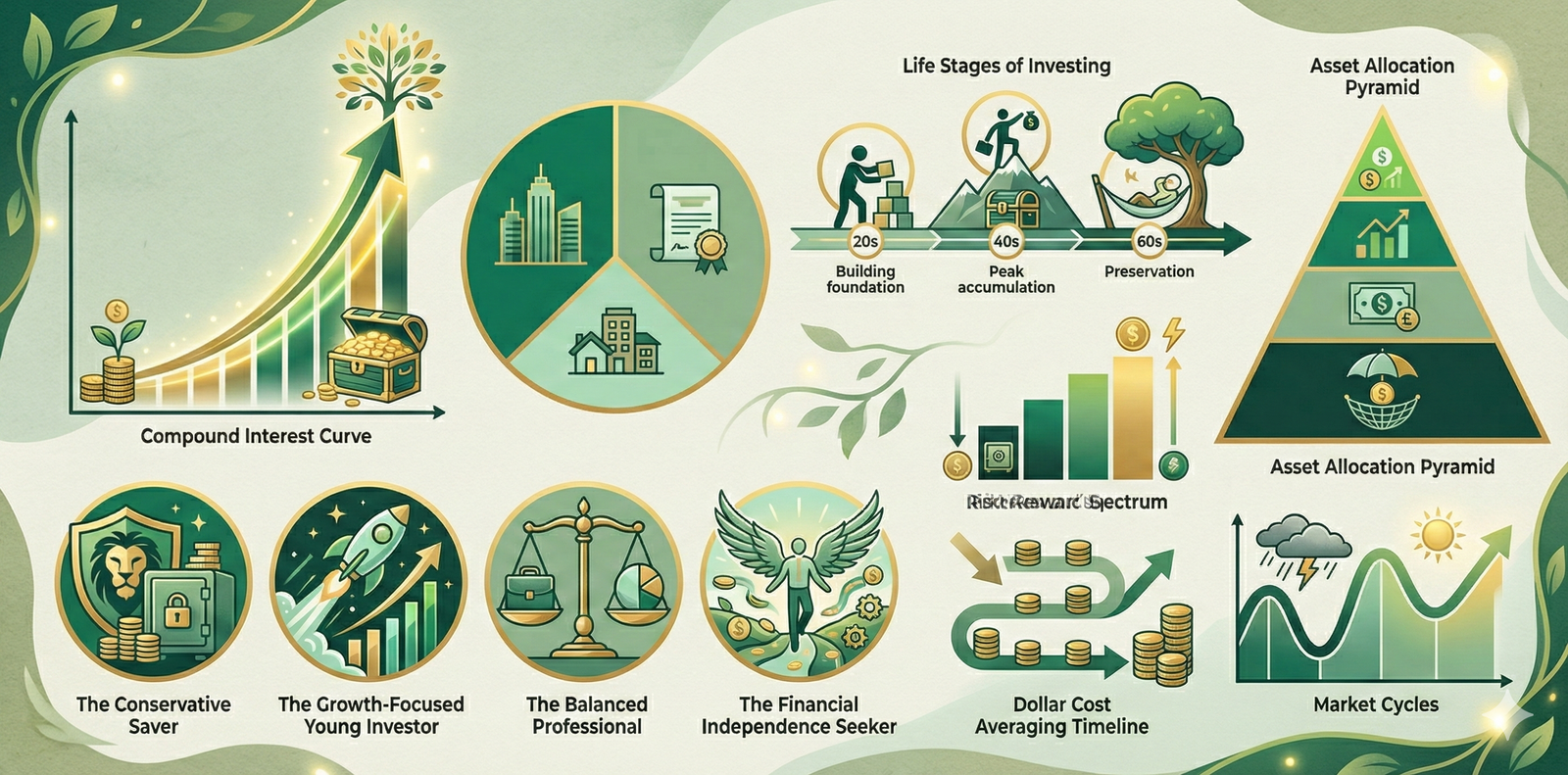
Most people believe investing requires thousands of dollars to start. In reality, modern brokerages let you invest just $1 through fractional shares, making wealth-building accessible to everyone.
Fear of making wrong investment decisions often paralyzes potential investors. But with the right framework and tools, anyone can learn to invest confidently and build lasting financial security.
What Is Investment?
Investment is purchasing financial assets—stocks, bonds, mutual funds, ETFs, or real estate—expecting them to increase in value or generate income over time. When you invest, you become a partial owner of companies (stocks), a lender to governments or corporations (bonds), or holder of tangible assets (real estate). The return on your investment comes from capital appreciation (price increases) and income (dividends or interest).
Not financial advice.
Investment differs fundamentally from gambling, despite both involving risk. Investing is based on research, strategy, and time horizon, while gambling relies on chance. Successful investing also requires understanding your personal risk tolerance, time horizon, and financial goals—factors that have nothing to do with luck.
Surprising Insight: Surprising Insight: Investors who hold diversified portfolios through market downturns typically achieve better long-term returns than those who sell during volatility. Time in the market beats timing the market.
Investment Risk-Return Spectrum
Visual comparison of different asset types arranged by risk level and potential returns, from cash to stocks.
🔍 Click to enlarge
Why Investment Matters in 2026
In 2026, investment has become essential for financial security due to inflation eroding savings and pensions proving insufficient for modern retirement. Inflation averages 2-3% annually, meaning cash sitting in savings accounts loses purchasing power. By investing in diversified assets, you combat inflation and build real wealth over time.
Investment opportunities have democratized significantly. Where investing once required tens of thousands of dollars and professional intermediaries, today's digital platforms let you start with $1 and manage your portfolio directly. This accessibility means wealth-building is no longer exclusive to the wealthy.
Technology and artificial intelligence are reshaping investment opportunities. According to 2026 market outlook reports, AI-driven sectors are growing aggregate net income 30% yearly versus just 3% for non-AI sectors. Understanding these trends helps you position your portfolio for long-term growth.
The Science Behind Investment
Behavioral finance research shows that emotion, not logic, drives most investment decisions. Fear and greed create market cycles: greed pushes investors to take excessive risks during bull markets, while fear triggers panic selling during downturns. Understanding your psychological biases helps you make rational decisions aligned with your long-term strategy.
Risk tolerance research reveals that initial investment experience shapes future behavior through risk perception. Beginners who experience losses may become overly cautious, while those who see early gains might take excessive risks. NIH-published research shows that your ability to tolerate risk depends on investment knowledge, experience, and time horizon—not just age or wealth.
Behavioral Biases Affecting Investments
Common psychological patterns that lead investors to make suboptimal decisions during different market conditions.
🔍 Click to enlarge
Key Components of Investment
Risk Tolerance Assessment
Risk tolerance is your ability and willingness to lose part of your investment for greater potential returns. It depends on three factors: investment knowledge (how well you understand markets), time horizon (years until you need the money), and financial situation (emergency fund and income stability). A 25-year-old with 40 years until retirement has higher risk tolerance than a 60-year-old needing income in 5 years.
Asset Allocation Strategy
Asset allocation involves dividing your portfolio among stocks (growth), bonds (income), and cash (stability). A common beginner rule: subtract your age from 110 to find your stock percentage. A 30-year-old might invest 80% stocks and 20% bonds; a 60-year-old might do 50% stocks and 50% bonds. Regular rebalancing keeps your allocation aligned with your risk tolerance.
Diversification Principle
Diversification spreads investment risk across different asset types, sectors, and geographies. Instead of betting everything on one stock, diversified investors own hundreds of companies through index funds or ETFs. Research shows that diversified portfolios achieve superior returns during market downturns compared to concentrated portfolios.
Time Horizon Planning
Your time horizon—how long before you need your money—determines appropriate investment risk. Short-term goals (less than 3 years) demand conservative strategies with bonds and cash. Medium-term goals (3-10 years) mix stocks and bonds. Long-term goals (10+ years) can weather volatility and benefit from stock-heavy portfolios. Matching your investments to your timeline reduces forced selling during downturns.
| Asset Class | Typical Return (Long-term) | Risk Level | Best For |
|---|---|---|---|
| Cash/Savings | 2-4% annually | Very Low | Emergency funds, short-term goals |
| Bonds | 3-5% annually | Low-Moderate | Income, capital preservation |
| Stocks | 8-10% annually | Moderate-High | Long-term growth, retirement |
| Real Estate | 6-8% annually | Moderate | Diversification, income generation |
How to Apply Investment: Step by Step
- Step 1: Assess your financial foundation: Build a 3-6 month emergency fund in a high-yield savings account before investing. This prevents forced selling during emergencies.
- Step 2: Determine your investment goals: Define what you're investing for (retirement, home, education) and when you'll need the money (time horizon).
- Step 3: Calculate your risk tolerance: Answer questions about comfort with losses, investment knowledge, and financial obligations. Online risk questionnaires help quantify this.
- Step 4: Choose your investment accounts: Select tax-advantaged accounts (401k, IRA, HSA) when available, then use a regular brokerage account for additional investing.
- Step 5: Select your asset allocation: Based on risk tolerance and time horizon, decide your stock/bond/cash split. Use online calculators for personalized guidance.
- Step 6: Open a brokerage account: Choose from platforms like Vanguard, Fidelity, or Charles Schwab that offer low fees and educational resources.
- Step 7: Start with index funds or ETFs: Low-cost, diversified funds tracking market indexes are ideal for beginners. They offer instant diversification with minimal decision-making.
- Step 8: Set up automatic contributions: Automate monthly investments through payroll deduction or automatic transfers. This removes emotion and builds wealth consistently.
- Step 9: Review your portfolio quarterly: Check whether your allocation still matches your goals. Rebalance if any asset class has drifted significantly.
- Step 10: Avoid common mistakes: Don't time the market, panic sell, or chase performance. Stay focused on your plan and ignore short-term noise.
Investment Across Life Stages
Young Adulthood (18-35)
Young adults have the greatest advantage: time. With 30-50 years until retirement, young investors can weather market volatility and benefit from compound growth. A $5,000 investment at age 25 can grow to $100,000+ by age 65 at historical stock market returns. Young adults should prioritize starting early with stock-heavy portfolios, using tax-advantaged retirement accounts like 401(k)s or Roth IRAs, and taking advantage of employer 401(k) matches when available.
Middle Adulthood (35-55)
Middle-aged investors typically have higher incomes but shorter time horizons until retirement (10-30 years). This phase calls for balanced portfolios with 60-70% stocks and 30-40% bonds. Middle-aged investors should maximize retirement account contributions, diversify beyond employer stock, and begin shifting gradually toward more conservative allocations. This is also the ideal time to review and adjust investment strategies as life circumstances change.
Later Adulthood (55+)
Pre-retirees and retirees (15+ years to retirement) should shift to capital preservation while maintaining growth. A 60-year-old might allocate 40-50% to stocks and 50-60% to bonds and stable income sources. Later adulthood requires careful planning for required minimum distributions, Social Security optimization, and withdrawal strategies. Consider consulting a financial advisor to coordinate investment, tax, and retirement income strategies.
Profiles: Your Investment Approach
The Hands-Off Investor
- Automated investment systems that require minimal maintenance
- Diversified index funds and target-date funds
- Clear quarterly statements showing progress
Common pitfall: Setting up investments but never reviewing them, missing opportunities to rebalance or optimize.
Best move: Use robo-advisors or target-date funds that automatically rebalance. Schedule quarterly 30-minute reviews. Automate all contributions.
The Active Researcher
- Educational resources and research tools for stock/fund analysis
- Community forums and discussion boards
- Regular market insights and investment updates
Common pitfall: Overconfidence from research leading to overtrading, concentrated bets, or excessive portfolio turnover.
Best move: Channel research interest into understanding asset allocation and sector trends, not individual stock picking. Limit portfolio changes to quarterly reviews.
The Goal-Focused Planner
- Clear connection between investments and specific financial goals
- Milestone tracking showing progress toward targets
- Strategic guidance on appropriate risk levels for different goals
Common pitfall: Combining different goals into one portfolio, mismatching investment risk to goal timeline.
Best move: Separate accounts by goal (retirement, home, education). Allocate conservatively for near-term goals, aggressively for distant goals.
The Socially Conscious Investor
- Investment options aligned with personal values and sustainability
- Impact measurement and ESG (Environmental, Social, Governance) metrics
- Community of like-minded investors
Common pitfall: Prioritizing values over diversification or returns, reducing long-term wealth accumulation.
Best move: Use ESG funds or sustainable investment options without sacrificing diversification. Balance values with financial goals.
Common Investment Mistakes
Panic selling during market downturns is the most costly investment error. History shows that investors who sold stocks during the 2008 financial crisis and 2020 pandemic missed the subsequent gains. Missing just the 10 best market days over 20 years cuts returns roughly in half. Market volatility is normal; staying invested through cycles is essential for long-term success.
Starting too late because of knowledge gaps or intimidation prevents many people from building wealth. Research shows that procrastination costs thousands in compound growth. The best investment strategy is one you'll actually follow. Start with simple, diversified index funds and increase knowledge over time rather than waiting for perfect knowledge.
Overconcentration in employer stock or single companies creates unnecessary risk. Employees who have retirement assets heavily weighted toward their employer's stock face double risk: job loss and investment loss occur simultaneously. Diversification across hundreds of companies and asset types reduces this concentration risk significantly.
Investment Decision Tree: Avoiding Common Pitfalls
Logic flow showing how to identify and avoid the most common investment mistakes through simple checkpoints.
🔍 Click to enlarge
Science and Studies
Recent research from leading institutions confirms that behavioral finance principles and evidence-based investment strategies significantly improve outcomes. Key studies demonstrate that diversification, regular contributions, and long-term commitment outperform active trading and timing attempts.
- NIH Research (2023): Investment experience influences novice behavior through risk perception. Initial losses can create lasting aversion, while early gains may encourage excessive risk-taking.
- Morgan Stanley 2026 Investment Outlook: AI stocks grew aggregate net income 30% annually (2023-2025) versus 3% for non-AI sectors, highlighting sector diversification importance.
- Vanguard Asset Allocation Study: Factor-based allocations outperformed sector allocations for longer investment horizons, supporting diversification across multiple factors.
- Morningstar Behavioral Finance Research: Investors who stuck with diversified portfolios through market cycles achieved returns 2-3% higher annually than those who attempted to time markets.
- Financial Planning Association: Risk tolerance assessment combining knowledge, experience, and time horizon predicts portfolio success better than age alone.
Your First Micro Habit
Start Small Today
Today's action: Transfer $10-50 to your investment account today and set up automatic monthly contributions of any amount—even $25/month compounds to $3,000+ within 10 years.
Tiny initial actions overcome psychological barriers and create momentum. Automatic contributions remove decision-making and ensure consistency without discipline or motivation. Small contributions prove to yourself that investing is achievable, making larger contributions feel natural over time.
Track your investment progress and get personalized AI coaching with our app.
Quick Assessment
What best describes your current investment experience?
Your experience level determines which resources and strategies work best. Beginners benefit from simple index funds; experienced investors can explore advanced strategies.
How do you typically respond to market volatility?
Your emotional response to market swings predicts investment success. Those who stay calm or see opportunities typically achieve better returns than those who panic.
What is your primary investment goal?
Your goal timeframe determines appropriate risk. Longer timeframes support stock-heavy portfolios; shorter timeframes require conservative strategies.
Take our full assessment to get personalized recommendations.
Discover Your Style →Next Steps
Start your investment journey by opening an account with a beginner-friendly brokerage like Vanguard, Charles Schwab, or Fidelity. These platforms offer zero account minimums, fractional shares, educational resources, and low fees. Complete a risk tolerance assessment on their websites to determine your appropriate asset allocation.
Choose simple, diversified index funds or target-date funds matching your risk tolerance and time horizon. Automate monthly contributions even if small—$25 monthly compounds to meaningful wealth. Review quarterly but avoid emotional reactions to normal market volatility. As your knowledge grows, gradually explore additional investments aligned with your goals and values.
Get personalized guidance with AI coaching.
Start Your Journey →Research Sources
This article is based on peer-reviewed research and authoritative sources. Below are the key references we consulted:
Related Glossary Articles
Frequently Asked Questions
How much money do I need to start investing?
You can start with as little as $1-10 through fractional share investing. Modern brokerages like Fidelity, Charles Schwab, and Vanguard offer zero-minimum account openings and fractional shares, eliminating the wealth barrier.
Is investing the same as gambling?
No. Investing is research-based decision-making over long timeframes with strategies and risk management. Gambling relies on chance with outcomes largely outside your control. Investing builds wealth; gambling transfers it.
What's the difference between stocks and bonds?
Stocks represent partial ownership in companies with growth potential but higher volatility. Bonds are loans to governments or corporations offering predictable income but lower returns. Diversified portfolios combine both for balanced growth and stability.
Should I try to time the market?
No. Research consistently shows that investors attempting to time the market underperform those who invest consistently through all market conditions. Time in the market beats timing the market.
How often should I check my investment portfolio?
Check quarterly (4 times yearly) during scheduled reviews. More frequent checking increases emotional reactions to normal volatility. Less frequent checking risks missing important rebalancing opportunities.
Take the Next Step
Ready to improve your wellbeing? Take our free assessment to get personalized recommendations based on your unique situation.
- Discover your strengths and gaps
- Get personalized quick wins
- Track your progress over time
- Evidence-based strategies