Cognitive
Cognitive flexibility is your brain's ability to switch between different thoughts, adapt to new information, and adjust your perspective when circumstances change. It's the mental agility that helps you solve problems creatively, navigate challenges with resilience, and maintain emotional wellbeing. In our fast-changing world, developing stronger cognitive flexibility directly enhances happiness, reduces anxiety, and strengthens your capacity to thrive. People with higher cognitive flexibility report greater life satisfaction, better stress management, and improved relationships. This mental skill isn't fixed—it grows stronger with practice and intention.
Imagine facing a setback at work. Instead of getting stuck in one negative interpretation, cognitive flexibility lets you consider multiple perspectives, find hidden opportunities, and move forward productively. This mental agility transforms obstacles into growth moments.
The science shows that people who develop cognitive flexibility experience higher emotional resilience, better decision-making, and deeper satisfaction with life. Your brain's capacity to shift mental sets becomes your greatest asset for happiness.
What Is Cognitive?
Cognitive flexibility refers to the executive function that enables you to mentally shift between different tasks, rules, strategies, and perspectives. It's your brain's capacity to adapt thinking patterns in response to changing situations, switch between multiple concepts, and generate creative solutions when your usual approaches don't work. This mental skill encompasses set shifting, mental flexibility, and cognitive adaptation—all describing your ability to be mentally agile rather than rigid.
Not medical advice.
Cognitive flexibility operates through interconnected brain networks that span your prefrontal cortex, anterior cingulate, and parietal regions. These neural pathways strengthen through practice, learning, and mindful effort. When you deliberately practice shifting perspectives, learning new skills, or solving problems from different angles, you're physically rewiring your brain to become more adaptable. This neural plasticity means cognitive flexibility isn't a fixed trait—it's a skill you can develop at any life stage.
Surprising Insight: Surprising Insight: Life satisfaction prevents decline in working memory and processing speed across 23 years of aging. People who maintain high life satisfaction experience slower cognitive decline, suggesting happiness protects brain health.
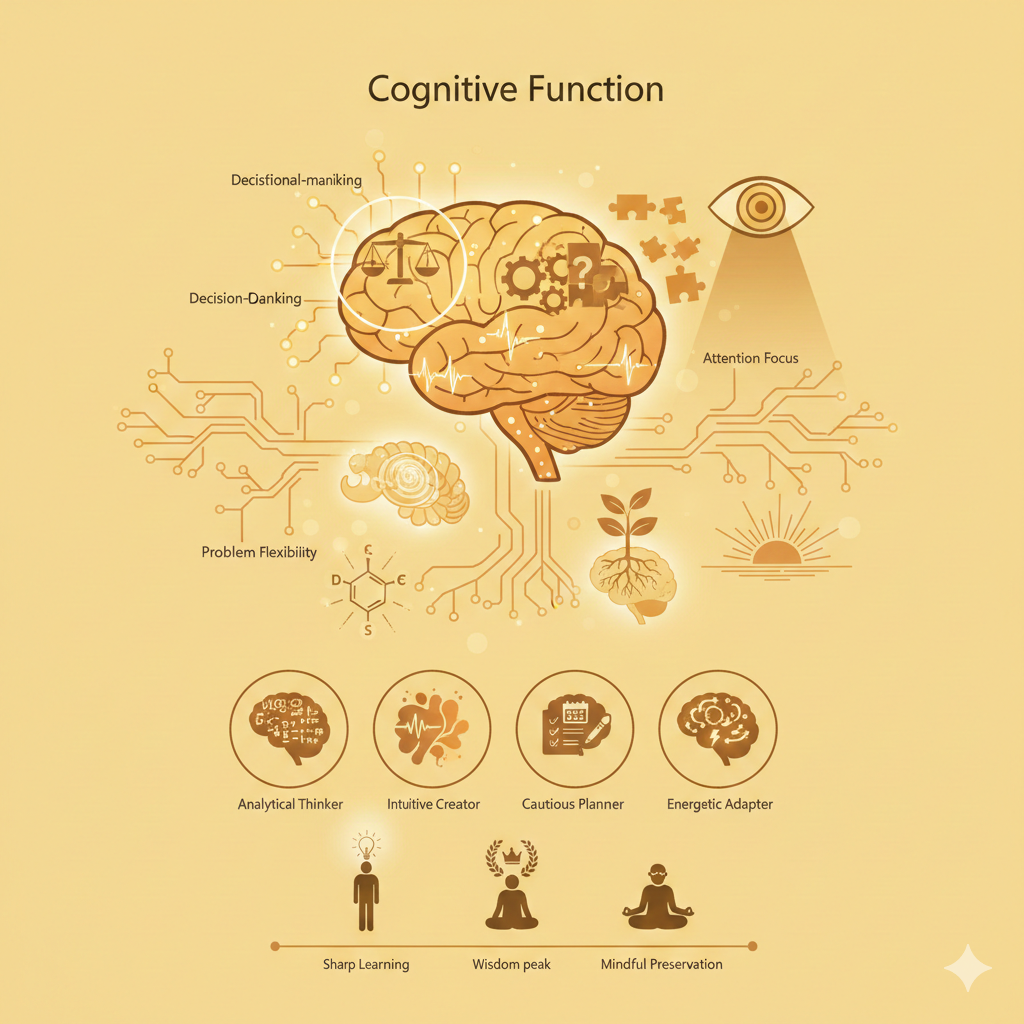
How Cognitive Flexibility Works
The neural pathways and cognitive processes that enable mental flexibility and adaptive thinking
🔍 Click to enlarge
Why Cognitive Matters in 2026
In 2026, cognitive flexibility has become essential for wellbeing in an era of constant change, information overload, and rapid career transitions. The World Happiness Report 2025 reveals that adaptability and resilience are key determinants of life satisfaction across all demographics. People with stronger cognitive flexibility navigate workplace stress better, maintain healthier relationships, and report higher overall life satisfaction. As technology evolves and career paths shift unpredictably, your mental adaptability determines whether change feels threatening or like opportunity.
Research from 2024-2025 demonstrates that cognitive flexibility serves as a protective factor against anxiety, depression, and burnout. Adults who practice mental flexibility report experiencing greater joy, deeper connection in relationships, and more resilience when facing setbacks. The connection between flexible thinking and happiness is bidirectional—as your cognitive flexibility improves, your life satisfaction increases, which then further enhances your mental adaptability. This creates a positive feedback loop that strengthens both your mental health and your capacity for contentment.
Additionally, cognitive flexibility acts as a resilience factor that improves your immune function, sleep quality, stress management, and overall physical health. People who maintain flexible thinking experience better mental clarity, enhanced creativity, and improved decision-making. In professional settings, cognitive flexibility distinguishes high performers who can pivot strategies, learn quickly, and contribute innovative solutions. At home, mental adaptability strengthens communication and helps relationships weather challenges.
The Science Behind Cognitive
Neuroscience research reveals that cognitive flexibility relies on multiple brain regions working in coordination. The prefrontal cortex handles executive decision-making, the anterior cingulate detects conflicts between perspectives, and the parietal cortex processes information integration. When you practice mental shifting—deliberately viewing situations from different angles—these brain regions strengthen their connections. This neural adaptation means your brain becomes literally more flexible with practice. Functional brain imaging studies show that people with higher cognitive flexibility display more efficient activation patterns in these networks, suggesting that mental flexibility is energy-efficient and sustainable.
A 2025 study from the NIH examining bidirectional associations between life satisfaction and cognitive function found that at the within-person level, declines in life satisfaction predict subsequent declines in cognitive function, and vice versa. This research demonstrates that maintaining happiness directly protects your cognitive health. The study tracked participants over 23 years and found that life satisfaction prevents decline in working memory, spatial cognition, and processing speed. People who prioritize wellbeing experience better cognitive aging, while those who develop stronger cognitive flexibility report higher life satisfaction and emotional resilience.
The Cognitive Flexibility-Happiness Cycle
How cognitive flexibility and life satisfaction strengthen each other over time through positive feedback mechanisms
🔍 Click to enlarge
Key Components of Cognitive
Mental Set Shifting
Mental set shifting is your ability to switch between different tasks, rules, or mental frameworks. When you transition from work mode to family time, you're shifting mental sets. Strong set shifters adapt quickly to new rules, learn new software efficiently, and pivot strategies when circumstances change. This component develops through deliberate practice switching between different types of thinking—analytical, creative, empathetic, logical. People with strong mental set shifting experience less cognitive fatigue because their brains transition smoothly between contexts.
Perspective Taking
Perspective taking involves seeing situations from multiple viewpoints beyond your natural bias. It's the cognitive capacity that enables empathy, conflict resolution, and creative problem-solving. When you ask 'how would others view this situation?', you activate perspective-taking circuits in your brain. This component directly improves relationship quality, reduces misunderstandings, and enables you to find innovative solutions that benefit multiple stakeholders. High perspective takers report stronger social connections and deeper satisfaction in their relationships.
Adaptive Response Generation
Adaptive response generation is your ability to generate new solutions and modify behavior based on feedback. When your first approach doesn't work, you can quickly generate alternatives without getting stuck in frustration. This component prevents rumination, enables learning from failure, and supports resilience. People with strong adaptive response generation experience setbacks as temporary and solvable rather than catastrophic. They maintain optimism and take productive action rather than becoming paralyzed by obstacles.
Attention Regulation
Attention regulation is your capacity to deliberately direct your focus toward what matters and away from distractions or unhelpful thoughts. Strong attention regulation enables you to concentrate on goals, manage anxious thoughts, and stay present during difficult emotions. This component prevents overthinking, reduces anxiety spirals, and enables flow states. People with strong attention regulation maintain better emotional equilibrium and experience more moments of contentment throughout their days.
| Component | Definition | Life Impact |
|---|---|---|
| Mental Set Shifting | Ability to switch between different tasks and mental frameworks | Faster learning, easier transitions, reduced cognitive fatigue |
| Perspective Taking | Seeing situations from multiple viewpoints | Better relationships, improved empathy, creative solutions |
| Adaptive Response | Generating new solutions based on feedback | Enhanced resilience, learning from failure, optimism |
| Attention Regulation | Directing focus toward important information | Better focus, reduced anxiety, more contentment |
How to Apply Cognitive: Step by Step
- Step 1: Start your morning with perspective-taking practice: Before responding to emails or messages, pause and ask 'What might this person need from me? What challenges might they face?' This activates your perspective-taking circuits and sets a more empathetic tone for your day.
- Step 2: Practice deliberate mental shifting during transitions: When moving between activities, spend 30 seconds consciously transitioning your mental state. Notice what you're leaving behind mentally and what you're moving toward. This strengthens your mental set shifting capacity.
- Step 3: Reframe one challenge daily using the three-perspective approach: Pick one frustration or problem. Describe it from your perspective, from a concerned friend's perspective, and from a neutral observer's perspective. This immediately expands your thinking flexibility.
- Step 4: Use the 'what else could this mean?' technique: When you notice a negative thought or interpretation, ask yourself 'What else could this situation mean?' Generate at least three alternative interpretations. This prevents cognitive rigidity and reduces anxiety.
- Step 5: Learn something new in a different format weekly: If you normally read, watch a video or podcast. If you normally watch, try hands-on learning. Different learning formats strengthen different neural pathways and enhance overall cognitive flexibility.
- Step 6: Practice constraint-removal thinking: Take a problem you're facing and ask 'If I removed constraint X, how would I solve this differently?' Try removing different constraints each time. This generates creative solutions and strengthens adaptive thinking.
- Step 7: Engage in deliberate disagreement practice: Find a credible perspective you disagree with and genuinely try to understand its logic and reasoning. You don't need to agree, but this mental exercise strengthens perspective flexibility dramatically.
- Step 8: Use the 'yes, and...' technique in conversations: Instead of 'but' which dismisses ideas, try 'yes, and...' which builds on them. This shifts your brain toward synthesis instead of opposition and improves your flexibility in collaborative situations.
- Step 9: Practice attention shifting meditation: For 5 minutes, deliberately shift your attention between five anchors: sounds, sensations, thoughts, emotions, and breath. This directly trains your attention regulation and cognitive flexibility circuits.
- Step 10: Reflect weekly on a mistake using growth framing: Each week, identify something you got wrong and write about what it taught you. This trains your brain to view mistakes as feedback rather than failure, strengthening your adaptive response capacity.
Cognitive Across Life Stages
Young Adulthood (18-35)
Young adults benefit enormously from intentional cognitive flexibility practice because your brain is still forming habits and neural pathways. In this stage, cognitive flexibility helps you navigate multiple life changes—career exploration, relationship development, and identity formation. Young adults who develop strong cognitive flexibility adapt better to job transitions, form healthier relationships, and experience less anxiety about uncertainty. Building these habits now creates lifelong benefits. The key practice for this stage is exploring different perspectives through travel, diverse friendships, and trying new activities that challenge your default thinking patterns.
Middle Adulthood (35-55)
Middle adults often face complexity—managing careers, relationships, and family responsibilities simultaneously. Cognitive flexibility becomes essential for preventing rigidity and maintaining wellbeing during high-stress periods. Middle adults who strengthen cognitive flexibility navigate career changes more successfully, manage relationship conflicts more effectively, and experience less burnout. This life stage offers particular benefits from deliberate perspective-taking practice, learning new skills in unfamiliar domains, and reframing challenges as opportunities. The mental flexibility developed in this stage significantly improves your trajectory toward aging well.
Later Adulthood (55+)
Older adults who maintain cognitive flexibility experience dramatically better cognitive aging, stronger life satisfaction, and better physical health outcomes. The 2025 NIH research on life satisfaction and cognitive function specifically tracked adults aging over 23 years and found that those maintaining flexible thinking prevented decline in memory, processing speed, and spatial cognition. Later adulthood is the ideal time to focus on cognitive flexibility as a brain-health practice. Social engagement, learning new skills, and deliberately practicing perspective-taking all strengthen cognitive function while directly improving life satisfaction and emotional resilience in this stage.
Profiles: Your Cognitive Approach
The Analytical Thinker
- Permission to consider non-logical factors like emotions and relationships
- Practice with perspective-taking and empathetic understanding
- Deliberate exposure to ambiguous situations without immediate problem-solving
Common pitfall: Over-analysis and difficulty adjusting strategy when logic fails
Best move: Balance analysis with intuition by asking 'what does this situation need emotionally?' before optimizing logically
The Intuitive Creator
- Structure for testing ideas before full commitment
- Practice with systematic analysis of different perspectives
- Deliberate attention to feedback and adaptation
Common pitfall: Following intuition without testing, leading to repeated patterns
Best move: Combine creativity with systematic reflection by asking 'what data confirms or contradicts my intuition?'
The Cautious Planner
- Psychological safety to experiment without perfect planning
- Permission to make mistakes as learning opportunities
- Deliberate exposure to uncertainty managed in small doses
Common pitfall: Over-preparation and difficulty adapting when plans change
Best move: Practice flexible planning by asking 'what's the minimum viable step I can take to learn from this?'
The Energetic Adapter
- Depth and consistency alongside flexibility
- Practice with commitment to chosen directions
- Deliberate reflection on patterns across your adaptations
Common pitfall: Constant shifting without building depth or completing projects
Best move: Direct your flexibility strategically by asking 'what's worth committing to despite obstacles?' before adapting
Common Cognitive Mistakes
The first common mistake is confusing cognitive flexibility with flakiness or lack of commitment. True cognitive flexibility involves strong commitment with adaptive methods—you hold your goals firmly while adjusting your strategies fluidly. Flakiness means changing goals constantly without strategic reason. Strong cognitive flexibility means saying 'I'm committed to this outcome AND I'm flexible about the path to get there.' The best performers combine clarity about what matters with flexibility about how to achieve it.
The second mistake is using perspective-taking as an excuse for avoidance. 'I can see their perspective' shouldn't prevent you from having boundaries or taking action. Cognitive flexibility means understanding multiple perspectives AND deciding what aligns with your values. Strong cognitive flexibility involves understanding different viewpoints, then choosing consciously based on your principles. People who develop this balance find it easier to maintain healthy boundaries, make difficult decisions, and take decisive action when needed.
The third mistake is practicing cognitive flexibility only during crises. Like physical fitness, cognitive flexibility requires consistent practice during calm periods to be available during stress. The people who adapt most successfully to challenges are those who practiced mental flexibility daily when stakes were low. Building flexibility during normal times means your brain has strong neural pathways to access during emergencies.
Common Cognitive Mistakes to Avoid
Three key mistakes that undermine cognitive flexibility development and how to correct them
🔍 Click to enlarge
Science and Studies
Recent research demonstrates robust connections between cognitive flexibility and wellbeing outcomes. Multiple longitudinal studies track how flexible thinking predicts life satisfaction, resilience, and emotional health. The emerging consensus shows that cognitive flexibility is both trainable and essential for thriving in modern life.
- 2025 ELSA Study: Wellbeing and memory function show bidirectional associations over years of aging, with higher initial wellbeing predicting higher subsequent cognitive scores and vice versa.
- 2024 Psychological Medicine Research: Cognitive flexibility is a resilience factor that improves problem-solving and impacts stress sensitivity, sleep quality, exercise habits, immune function, and pain processing.
- 2025 PMC Study: Cognitive flexibility across the lifespan is supported by large-scale functional brain networks spanning lateral and orbital frontoparietal, midcingulo-insular, and frontostriatal regions.
- 2024-2025 Life Satisfaction Research: Life satisfaction prevents cognitive decline in working memory, spatial cognition, and processing speed across 23-year follow-ups, demonstrating protective effects of wellbeing on brain aging.
- 2025 Nature Study: Psychological flexibility and cognitive-affective processes in young adults' daily lives show that flexible thinking reduces emotional reactivity and increases effective coping during stress.
Your First Micro Habit
Start Small Today
Today's action: When you face a frustration today, pause and ask yourself 'What else could this mean?' Generate three alternative interpretations before responding. This single practice shifts your neural pathways toward flexibility.
This micro habit directly activates your perspective-taking circuits and interrupts rigid thinking patterns. By practicing during small frustrations, you build mental flexibility that's available during bigger challenges. The 60-second investment trains your brain to access multiple interpretations automatically, which is the foundation of cognitive flexibility.
Keep quitting habit apps after a missed day? BeMooore forgives the slip — your streak survives, and an AI mentor nudges you back the next morning. Free on iOS.
Quick Assessment
When your plans change unexpectedly, how do you typically respond?
Your answer reveals your current cognitive flexibility level and shows whether you naturally embrace change or experience resistance. This awareness is the first step toward intentional development.
How often do you deliberately consider perspectives different from your own?
This reveals your perspective-taking frequency, which is the strongest predictor of relationship satisfaction and successful conflict resolution in research.
When facing a setback, which response describes you best?
Your adaptive response pattern shows your resilience level and predicts how much cognitive flexibility you can access during challenging times.
Take our full assessment to get personalized recommendations.
Discover Your Style →Next Steps
Your next step is to choose one practice from the 10-step guide above and commit to daily practice for the next week. Pick the practice that resonates most with your personality and current challenges. Whether you choose the 'what else could this mean?' technique, perspective-taking exercises, or deliberate disagreement practice, consistency matters more than intensity. Seven days of daily practice creates noticeable changes in your mental flexibility and opens new possibilities in how you respond to situations.
Beyond this week, consider tracking your cognitive flexibility development. Notice when you catch yourself in rigid thinking, when you successfully reframe a situation, when you adapt quickly to unexpected changes. This awareness reinforces your neural pathways and motivates continued practice. As your cognitive flexibility strengthens, you'll naturally experience more resilience, better relationships, improved decision-making, and deeper life satisfaction.
Get personalized guidance with AI coaching.
Start Your Journey →Research Sources
This article is based on peer-reviewed research and authoritative sources. Below are the key references we consulted:
Related Glossary Articles
Frequently Asked Questions
Can I develop cognitive flexibility if I'm naturally rigid or analytical?
Absolutely. Cognitive flexibility is a trainable skill, not a fixed trait. Your brain demonstrates neuroplasticity throughout life, meaning you can develop new thinking patterns at any age. Even highly analytical people benefit from deliberate perspective-taking practice, learning in unfamiliar domains, and exposure to different thinking styles. The neural pathways strengthen with consistent practice.
How long does it take to notice improvements in cognitive flexibility?
Many people notice initial changes within 2-3 weeks of consistent daily practice. You might find yourself catching rigid thoughts sooner, generating alternatives more quickly, or adapting to surprises with less stress. Significant improvements in decision-making and relationship quality typically emerge within 4-6 weeks of dedicated practice.
Is cognitive flexibility the same as being indecisive?
No. Cognitive flexibility is about adaptability in methods while maintaining clear values and goals. Indecisiveness is avoidance or lack of clarity. Strong cognitive flexibility means you decide based on your values, then flexibly adjust how you pursue those goals. You make decisions quickly, then adapt your approach based on feedback—not second-guess your decisions constantly.
How does cognitive flexibility connect to stress management and anxiety?
Cognitive flexibility is one of the strongest protections against anxiety. Anxiety often stems from rigid thinking patterns—assuming the worst interpretation, replaying scenarios, seeing limited options. Cognitive flexibility breaks these patterns by generating alternative interpretations, finding multiple solutions, and preventing rumination. Research shows people with stronger cognitive flexibility experience significantly lower anxiety and greater stress resilience.
Can I practice cognitive flexibility on my own or do I need professional help?
Most people develop significant cognitive flexibility through self-directed practice using the techniques in this article. Daily practice with perspective-taking, reframing, and alternative-generation exercises produces measurable results. Professional support from a therapist specializing in cognitive-behavioral or acceptance-commitment approaches can accelerate development, especially if you're working with anxiety disorders or deeply ingrained thought patterns.
Take the Next Step
Ready to improve your wellbeing? Take our free assessment to get personalized recommendations based on your unique situation.
- Discover your strengths and gaps
- Get personalized quick wins
- Track your progress over time
- Evidence-based strategies