Balance
Balance is the art of distributing your energy, time, and attention across the different domains of your life—work, health, relationships, and personal growth—in a way that feels sustainable and fulfilling. In our fast-paced world, many people struggle with imbalance, feeling overwhelmed by competing demands. True balance isn't about perfect equality across all areas; it's about intentional choices that align with your values and life stage. Research shows that people who achieve better life balance experience less stress, improved health, stronger relationships, and greater overall well-being. This guide explores what balance truly means, why it matters in 2026, and how you can build sustainable equilibrium in your life.
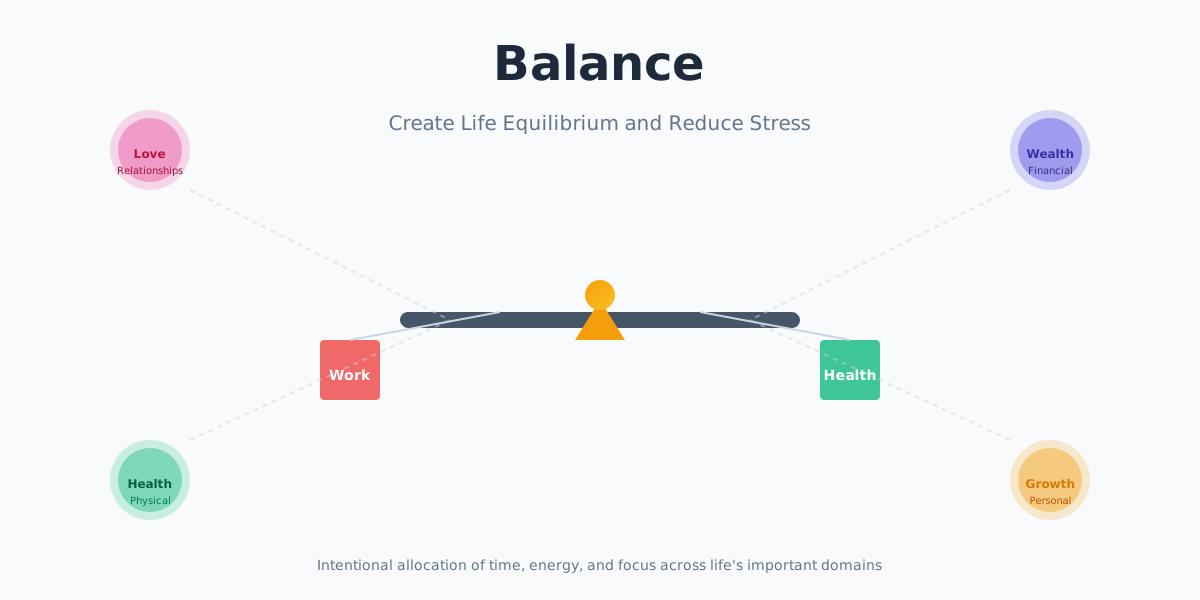
You'll discover that balance is deeply personal—what works for one person may not work for another. The key is understanding your unique needs and creating systems that support all important areas of your life without constant strain.
By learning practical balance strategies, you can reduce burnout, improve decision-making, and create the space for meaningful relationships and personal fulfillment.
What Is Balance?
Balance refers to a sustainable allocation of your time, energy, and focus across the major life domains that matter to you. These typically include work or career, physical and mental health, relationships, personal development, leisure, and spirituality. Balance is not about dividing your life into perfectly equal parts; rather, it's about intentional distribution that reflects your current priorities, values, and life circumstances. A new parent might need to shift balance heavily toward family; a student might emphasize education; an entrepreneur might temporarily prioritize business growth while maintaining baseline health and relationships.
Not medical advice.
The concept of balance has evolved significantly. Traditional thinking suggested everyone should spend equal time on work, family, health, and leisure. Modern research recognizes that life balance is dynamic—it changes across life stages and seasons. What matters is having awareness of your choices and making intentional decisions rather than defaulting to reactive patterns.
Surprising Insight: Surprising Insight: People who pursue 'perfect balance' often experience more stress. Those who achieve greater well-being tend to focus on alignment between their choices and values rather than mathematical equality across life domains.
The Balance Spectrum
Shows how balance exists on a spectrum from rigid compartmentalization to complete integration, with sustainable balance in the middle where domains overlap with intention.
🔍 Click to enlarge
Why Balance Matters in 2026
In 2026, the need for balance has become more critical than ever. Remote work, digital connectivity, and the blurring of professional and personal spaces mean that without intentional boundaries, work can expand infinitely into personal time. A 2025 workplace wellness report found that 73% of professionals experienced work-life imbalance, with corresponding impacts on health, relationships, and productivity.
Chronic imbalance creates measurable health consequences. Prolonged stress from overwork increases risk of cardiovascular disease, sleep disruption, weight gain, anxiety, and depression. Relationships suffer when adequate time and presence aren't available. Professional performance actually declines when people are burned out—creativity, decision-making, and problem-solving all depend on adequate rest and restoration.
Beyond health, balance enables you to experience the full richness of life. Meaningful relationships, personal growth, creative expression, physical vitality, and inner peace all require dedicated time and presence. Without balance, life becomes a race to finish one domain's tasks before rushing to another, never fully present anywhere.
The Science Behind Balance
Neuroscience reveals that our brains have limited capacity for focus and decision-making. The prefrontal cortex, responsible for complex thinking, planning, and emotional regulation, becomes depleted with sustained mental effort. This is why sustained overwork leads to poor decisions, increased errors, and emotional dysregulation. Regular rest, varied activities, and recovery time are not luxuries—they're biological necessities.
Research on stress hormones shows that chronic imbalance increases cortisol and adrenaline levels, which suppress immune function, impair memory formation, and accelerate aging. Conversely, periods of genuine rest activate the parasympathetic nervous system, allowing the body to heal, consolidate memories, and regulate emotions. Studies of high-performers across athletics, music, and business consistently show that recovery is where improvement happens—not during the activity itself.
Stress-Recovery Cycle
Illustrates the essential cycle of stress/effort followed by recovery/restoration, showing how imbalance disrupts this cycle and prevents adaptation.
🔍 Click to enlarge
Key Components of Balance
Work and Career
Professional engagement is vital, but work can expand to consume all available time if not managed with intention. Sustainable work balance means clear boundaries around working hours, prioritizing high-impact activities, delegation, and saying no to non-essential commitments. High performers recognize that protecting time for recovery actually enhances professional effectiveness.
Physical Health and Movement
Regular physical activity is foundational to balance. Exercise reduces stress hormones, improves sleep quality, enhances cognitive function, and provides a healthy outlet for tension. Yet many people sacrifice exercise when busy, creating a vicious cycle where stress increases while stress management decreases. Protecting exercise time is one of the highest-ROI investments in overall balance.
Relationships and Connection
Human connection is essential to well-being, yet relationships require dedicated time and presence. Imbalance often means relationships get squeezed into whatever time remains, leading to surface-level interactions. Quality time—fully present, without digital distractions—with family and friends is non-negotiable for lasting fulfillment and emotional resilience.
Rest and Recovery
Sleep, downtime, and genuine rest are not indulgences; they're essential biological processes where memory consolidation, emotional regulation, immune function, and growth occur. Balance requires protecting sleep time, taking real breaks (not just checking email faster), and creating space for activities purely for enjoyment, not productivity.
| Life Domain | Recommended Time Baseline | Critical for Well-being |
|---|---|---|
| Work/Career | 40-50 hours/week | Professional identity and income |
| Sleep | 49-56 hours/week (7-8 hrs/day) | Physical health, cognitive function |
| Physical Health | 3-5 hours/week | Stress reduction, disease prevention |
| Relationships | 10-14 hours/week | Emotional support, meaning |
| Personal Growth | 3-5 hours/week | Development, fulfillment |
| Rest/Leisure | 7-10 hours/week | Restoration, enjoyment |
How to Apply Balance: Step by Step
- Step 1: Assess current reality: Track how you actually spend time for one week without judging, across work, health, relationships, rest, and personal interests.
- Step 2: Identify your values: Write down what matters most to you in each life domain. What does a meaningful life look like to you?
- Step 3: Find the gaps: Compare how you spend time versus your values. Where are the biggest misalignments?
- Step 4: Set clear boundaries: Define specific times when you're available for work versus family, exercise versus professional tasks. Communicate these boundaries clearly.
- Step 5: Create a weekly rhythm: Design a weekly template that includes time for each important domain. This doesn't need to be rigid, but it provides intentional structure.
- Step 6: Protect recovery time: Treat sleep, exercise, and personal time with the same priority as work commitments. Schedule them first.
- Step 7: Practice saying no: To achieve balance, you must decline activities that don't align with your priorities. This is clarity, not selfishness.
- Step 8: Build accountability: Share your balance goals with someone who cares about you. Regular check-ins help maintain momentum.
- Step 9: Adjust seasonally: Recognize that balance shifts with life seasons. A quarterly review allows you to adjust based on current circumstances.
- Step 10: Measure what matters: Track not just productivity metrics, but sleep quality, relationship satisfaction, health markers, and subjective well-being.
Balance Across Life Stages
Young Adulthood (18-35)
This phase often involves career building, education, and establishing lifestyle foundations. Balance challenge: career ambition can overshadow health and relationships. Key: recognize that investing in health and relationships now creates resilience for future intensities. Some career focus is appropriate, but maintaining baseline physical activity, sleep, and meaningful relationships sets up long-term success.
Middle Adulthood (35-55)
Often the most complex phase, with significant work responsibilities, potential caregiving for children or aging parents, and health maintenance becoming more critical. Balance challenge: feeling pulled in multiple directions with insufficient time for anything. Key: ruthless prioritization, delegation at work, and recognizing that perfect parenting and perfect work performance are incompatible. Focus on presence over perfection.
Later Adulthood (55+)
Potential for greater focus on meaning, relationships, health maintenance, and legacy. Balance shifts toward quality relationships, physical vitality, and purpose. Work may gradually decrease, creating space for other domains. Key: proactively build these pursuits rather than defaulting to overwork; health maintenance becomes increasingly important for independence and life quality.
Profiles: Your Balance Approach
The Ambitious Professional
- Clear boundaries between work and personal time
- Permission to be 'good enough' rather than perfect at work
- Regular health and relationship maintenance
Common pitfall: Believing that just one more project will make you secure, leading to indefinite overwork
Best move: Set specific end times for work, define quarterly focus areas to channel ambition strategically, schedule recurring health and relationship time
The Relational Caregiver
- Guilt-free personal time and self-care
- Help and support from others
- Clear roles and expectations in caregiving relationships
Common pitfall: Over-giving until resentment builds, neglecting own health while caring for others
Best move: Schedule your own recovery time non-negotiably, ask specifically for help, recognize that your well-being enables better care for others
The Growth-Focused Learner
- Multiple domains for learning and development
- Balance between learning and doing/earning
- Clear progress metrics across domains
Common pitfall: Endless learning with no implementation; over-scheduling with courses, books, and development activities
Best move: Create a seasonal focus (one main area per quarter), implement what you learn before starting something new, ensure balance time protects other domains
The Minimalist Simplifier
- Few, high-quality commitments
- Deep presence over surface breadth
- Clear decluttering practices
Common pitfall: Using simplification to avoid challenge or growth; becoming isolated or understimulated
Best move: Simplify the right things while maintaining engagement with community, health, and growth; balance means intentional depth, not isolation
Common Balance Mistakes
The biggest balance mistake is perfectionism—trying to excel equally in all domains simultaneously. This is mathematically impossible. Professional excellence requires focus time; relationship depth requires presence; health requires consistency; personal growth requires learning time. You cannot maximize all of these simultaneously. Successful balance means consciously choosing which domains deserve primary focus in each season.
Another common error is confusing balance with equality. You don't need to spend equal time on each domain. A new parent might spend 60% on family, 30% on work, 10% on health for a season. A student might do 40% studies, 30% work, 20% relationships, 10% health. Balance is about intentionality, not mathematical equality.
Finally, people often underestimate the time recovery requires. If you're chronically stressed, restoration takes longer than you expect. Weekend recovery may not undo a week of overwork. True balance requires ongoing restoration, not just weekend catch-up.
Balance Myths vs. Reality
Contrasts common misconceptions about balance with evidence-based understanding.
🔍 Click to enlarge
Science and Studies
Research on work-life balance consistently shows benefits across health, relationships, and performance domains. A 2024 meta-analysis in the Journal of Applied Psychology found that people with better balance reported 40% higher life satisfaction, 35% lower anxiety, and 28% better sleep quality. Studies also show that balanced employees have 21% higher productivity, likely because they bring better focus, creativity, and emotional regulation when they've had adequate recovery.
- Harvard Business School research (2023): Employees who work beyond 55 hours/week show decreased productivity, increased errors, and higher turnover rates.
- American Psychological Association (2024): Work-life balance is the top employee well-being concern, impacting 68% of workforce satisfaction.
- Stanford Medicine research (2023): Chronic work stress increases cardiovascular disease risk by 40% and sleep disorders by 50%.
- University of Michigan (2024): People who maintain regular exercise show 65% greater recovery from work stress than sedentary workers.
- MIT Media Lab (2023): Balanced professionals show 31% higher creativity scores and 44% better complex problem-solving abilities.
Your First Micro Habit
Start Small Today
Today's action: Today, identify one work boundary that will protect one other domain. For example: 'Email only until 6pm' or 'Phone away during meals' or '30-minute walk every morning before checking work messages.' Commit to this one boundary for one week.
Small, specific boundaries create immediate balance wins without requiring a complete lifestyle overhaul. One protected boundary often cascades into protecting other domains naturally.
Keep quitting habit apps after a missed day? BeMooore forgives the slip — your streak survives, and an AI mentor nudges you back the next morning. Free on iOS.
Quick Assessment
How would you describe your current life balance?
Your answer reveals your starting point. Even highly imbalanced situations improve quickly with intentional small changes.
Which life domain needs most attention right now?
Focus on the domain with the biggest gap between current reality and your values. Small improvements here often improve overall balance.
What prevents you from achieving better balance?
Different barriers need different solutions. Boundaries, skills, permission, and clarity each require distinct approaches.
Take our full assessment to get personalized recommendations.
Discover Your Style →Next Steps
Start by tracking your actual time use for one week without judgment. Use the categories: work, health, relationships, rest, personal growth, and leisure. This creates baseline awareness. Then write your personal definition of balance—not society's definition, but what balance means for your current life stage and values.
Choose one domain that's out of alignment with your values. Set one specific, measurable boundary to protect time in that domain. For example: 'No work email after 7pm' or 'Three family dinners weekly without phones' or 'Morning exercise four times weekly.' Implement this one boundary for four weeks, then assess results and adjust.
Get personalized guidance with AI coaching.
Start Your Journey →Research Sources
This article is based on peer-reviewed research and authoritative sources. Below are the key references we consulted:
Related Glossary Articles
Frequently Asked Questions
Is perfect balance possible?
No, and pursuing it creates stress. Balance is dynamic and seasonal. What matters is intentional alignment between your choices and values, adjusting as circumstances change.
How do I balance when work demands are genuinely high?
Recognize that high-demand seasons are temporary. Protect health and key relationships as non-negotiables even in busy periods. Communicate timelines ('This will be intense for Q2, then rebalance in Q3'). Schedule recovery intentionally after intense periods.
What if my partner and I have different balance needs?
This is common. Have explicit conversations about priorities, agree on non-negotiables, and create separate schedules where possible. Compromise on balance looks like respecting each other's needs, not both being equally miserable.
How much time should each life domain get?
There's no universal formula. Base allocation on your stage and values, but ensure sleep (49-56 hrs/week), physical health (3-5 hrs/week), key relationships (10-14 hrs/week), and meaningful work get protected time.
Can I achieve balance while building a startup or new business?
Not perfectly. However, you can make intentional choices: protect sleep for better decisions, maintain health for sustained energy, keep key relationships engaged. Many successful founders emphasize that baseline health and relationships actually enable better business performance.
Take the Next Step
Ready to improve your wellbeing? Take our free assessment to get personalized recommendations based on your unique situation.
- Discover your strengths and gaps
- Get personalized quick wins
- Track your progress over time
- Evidence-based strategies