Work
We spend roughly one-third of our adult lives working. Yet research shows that only about half of all workers say they've found meaningful careers, while 41% of employees experience significant stress daily. This gap between work-as-obligation and work-as-fulfillment shapes not just career satisfaction but your overall health, relationships, and sense of purpose. The good news? The difference between dreading Monday and feeling energized by your work isn't about finding the perfect job—it's about understanding what creates meaning, building sustainable practices, and aligning your efforts with what matters to you.
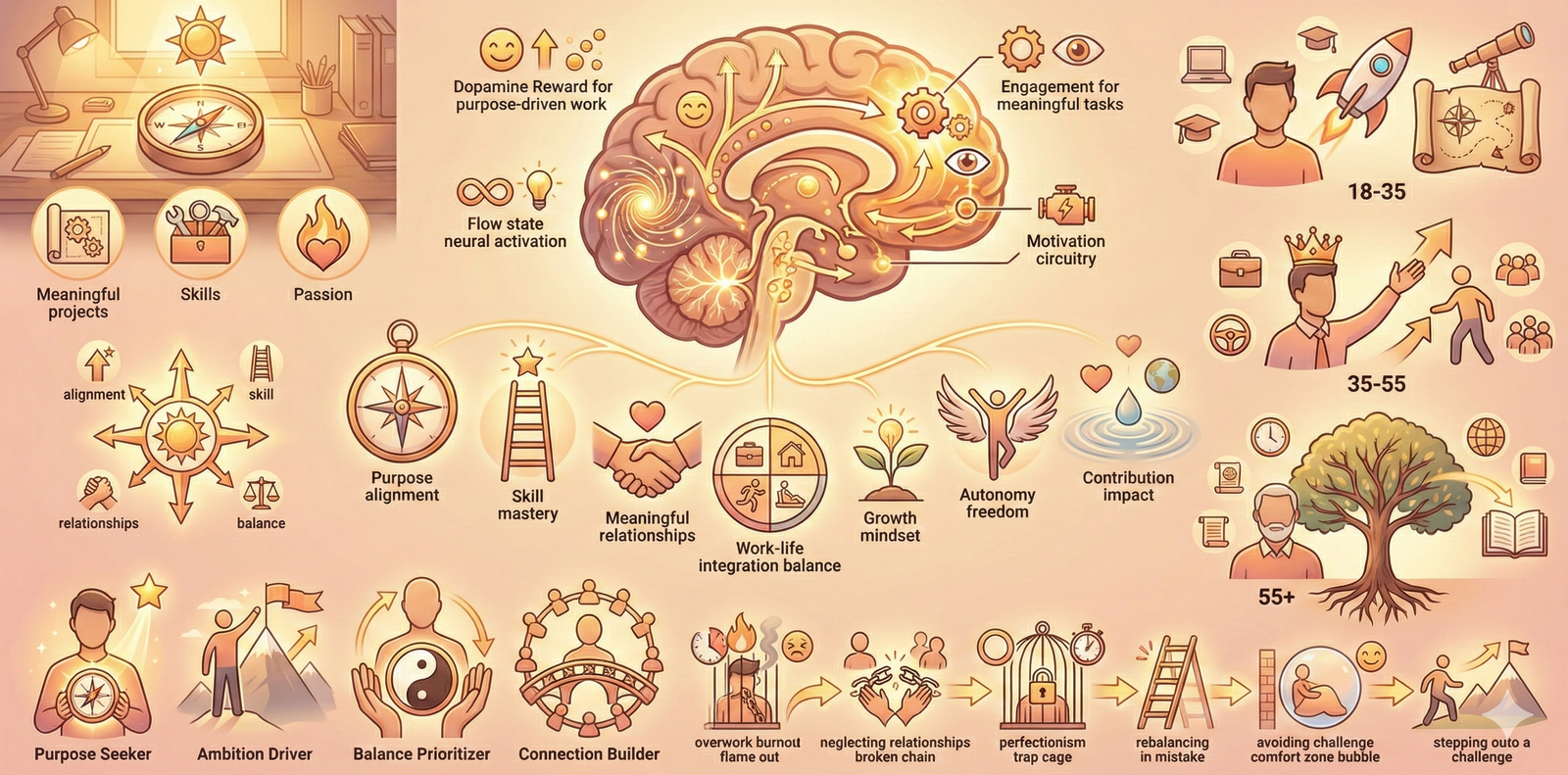
Work can be either a source of burnout or a pathway to fulfillment—the science shows exactly what determines which one you'll experience.
Whether you're climbing the corporate ladder, building your own business, or finding your way through career transitions, the principles of meaningful work apply universally.
What Is Work?
Work is any structured activity performed in exchange for compensation, identity, or purpose. But this definition barely scratches the surface of what work really is. Work is where we spend significant time, develop skills, build relationships, and—ideally—contribute to something larger than ourselves. It's the intersection of your abilities, your values, and what the world needs.
Not medical advice.
In modern contexts, work has expanded beyond traditional employment. Entrepreneurship, freelancing, creative pursuits, caregiving, and volunteering all count as work when they involve sustained effort toward meaningful outcomes. The challenge is that many people treat work as something to endure rather than something to shape—a mindset that creates invisible costs to mental health, relationships, and long-term wellbeing.
Surprising Insight: Surprising Insight: Employees who find meaning in their work are 91% more motivated than those perceiving little meaning—yet this requires active engagement with how you frame your role, not waiting for the perfect job.
The Three Dimensions of a Good Working Life
Job satisfaction, work meaningfulness, and psychological richness represent distinct but complementary aspects of workplace wellbeing
🔍 Click to enlarge
Why Work Matters in 2026
The landscape of work has fundamentally shifted. Remote work, gig economy participation, AI integration, and rapid industry changes mean that career stability no longer comes from staying in one role for decades. Instead, resilience, adaptability, and meaning-making have become essential. In 2026, work satisfaction increasingly depends on having agency—the ability to shape your work experience even within constraints.
Global data shows 70% of workers report being happy at work, but engagement has stagnated while overall wellbeing declined. This paradox suggests many people are settling for contentment rather than pursuing fulfillment. The cost shows up in burnout rates (76% of employees report burnout at least sometimes), turnover (burned-out employees are 2.8x more likely to actively search for new jobs), and health (workplace stress links directly to cardiovascular disease, anxiety, and depression).
The most significant insight: the drivers of burnout and engagement are mostly organizational, not personal. This means your experience at work depends heavily on workplace culture, psychological safety, recognition, growth opportunities, and supervisor support—factors that create either depletion or thriving.
The Science Behind Work Satisfaction
Self-Determination Theory (SDT) identifies three core psychological needs that fuel work motivation: autonomy (feeling in control), competence (developing skills and seeing progress), and relatedness (connection with colleagues and purpose). Research from 2024-2025 confirms that when organizations and individuals actively cultivate these needs, engagement and wellbeing increase substantially. Conversely, jobs that limit autonomy, provide no growth, and lack meaningful connection become sources of chronic stress.
The brain science is equally clear: meaningful work activates reward centers (dopamine release) and creates protective effects against stress. When you see your work as contributing to something valuable—helping others, building something, solving problems—your nervous system interprets work as opportunity rather than threat. This distinction between threat and opportunity fundamentally shapes job satisfaction, health outcomes, and decision-making.
How Meaningful Work Protects Mental Health
Work meaningfulness activates reward centers and builds resilience against workplace stress
🔍 Click to enlarge
Key Components of Meaningful Work
Purpose and Impact
Purpose is the intrinsic sense of fulfillment from work that has meaning and impact. This isn't about changing the world single-handedly—it's about understanding how your specific efforts contribute to outcomes you care about. A nurse, software engineer, teacher, accountant, or parent all experience purpose when they see their work making a concrete difference in people's lives. The research is clear: people who understand their work's impact experience higher engagement and lower burnout.
Autonomy and Control
Autonomy means having meaningful input into how you do your work, not just what work you do. Jobs that allow you to solve problems creatively, choose your approach, and influence decisions create psychological safety and engagement. Micromanagement and rigid control, by contrast, trigger stress responses and reduce motivation. Research shows autonomy is one of the strongest predictors of job satisfaction and longevity.
Skill Development and Growth
The brain is wired for growth—we feel most engaged when facing challenges slightly beyond current skill levels. Work that provides clear opportunities to develop new competencies, receive feedback, and see measurable progress creates psychological richness. Stagnant roles, conversely, lead to disengagement and boredom. Seeking or creating growth opportunities within your current work fundamentally improves satisfaction.
Connection and Belonging
Humans are social beings—work satisfaction increases substantially when you have positive relationships with colleagues and feel part of a community. Psychological safety (the ability to be authentic without fear of judgment or punishment) is the foundation. Teams with high psychological safety show better engagement, innovation, and mental health outcomes. Conversely, isolated or toxic work environments are major contributors to burnout.
| Pillar | What It Means | Health Impact |
|---|---|---|
| Purpose and Impact | Understanding how your work matters and seeing concrete results | 91% more motivation, reduced depression risk |
| Autonomy | Having control over how you work and ability to influence decisions | Lower anxiety, higher resilience, longer tenure |
| Growth and Competence | Developing skills, facing growth challenges, receiving feedback | Higher engagement, improved cognitive health, sense of progress |
| Connection and Safety | Positive relationships, belonging, psychological safety with team | Reduced stress hormones, better mental health, innovation |
How to Apply Work Fulfillment: Step by Step
- Step 1: Clarify your values: Write down 3-5 core values (e.g., helping others, creativity, growth, security, contribution). Assess how your current work aligns with these values.
- Step 2: Identify work meaningfulness: List specific ways your current role contributes to outcomes you care about. Be concrete—'I help people solve problems' or 'I create value for customers.'
- Step 3: Audit autonomy: Identify decisions you currently make independently, then one area where you could request more input or control. Start small.
- Step 4: Find growth edges: Identify one new skill you could develop in your current role. Could you lead a project, mentor someone, or take a course related to your work?
- Step 5: Strengthen connections: Schedule one-on-one time with a colleague you trust, or suggest a team activity that builds connection rather than just task focus.
- Step 6: Address stressors: Identify your top 3 workplace stressors. For each, determine if it's organizational (recognition, support, workload) or personal (boundaries, expectations). Address what you control.
- Step 7: Set boundaries: Establish one clear boundary around work hours, communication, or task scope. Burnout prevention starts with protecting recovery time.
- Step 8: Build psychological safety: Share one authentic perspective or question in team meetings. Notice if the response is supportive or dismissive—this indicates team safety.
- Step 9: Create feedback loops: Request specific feedback on one recent project. Use this to improve and demonstrate receptiveness to growth.
- Step 10: Revisit alignment quarterly: Every 3 months, assess how your work aligns with the four pillars. Adjust actions or perspectives based on what you've learned.
Work Across Life Stages
Young Adulthood (18-35)
This stage prioritizes skill-building, exploration, and establishing competence. Young adults often seek roles offering mentorship, learning opportunities, and exposure to different areas. The focus is discovering what resonates rather than optimizing for maximum income. This is the ideal time to take calculated risks—trying different roles, industries, or career paths—because you have fewer constraints. Psychological safety and growth opportunities matter more than stability. The challenge: resisting pressure to choose one path too early or settle for adequate when meaningful work is possible.
Middle Adulthood (35-55)
This stage typically involves deepening expertise, increasing responsibility, and navigating competing demands (career, family, caregiving). Work satisfaction here depends on meaningful progression—seeing how accumulated expertise creates impact. Many experience the 'peak earnings years' pressure alongside burnout risk from sustained high intensity. This stage benefits most from attention to boundaries, delegation, and mentoring others (which provides meaning beyond title advancement). The challenge: preventing burnout from overcommitment while maintaining growth and engagement.
Later Adulthood (55+)
This stage shifts toward legacy-building, knowledge-sharing, and often more flexibility around work structure. Many find renewed engagement through mentoring, consulting, or redefining work toward personal values rather than external advancement. This is when alignment between work and core values becomes most critical—people often shift toward purpose-driven work or reduce intensity. Some transition to part-time, portfolio careers, or second careers aligned with later-life priorities. The opportunity: leveraging accumulated expertise to do work that matters most to you.
Profiles: Your Work Approach
The Purpose-Driven Achiever
- Clear alignment between work and personal values
- Visible impact and contribution to meaningful outcomes
- Autonomy in how work gets done
Common pitfall: Over-committing to meaningful work and burning out from intensity, or becoming frustrated when values and reality don't align perfectly
Best move: Find 'good enough' alignment (80% match, not 100%), build boundaries around work intensity, and channel passion into sustainable practices rather than endless extra effort
The Growth-Oriented Learner
- Ongoing skill development and learning opportunities
- Clear feedback on progress and competence
- Challenges slightly beyond current ability
Common pitfall: Becoming restless in static roles, or pursuing growth without direction toward any particular goal
Best move: Actively identify growth opportunities within current role, seek mentorship and feedback regularly, and set quarterly learning goals rather than waiting for the perfect growth opportunity
The Connector and Collaborator
- Strong relationships and team belonging
- Psychological safety to be authentic at work
- Collaborative rather than isolated work structures
Common pitfall: Over-prioritizing team harmony at expense of own boundaries, or feeling drained by toxic team dynamics
Best move: Invest in quality relationships while maintaining professional boundaries, identify or build psychologically safe subgroups if broader team culture is weak
The Stability-Focused Pragmatist
- Reliable income and predictable structure
- Security and clear expectations
- Balance between work and other life domains
Common pitfall: Settling for unfulfilling work because it feels secure, or missing opportunities for growth due to risk-aversion
Best move: Build stability foundation first (emergency fund, skills), then incrementally take small risks; add meaning through purpose beyond job title (volunteering, hobbies, relationships)
Common Work Mistakes
Mistake #1: Waiting for the Perfect Job. Many people remain in unfulfilling roles hoping the next job will have perfect alignment. Reality: most jobs require active engagement to become meaningful. Waiting paralyzes action and often leads to missed growth opportunities. Better approach: assess the four pillars in your current role, then either address what's controllable or make an intentional move toward better alignment.
Mistake #2: Neglecting Boundaries and Recovery. High engagement and purpose can mask unsustainable intensity. Many achieve substantial work impact while slowly burning out from insufficient recovery. Prevention requires protecting sleep, relationships, and non-work time as actively as you pursue professional goals. Burnout often appears suddenly only because the foundation eroded gradually.
Mistake #3: Decoupling Work from Overall Wellbeing. Treating work as separate from health, relationships, and purpose creates fragmentation. In reality, work satisfaction and overall wellbeing are deeply integrated. A job that undermines relationships or health isn't actually fulfilling, even if it seems impressive externally. Conversely, work aligned with values and growth enhances all life domains.
The Burnout Spiral vs. Engagement Spiral
How workplace conditions create either declining wellbeing or increasing resilience over time
🔍 Click to enlarge
Science and Studies
Recent research (2024-2025) provides compelling evidence for what creates meaningful work and sustainable engagement. These studies span organizational psychology, neuroscience, and population health research.
- Self-Determination Theory research confirms that autonomy, competence, and relatedness are universal needs driving motivation and wellbeing across cultures and industries (Deci & Ryan)
- World Happiness Foundation's 2025 Happiness at Work report: 70% of workers report happiness, but only 25% identify as 'very happy,' indicating widespread settling for contentment over fulfillment
- Cambridge Journal of Management (2024): Work meaningfulness is the strongest predictor of job satisfaction and lowest predictor of turnover intentions—more influential than compensation or advancement opportunity
- American Psychological Association 2025 Work in America survey: Psychological safety, recognition, growth opportunities, and supportive supervision are organizational factors most strongly predicting engagement and preventing burnout
- Global Wellness Institute (2025): 76% of employees report experiencing burnout at least sometimes, with organizational factors (workload, support, culture) accounting for approximately 80% of variance in burnout risk
Your First Micro Habit
Start Small Today
Today's action: Identify one concrete way your current work contributes to something you care about, and write it down. This single insight—seeing your work's actual impact—begins activating the brain's reward centers and purpose recognition.
Purpose recognition is the foundation of sustained work engagement. By explicitly articulating how your work matters, you activate intrinsic motivation and resilience against stress. This takes 5 minutes but fundamentally changes your relationship with work.
Track your work fulfillment practices and get personalized AI coaching with our app.
Quick Assessment
How aligned is your current work with your core values and sense of purpose?
People with high values alignment experience lower burnout and higher engagement. Even without changing jobs, increasing awareness of how your work matters can significantly shift experience.
To what degree do you experience autonomy and control over how you do your work?
Autonomy is one of the strongest predictors of job satisfaction. Even small increases in control (choosing approach to tasks, having voice in decisions) improve engagement significantly.
How would you rate the psychological safety in your current workplace?
Psychological safety is the foundation of engagement and innovation. When you must hide your authentic self, stress increases and wellbeing declines. Even subtle cultural shifts toward greater safety improve outcomes.
Take our full assessment to get personalized recommendations for your work and life.
Discover Your Style →Next Steps
Start by choosing one of the four pillars (purpose, autonomy, growth, connection) where you'd like to build. Identify one specific action this week—maybe asking for feedback on a project (growth), having a genuine conversation with a colleague (connection), proposing a different approach to a task (autonomy), or writing down how your work contributes (purpose). Small shifts compound over time.
Remember: meaningful work isn't a luxury for fortunate few. It's a fundamental human need that organizations and individuals can actively cultivate. Your work experience is both shaped by workplace conditions and influenced by how you choose to engage. Understanding both these factors puts real agency back in your hands.
Get personalized guidance for building meaningful work with AI coaching.
Start Your Journey →Research Sources
This article is based on peer-reviewed research and authoritative sources. Below are the key references we consulted:
Related Glossary Articles
Frequently Asked Questions
Can you find meaningful work in any job?
To a significant degree, yes. While some jobs inherently offer more meaning potential than others, research shows that actively framing work around contribution, developing relationships, seeking growth, and establishing autonomy within constraints can create meaningfulness in most roles. However, genuinely toxic or exploitative situations require either major structural change or moving to healthier environments.
How do you prevent work burnout?
Burnout prevention requires organizational and personal approaches. Organizationally: psychological safety, reasonable workloads, recognition, growth opportunities, and supportive supervision. Personally: clear boundaries around hours and intensity, protecting recovery time, maintaining relationships outside work, and regularly assessing alignment. Addressing burnout requires tackling both levels—personal strategies alone rarely solve organizationally-created burnout.
Is it better to stay in one job or move frequently for growth?
There's no universal answer. Research shows staying long enough to develop expertise creates satisfaction (typically 3-5 years minimum), but moving too infrequently can create stagnation. The key is intentionality: move when growth plateaus or values-misalignment becomes chronic; stay and deepen when meaningful progression is possible. Some people thrive with portfolio careers (multiple simultaneous roles); others need focus on one path.
How much should compensation factor into work satisfaction?
Compensation matters—financial security reduces stress and allows focus on higher needs. However, research is clear: above the security threshold (bills paid, some savings, stability), additional income produces minimal satisfaction improvements compared to purpose, autonomy, relationships, and growth. Many people optimize for maximum income at expense of meaning, relationships, and health—a trade rarely worth the cost.
What if your workplace culture is genuinely toxic?
Individual efforts can only accomplish so much in toxic systems. Signs of genuine toxicity: high rates of turnover, widespread anxiety, psychological unsafety, lack of recognition, or harmful behavior by leadership. If these persist despite your best efforts, the healthiest move is often leaving. You cannot fix culture alone, and staying in genuinely damaging environments erodes health significantly. Sometimes the most important work decision is recognizing when to go.
Take the Next Step
Ready to improve your wellbeing? Take our free assessment to get personalized recommendations based on your unique situation.
- Discover your strengths and gaps
- Get personalized quick wins
- Track your progress over time
- Evidence-based strategies