Business Fundamentals
Business is the engine of economic growth and personal opportunity. Whether you're starting your first venture or scaling an established enterprise, understanding core business fundamentals is essential for success in 2026. A business combines resources—money, time, people, and ideas—to create value that customers will pay for. The journey from concept to sustainable revenue requires strategy, resilience, and a deep understanding of your market. This guide explores the essential components of building a successful business, from initial planning through growth phases.
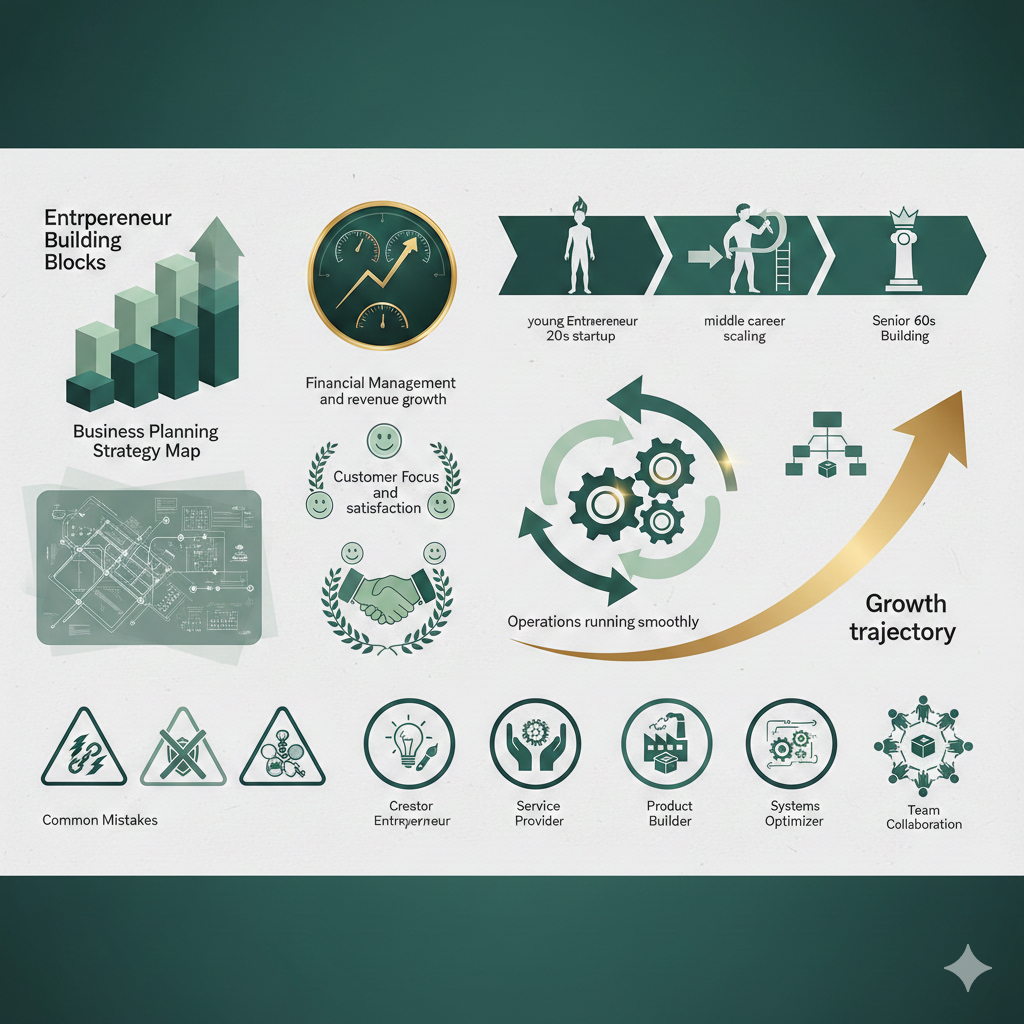
Discover the key strategies that separate thriving businesses from those that stall. Learn about market research techniques that reveal genuine customer needs. Understand the business models that generate predictable revenue. Explore the financial frameworks that keep cash flow healthy and growth sustainable.
Building a business tests your entrepreneurial courage, strategic thinking, and adaptability. Every successful business started with someone willing to identify a problem and create a solution. Your business can too—with the right knowledge, planning, and mindset.
What Is Business?
Business is an organized economic activity designed to produce and deliver goods or services to customers in exchange for payment. It involves the systematic creation, management, and exchange of value. A business can be as simple as a freelance service or as complex as a multinational corporation with thousands of employees. At its core, every business solves a customer problem, meets a customer need, or fulfills a customer desire while generating profit for the owner or stakeholders.
Not medical advice.
The business landscape in 2026 includes diverse organizational types: sole proprietorships where one person owns and operates everything; partnerships where two or more people share ownership; corporations with formal legal structures and multiple shareholders; and modern digital businesses that operate globally from distributed teams. Regardless of structure, successful businesses share common elements: a clear value proposition, understanding of their target market, sustainable financial management, and the ability to adapt to changing conditions.
Surprising Insight: Surprising Insight: Research shows that human capital—experience, education, and age—is the most significant predictor of entrepreneurial success. A founder's knowledge and skills matter more than initial funding.
The Business Fundamentals Framework
Shows the core components that every business needs to function: value creation, customer understanding, revenue generation, and operational efficiency.
🔍 Click to enlarge
Why Business Matters in 2026
In 2026, entrepreneurship and business ownership have become more accessible than ever. Digital technology has removed geographic barriers, allowing individuals to reach global markets from their homes. The gig economy has created millions of micro-businesses. Remote work has enabled distributed teams. Yet this accessibility brings competition—success now requires deeper market knowledge, faster adaptation to trends, and authentic value creation that resonates with increasingly discerning customers.
The economic landscape favors businesses that innovate, that embrace AI and data-driven decision-making, and that build genuine customer relationships. For individuals, business ownership offers unparalleled opportunity for wealth creation, personal growth, and impact. Starting or growing a business forces you to develop critical skills: problem-solving, resilience, negotiation, financial management, and leadership. These skills compound in value throughout your career, even if you eventually exit that business.
Consumer spending in 2026 exhibits mixed patterns, with growth slowing in some quarters and contracting in others. This makes business strategy even more important. Companies that understand their numbers, know their customers deeply, and maintain financial discipline will outperform those that operate on intuition alone. Inflation rates continue to stabilize, creating a more predictable environment for business planning. Technology advancement accelerates, producing new tools that make businesses more efficient and productive—if entrepreneurs stay informed and adaptable.
The Science Behind Business
Successful business is both art and science. The scientific side relies on data-driven decision-making, market research, financial analysis, and tested business models. Research identifies five key success factors: (1) the strength of the original idea, (2) the CEO's leadership capability, (3) the business model's viability, (4) effective marketing approach, and (5) the quality of the entrepreneurial team. When founders score high across these five dimensions, their probability of success increases substantially. Conversely, weakness in any single area can cascade into failure.
The business landscape operates under economic principles: supply and demand, competitive advantage, customer lifetime value, and unit economics. Understanding these principles allows you to make strategic decisions rather than hoping for success. Financial literacy becomes crucial—knowing your gross margin, your customer acquisition cost, your break-even point, and your cash runway tells you whether your business is actually viable. Many businesses fail not because they lack great products, but because founders misunderstand their unit economics or run out of cash before reaching profitability.
The Entrepreneurial Success Equation
Illustrates how the combination of idea quality, leadership, business model, marketing, and team composition determines startup success probability.
🔍 Click to enlarge
Key Components of Business
Strategic Planning
Strategic planning translates your vision into actionable steps. It answers fundamental questions: What problem do you solve? Who needs your solution? How do you reach them? What makes you different? Rather than annual planning cycles, forward-thinking businesses now implement quarterly strategic reviews for rapid adaptation. Your strategy should outline your competitive positioning, key assumptions, customer segments, revenue model, and metrics for success. A well-developed strategy acts as your decision-making compass, helping you say yes to opportunities that align and no to distractions that don't.
Market Research and Customer Understanding
Before launching or pivoting, conduct thorough market research. Understand your target audience—who they are, what they value, what problems keep them awake at night. Use SWOT analysis to map your strengths, weaknesses, opportunities, and threats. Interview potential customers. Study your competitors. Look at what problems they solve and what gaps remain. The more intimately you know your market, the better decisions you'll make about pricing, positioning, features, and marketing. Many failed businesses pursued ideas the founder loved but customers didn't need.
Business Model Innovation
Your business model describes how you create, deliver, and capture value. Will you sell one-time products or build recurring subscription revenue? Will you operate direct-to-consumer or through partnerships? Will you scale through employees or remain lean with contractors? Different models have different unit economics, capital requirements, and growth trajectories. A subscription model with predictable monthly recurring revenue attracts investors differently than a marketplace that takes percentage cuts. Choose your model strategically based on your advantages, customer preferences, and capital availability.
Financial Management
Financial discipline separates sustainable businesses from ones that collapse. You must track revenue, expenses, profit margins, and cash flow meticulously. Understand your unit economics—how much does each customer cost to acquire, and how much lifetime value do they generate? Know your cash runway—how many months can you operate at current burn rate? Many businesses fail with positive top-line revenue because they operate at a loss on every sale. Financial modeling helps you forecast when you'll need additional funding and plan your milestones accordingly. In 2026, with access to spreadsheets and financial software, there's no excuse for businesses operating blind.
| Metric | Early Stage Focus | Growth Stage Focus |
|---|---|---|
| Customer Acquisition Cost (CAC) | Keep reasonable relative to LTV | Optimize down while maintaining quality |
| Monthly Recurring Revenue | Establish predictability | Grow 10%+ month over month |
| Cash Runway | Extend with every dollar | Transition to positive cash flow |
| Product-Market Fit | Achieve through iteration | Leverage for rapid scaling |
| Customer Retention Rate | Build strong foundation | Exceed 80-90% annually |
How to Apply Business: Step by Step
- Step 1: Identify the problem you want to solve. What frustrates you or people you know? What solution doesn't exist or exists poorly? This becomes your initial business idea.
- Step 2: Validate your idea through research. Interview potential customers. Do they agree this is a real problem? Would they pay for your solution? Don't fall in love with an idea before validation.
- Step 3: Build a basic business plan. Define your target customer, value proposition, revenue model, competitive advantage, and financial projections. This forces you to think through critical details.
- Step 4: Develop your minimum viable product (MVP). Launch the simplest version that lets customers experience your core value. Gather feedback. Iterate based on what you learn.
- Step 5: Create a go-to-market strategy. How will customers discover you? What's your pricing? What sales channels will you use? Distribution often determines success more than product quality.
- Step 6: Build your financial model. Project revenue, expenses, and cash burn. Understand when you'll need funding and how much. Know your unit economics.
- Step 7: Assemble your team. You can't build a significant business alone. Recruit partners, early employees, or contractors who complement your skills and share your vision.
- Step 8: Establish legal structure. Choose between sole proprietorship, partnership, LLC, C-corp, or S-corp based on your situation. Consult an accountant and lawyer.
- Step 9: Launch and measure. Start small, track metrics relentlessly, and iterate based on data. Celebrate early wins. Learn from failures quickly.
- Step 10: Scale what works. Once you achieve product-market fit and understand your unit economics, scale the systems, team, and capital to grow faster.
Business Across Life Stages
Young Adulthood (18-35)
In young adulthood, you have maximum energy, fewer financial obligations, and more tolerance for risk. This is ideal for starting your first business. You can afford to fail and recover quickly. Entrepreneurship at this stage often involves learning what works, validating assumptions, and building skills you'll use throughout your career. Consider starting a side business while maintaining employment to reduce financial pressure. Test multiple ideas. Find your edge. Young founders who successfully launch their first venture gain confidence and contacts that accelerate second and third ventures.
Middle Adulthood (35-55)
In middle adulthood, you bring substantial experience, established networks, and deeper financial resources. You may start a second business with lessons from the first. Your risk tolerance may be lower due to family obligations, but your decision-making sophistication is higher. You recognize patterns in markets and customer behavior that younger entrepreneurs miss. At this stage, business growth often comes through scaling systems and teams rather than just personal effort. Delegation becomes essential. Many businesses that become highly profitable scale during this life phase because founders have matured in their judgment and ability to build teams.
Later Adulthood (55+)
Later adulthood offers another business opportunity phase. You may launch a business you always dreamed of without pressure to make it mega-successful. Your credibility and experience open doors. Many successful businesses are founded by experienced professionals who identify gaps in their industry. You may also focus on building a legacy business—one that employs people, contributes to your community, and potentially passes to the next generation. Succession planning becomes more important. Some entrepreneurs at this stage focus on mentoring younger founders, creating a return on their experience.
Profiles: Your Business Approach
The Lean Operator
- Efficient systems and automation
- Clear financial tracking
- Ability to do multiple roles initially
Common pitfall: Under-resourcing growth because of reluctance to hire. Staying too hands-on and becoming the bottleneck.
Best move: Automate repetitive tasks early. Build financial dashboards that tell you instantly where the business stands. Hire your first employee strategically to unlock next-phase growth.
The Visionary Founder
- Excellent operational execution partner
- Customer feedback mechanisms
- Market validation of big ideas
Common pitfall: Building elegant solutions nobody wants. Getting so far ahead of market readiness that timing fails.
Best move: Partner with an operational expert who brings your vision to reality. Test assumptions rigorously. Launch earlier at 80% ready to learn from the market versus perfecting alone.
The Risk Manager
- Contingency planning frameworks
- Data-driven decision processes
- Clear financial guardrails
Common pitfall: Analysis paralysis—endless planning without launch. Seeing only obstacles rather than opportunities.
Best move: Set decision criteria and timelines upfront. Launch with a time-bound experiment mentality. Track what works and scale those vectors. Accept that perfect information never arrives.
The Growth Obsessive
- Systems for scaling quality
- Strong financial controls
- Clear customer acquisition metrics
Common pitfall: Growing for growth's sake, losing unit economics and profitability in pursuit of top-line revenue.
Best move: Measure unit economics obsessively. Don't scale until you understand exactly how much each customer costs and how much they're worth. Growth built on positive unit economics compounds exponentially.
Common Business Mistakes
The first common mistake is insufficient market research. Founders often fall in love with their idea and skip genuine customer validation. They build products nobody wants to buy. Before investing significant time or money, talk to dozens of potential customers. Ask them directly: would you pay for this? Watch their behavior, not just their words. Many brilliant ideas fail because they were solutions in search of problems rather than answers to genuine customer needs.
The second mistake is ignoring unit economics. A business that acquires each customer for $500 but generates only $400 in lifetime value is doomed, even if it has thousands of customers. Founders get excited about growth and user counts without understanding the financial foundation. Track your numbers from day one. Understand your gross margin per customer. Know your customer acquisition cost. Project when (if) you'll be profitable. Many seemingly successful businesses are actually destroying wealth at massive scale.
The third mistake is weak team building. You cannot build a meaningful business alone. The founder who insists on making every decision becomes the bottleneck. Recruit teammates who are smarter than you in specific areas. Hire slowly, fire quickly when mismatches appear, and build a culture that attracts the right people. Your founding team's quality determines the ceiling on your business success more than any other single factor.
The Business Failure Cascade
Shows how early mistakes compound and eventually trigger business failure if not corrected.
🔍 Click to enlarge
Science and Studies
Academic research has consistently identified success factors for entrepreneurs and growing businesses. Multiple studies from leading universities, research institutions, and business schools reveal patterns that separate thriving from failing ventures. The findings emphasize that success is predictable when founders understand and execute on the core fundamentals.
- Harvard Business School research identifies Idea quality, CEO leadership capability, Business model viability, Marketing effectiveness, and Team quality as the top five predictors of startup success.
- Multiple peer-reviewed studies demonstrate that human capital—education, experience, and age—is the strongest predictor of entrepreneurial success; founders with higher human capital achieve better outcomes.
- MDPI Sustainability journal research on entrepreneurial success factors identifies business performance, innovation capacity, personal factors, and resource availability as four key dimensions influencing outcomes.
- Frontiers in Psychology studies show that entrepreneurial passion combined with psychological capital significantly predicts success, especially when paired with supportive policies.
- The National Bureau of Economic Research documents that founders who conduct thorough market research before launch have 40% higher survival rates than those who skip this step.
Your First Micro Habit
Start Small Today
Today's action: This week, identify one specific customer problem you could solve and talk to three people who experience that problem. Ask them: Is this really a problem? Would you pay for a solution? Listen more than you pitch.
Customer conversations are the highest-leverage business activity. They replace assumptions with facts. They build your intuition about markets. They often reveal better solutions than what you initially imagined. This one habit, repeated consistently, is how successful entrepreneurs stay connected to real customer needs.
Track your customer conversations and get personalized AI coaching on idea validation with our app.
Quick Assessment
What is your current relationship with business?
Your current stage determines what you should focus on. Beginners need validation and basics. Existing founders need systems and scaling knowledge.
What excites you most about business?
Your core motivation shapes the type of business you should build. Match your business structure to what genuinely motivates you.
What concerns you most about starting or growing a business?
Your primary concern points to what you should tackle first. Address that fear through knowledge, mentorship, or strategic partnerships.
Take our full assessment to get personalized recommendations for your business stage.
Discover Your Style →Next Steps
Your business journey begins with a single decision: to start. If you've been thinking about an idea, validate it this week. If you've already started, conduct a business health check. Do you understand your numbers? Have you talked to customers recently? Is your team energized and aligned? Sometimes the next step isn't launching bigger or hiring more—it's pausing to get the fundamentals right.
Remember that every successful business started exactly where you are now. The founders of PayPal, YouTube, Apple, and Amazon all began with a problem to solve and courage to try. Many failed before succeeding. The pattern isn't talent or luck—it's people who understood business fundamentals, learned from failures quickly, and stayed persistent. You can be one of those people. The framework exists. The examples abound. The barriers have never been lower.
Get personalized guidance with AI coaching as you develop your business idea.
Start Your Journey →Research Sources
This article is based on peer-reviewed research and authoritative sources. Below are the key references we consulted:
Related Glossary Articles
Frequently Asked Questions
How much money do I need to start a business?
It depends on your business model. Service-based businesses can launch for under $1,000. Product-based businesses might need $10,000-100,000+ for inventory and manufacturing. Digital businesses often start for free. Begin by understanding your specific unit economics. What are the actual capital requirements for your model? Start lean, validate your idea with minimal spend, then raise capital once you've proven something works.
What's the difference between a business plan and a business model?
A business model describes how you create and capture value—your revenue streams, cost structure, and customer relationships. A business plan takes that model and adds detailed execution: marketing strategy, team roles, financial projections, and milestones. Think of the model as the foundation and the plan as the blueprint for building on it.
How do I find my target customer?
Start with who you think needs your solution, then test that assumption. Define your customer by demographics, psychographics, behaviors, and pain points. Where do they spend time online and offline? What language do they use to describe their problem? Interview dozens of them. Use online communities, surveys, and direct conversations. Your target customer becomes clearer through testing, not theorizing.
How do I know if my business has product-market fit?
Product-market fit happens when customers actively seek your product, rave about it, and keep paying for it. You'll see high retention rates, strong word-of-mouth growth, minimal churn, and customers willing to pay premium prices. If you feel like you're constantly selling but can't get traction, you likely lack fit. Pause growth. Go back to listening and iterating.
When should I hire my first employee?
Hire when you clearly identify a task that prevents you from doing higher-value work. If you're spending 30% of your time on something that generates 5% of your value, that's a hiring signal. You should also have clear revenue—enough to cover salary, payroll taxes, and still have business growth. Start with the highest-leverage hire: someone who handles the work that blocks your growth most.
Take the Next Step
Ready to improve your wellbeing? Take our free assessment to get personalized recommendations based on your unique situation.
- Discover your strengths and gaps
- Get personalized quick wins
- Track your progress over time
- Evidence-based strategies