Parenting
Parenting is one of life's most profound roles—the continuous act of providing physical care, emotional support, and guidance to help children develop into capable, confident, emotionally resilient adults. Effective parenting builds secure attachment bonds that shape a child's brain development, nervous system regulation, and lifelong ability to form healthy relationships. Modern neuroscience reveals that the parental brain itself undergoes remarkable changes during parenthood, demonstrating that parenting is a transformative bidirectional relationship where both parent and child grow together.
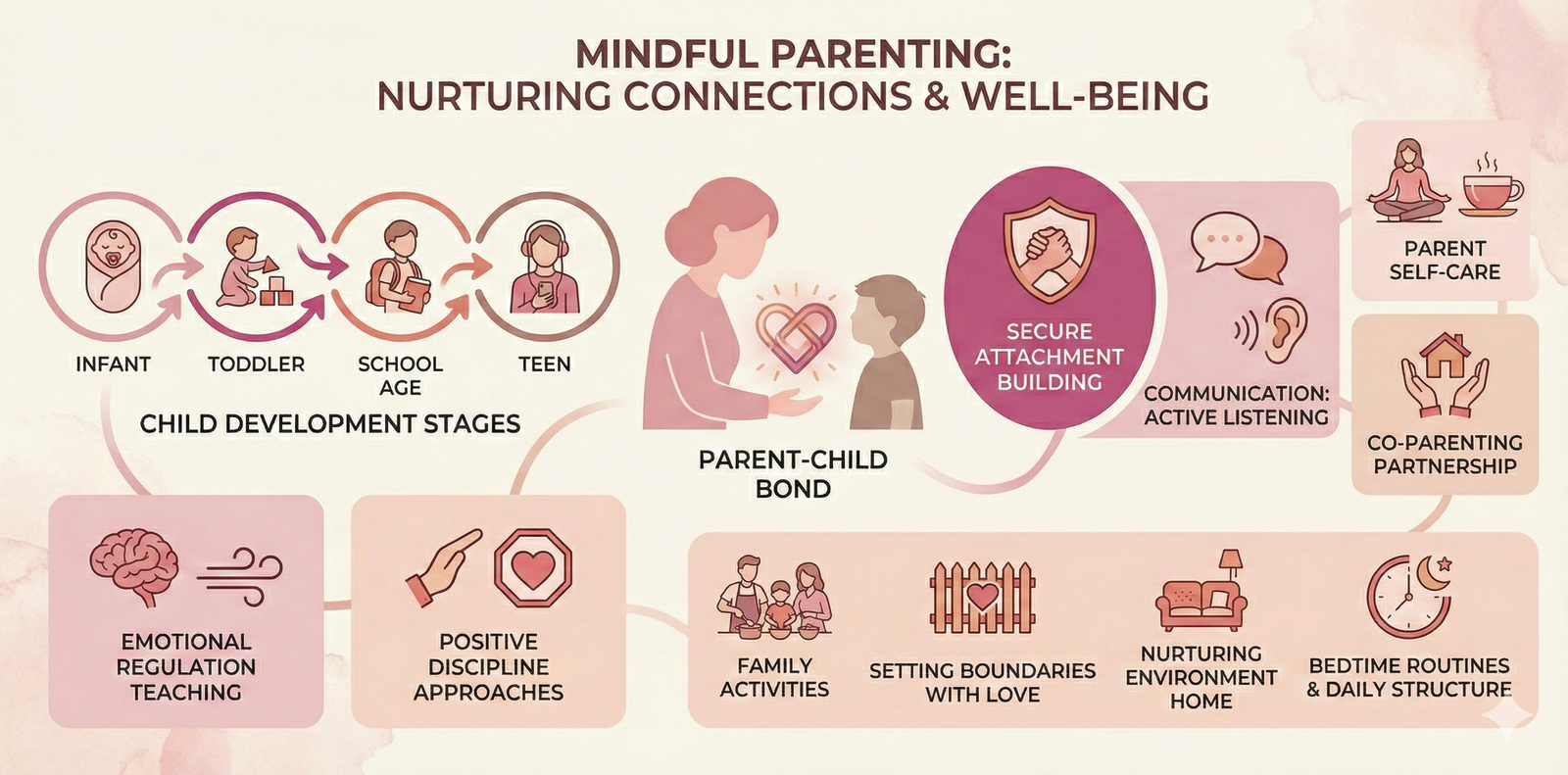
In 2025, parenting research emphasizes secure attachment as the foundation for everything—emotional security, behavioral cooperation, cognitive development, and self-regulation skills. When children feel emotionally safe and supported, their prefrontal cortex (the thinking brain) develops more robustly, enabling better decision-making and impulse control.
The shift toward evidence-based parenting reflects a move away from punishment-focused approaches toward connection-based methods that honor both child autonomy and parental authority, fostering families where respect flows both directions.
What Is Parenting?
Parenting is the intentional act of nurturing, teaching, guiding, and supporting a child's physical, emotional, cognitive, and social development across all life stages. It encompasses day-to-day caregiving (feeding, safety, hygiene) alongside emotional support, limit-setting, modeling desired behaviors, and gradually releasing responsibility as children mature. Parenting is not a single fixed approach but an evolving relationship that adapts to each child's developmental stage, temperament, needs, and family context.
Not medical advice.
The core purpose of parenting is to help children develop autonomy, resilience, emotional intelligence, and the internal resources to navigate life successfully. This requires parents to regulate their own emotions, remain responsive (especially during conflict), and maintain consistency while also remaining flexible. Parenting operates at the intersection of biology, psychology, culture, economics, and personal values—it's deeply personal yet rooted in universal human needs for safety, belonging, and growth.
Surprising Insight: Surprising Insight: Research from 2024 shows that the parental brain undergoes structural plasticity similar to learning a new skill—parenting literally rewires parents' brains, especially the circuits governing empathy, risk-sensing, and emotional processing. More children equals higher brain-wide functional connectivity, suggesting parenting may enhance parental cognitive resilience.
The Attachment Security Model
How secure attachment forms through parental responsiveness and supports child development across domains
🔍 Click to enlarge
Why Parenting Matters in 2026
In 2026, parenting matters more than ever because the world is more complex, stimulating, and demanding. Children face screen exposure, social media pressure, rapid technological change, and unprecedented access to information at a developmental stage when their prefrontal cortex (responsible for judgment, impulse control, long-term thinking) is still maturing until age 25. Parental guidance, secure relationships, and emotional coaching become essential anchors that help children navigate modern life with resilience and wisdom.
The neuroscience of early childhood is now clear: the first few years of life establish neural pathways that influence stress response, emotional regulation, learning capacity, and relational patterns for life. When parents are emotionally available and responsive, they literally shape their child's developing brain for resilience. Secure attachment in childhood predicts better mental health outcomes, stronger relationships, academic success, and less risky behavior in adolescence.
Furthermore, research on parental mental health shows that when parents receive support, reduce stress, and experience greater life satisfaction, their children benefit directly through better parental responsiveness and more secure attachment. Parenting is no longer viewed as a solo endeavor but as a network involving both parents, extended family, teachers, and community—the child thrives when multiple relationships are secure and coordinated.
The Science Behind Parenting
Modern parenting science rests on three pillars: attachment theory, neurobiology of child development, and parental neuroplasticity. Attachment theory, pioneered by John Bowlby and expanded by Mary Ainsworth, demonstrates that secure emotional bonds between parent and child are the foundation for all other development. When a child experiences their parent as a safe haven (comfort during distress) and secure base (encouragement for exploration), they develop what researchers call "earned security"—the confidence to explore the world and try new things because they know they can return for support.
Neuroscience reveals the mechanism: when a parent responds warmly to a child's distress, they help activate the parasympathetic nervous system (the calming branch), teaching the child's developing brain how to self-soothe. Repeated experiences of emotional support literally wire neural circuits for emotional regulation. Conversely, chronic stress or harsh parenting activates the amygdala (fear center) and limits prefrontal development. 2024 research confirmed that parenting interventions aimed at increasing parental responsiveness alter amygdala-prefrontal connectivity in middle childhood, demonstrating that parenting quality has measurable effects on brain circuitry.
How Parenting Shapes Child Brain Development
Neural pathways activated by responsive parenting vs. harsh parenting and their impacts on regulation and learning
🔍 Click to enlarge
Key Components of Parenting
Secure Attachment Building
Secure attachment is created through consistent, warm, emotionally available responses to a child's needs. This doesn't mean never saying no or being perfect—it means children experience their parent as generally responsive, present, and on their side even during conflict. Parents build attachment by being emotionally attuned (noticing what the child feels), validating feelings ("I see you're frustrated"), and providing comfort. Research shows that parental sensitivity to children's emotional and physical signals is the strongest predictor of secure attachment. When parents struggle with attachment, early intervention that teaches responsiveness and emotional coaching produces measurable improvements in child-parent security and child brain development.
Positive Discipline and Limit-Setting
Positive discipline means setting clear expectations and boundaries while maintaining the child's dignity and the relationship. Instead of punishment (which creates fear and shame), positive discipline teaches. It involves naming the rule ("We use gentle hands"), explaining why ("Hitting hurts"), and coaching alternatives ("You can ask, tap them gently, or use your words"). Specific praise reinforces positive behavior ("I noticed you waited your turn—that showed patience"), while natural consequences help children learn ("You spilled the juice; let's clean it together and be more careful next time"). Research on Zero to Three's 2025 study found that toddlers cooperate more when given two clear choices, as this respects their autonomy while maintaining parental authority.
Emotional Coaching and Co-Regulation
Children are born with emotions but not the skill to manage them. Parents coach emotional regulation by helping children name and understand feelings. Co-regulation means the parent lends their calm nervous system to the child—staying regulated themselves during a child's tantrum, naming the emotion ("You feel so angry"), and providing comfort ("I've got you; you're safe"). Over time, children internalize this regulating presence and develop their own capacity to self-soothe. This is especially critical during the toddler and early childhood years when the prefrontal cortex is still developing. Children who receive emotional coaching develop better mental health outcomes and stronger stress resilience.
Modeling and Values Transmission
Children learn primarily by observing their parents. They watch how you handle stress, solve problems, treat others, manage mistakes, and express emotions. Parents who model kindness, patience, curiosity, and honest communication teach children these values far more effectively than words alone. This includes modeling self-care, seeking help, apologizing, and managing failure gracefully. Children internalize these patterns and replicate them in their own relationships and decision-making throughout life. The goal is not perfection but authenticity—showing children that adults make mistakes, learn from them, and keep trying.
| Life Stage | Key Developmental Task | Primary Parenting Focus |
|---|---|---|
| Infancy (0-12 months) | Attachment formation, safety | Responsive feeding, comfort, skin-to-skin contact, predictability |
| Toddlerhood (1-3 years) | Autonomy, language, self-awareness | Safe exploration, gentle limits, emotional naming, consistency |
| Early Childhood (3-6 years) | Social skills, impulse control, imagination | Cooperative play, emotion coaching, positive discipline, peer interaction |
| Middle Childhood (6-12 years) | Competence, identity, friendships | Support for interests, academic encouragement, problem-solving coaching, social skills |
| Adolescence (12-18 years) | Identity, autonomy, peer belonging | Respectful boundaries, earned trust, emotional support, collaborative decision-making |
How to Apply Parenting: Step by Step
- Step 1: Assess your own nervous system: Before you can co-regulate with your child, notice your own stress level. Practice deep breathing, pause before responding to misbehavior, and recognize your triggers. Self-regulation is the first step.
- Step 2: Name emotions explicitly: When your child cries, is frustrated, or is excited, help them name the feeling ("You're feeling sad right now"). This builds their emotional vocabulary and helps wire their brain for emotional awareness.
- Step 3: Validate feelings while maintaining boundaries: You can accept a child's emotion without accepting misbehavior. "I see you're angry. It's okay to feel angry. It's not okay to hit. Let's find another way to show you're upset."
- Step 4: Create consistent routines and clear expectations: Children thrive with predictability. Establish daily rhythms (mealtimes, sleep times, transition times) and clear house rules. Consistency creates security.
- Step 5: Catch them being good: Specifically praise effort, cooperation, and values-aligned behavior. "I saw you share your toy with your sister—that was kind" is more powerful than general praise.
- Step 6: Use natural consequences: Whenever possible, let natural outcomes teach. Forgot lunch? Experience hunger and plan ahead next time. Rough play? Playmate leaves. This is more effective than punishment.
- Step 7: Set boundaries from a place of love: When you need to say no, show empathy first. "I know you want another cookie. My job is to keep you healthy. We have healthy snacks available."
- Step 8: Practice collaborative problem-solving: Instead of imposing solutions, ask "What do you think we should do?" or "How can we solve this together?" This builds their thinking brain and ownership of solutions.
- Step 9: Stay emotionally available during conflict: The moments when your child misbehaves or struggles are teaching moments, not punishment moments. Stay calm, curious, and connected.
- Step 10: Prioritize your own wellbeing and support: Parents who have emotional support, manage stress, and practice self-care are more patient and responsive. Seek help from your co-parent, family, friends, or professionals when needed. You cannot pour from an empty cup.
Parenting Across Life Stages
Young Adulthood (18-35)
Young adult parents often juggle new parenthood with establishing careers, relationships, and financial stability. The key challenge is building secure attachment despite energy, time, and resource constraints. Many young parents benefit from understanding the neuroscience—knowing that 10 minutes of truly present, undivided attention is more neurologically effective than hours of distracted presence. Prioritizing emotional connection over perfection, seeking support from family or community, and building a realistic routine that honors both parenting and personal needs reduces postpartum stress and supports responsive parenting.
Middle Adulthood (35-55)
Middle-aged parents often navigate older children (adolescents, young adults) while potentially caring for aging parents and managing peak career demands. The parenting focus shifts from attachment building to supporting autonomy, identity exploration, and peer relationships. These years require parents to loosen control while maintaining connection—a delicate balance. Many middle-aged parents find that adjusting expectations of perfection, maintaining humor and warmth despite conflicts, and staying curious about their children's evolving identities strengthens relationships through this complex stage.
Later Adulthood (55+)
Later-life parenting includes parenting adult children, potentially grandparenting, and maintaining relationships across geographic distance and life stages. The role evolves toward emotional support and wisdom-sharing rather than direct care. Newer research shows that the parental brain continues to be neuroplastic—engaging in active grandparenting, mentoring, and intergenerational connection actually maintains cognitive function and emotional wellbeing in later life. This stage offers opportunity to deepen relationships beyond day-to-day management and enjoy the fruits of earlier attachment work.
Profiles: Your Parenting Approach
The Responsive Nurturer
- Time and emotional space to be present with children
- Validation that attachment and emotional connection are primary parenting goals
- Tools for staying calm and regulated under stress
Common pitfall: Over-accommodating children's every want, losing boundaries between nurturance and limits
Best move: Combine warmth with clear boundaries. Attachment-based parenting is both responsive and structured. You can be warm while enforcing expectations. Practice saying no with compassion.
The Structure-Builder
- Clear frameworks and predictable routines
- Evidence that consistency supports child development
- Permission to be warm within structure
Common pitfall: Prioritizing compliance over connection, becoming rigid rather than adaptable
Best move: Remember that structure exists to support connection, not replace it. Your routines create safety—now fill them with warmth, eye contact, and emotional attunement. Children with structure plus warmth thrive most.
The Coach-Collaborator
- Involvement in child's learning and development decisions
- Collaborative problem-solving opportunities
- Recognition that children have valid perspectives
Common pitfall: Over-involving children in adult decisions, creating confusion about roles and responsibility
Best move: Your collaborative instinct is valuable—it builds children's thinking skills and autonomy. Balance it by being clear about which decisions are theirs ("What snack would you like?"), which are collaborative ("How should we solve this?"), and which are yours ("Bedtime is 8 PM").
The Protective Guardian
- Reassurance that safety comes first
- Ways to encourage age-appropriate risk and exploration
- Understanding that overprotection can limit child development
Common pitfall: Limiting children's exploration and independence to prevent all possible risks, creating anxiety
Best move: Channel your protective instinct into teaching safety skills. Teach rather than restrict. Your child's developing brain needs challenges and age-appropriate risk to build resilience. "I know you're nervous about trying the monkey bars. I'm right here. You've got this."
Common Parenting Mistakes
One of the most common mistakes is confusing punishment with discipline. Punishment (yelling, shame, physical discipline) creates fear and shame, activating the child's threat response and limiting prefrontal development. Modern research is clear: harsh punishment doesn't work better, and it damages the parent-child relationship and child's developing nervous system. If you grew up with this style, recognize it's not your fault—you're breaking a cycle. Discipline (teaching) is infinitely more effective and maintains connection.
Another mistake is expecting adult-like emotional regulation from young children. Young children's brains are literally incapable of the impulse control and emotional regulation adults expect. A 3-year-old having a tantrum isn't being manipulative; their brain is overwhelmed. When you interpret normal developmental behavior as defiance and respond harshly, you damage security. The wise response is "Your feelings make sense. Let me help you calm down." as you provide comfort and coaching.
A third mistake is parenting in isolation without support. The "do it all yourself" narrative leads to burnout, stress, and reduced parental responsiveness. Children sense parental stress and it destabilizes them. Seeking support—from your partner, family, friends, or professionals—isn't weakness; it's wisdom. When you prioritize your own wellbeing and connection, you become a more effective parent. Community-based parenting is actually the ancestral norm.
The Parenting Stress Cycle and Path to Resilience
How parental stress affects responsiveness, and how support breaks the cycle
🔍 Click to enlarge
Science and Studies
Modern parenting science draws from decades of attachment research, neurobiology, and longitudinal studies tracking child outcomes. The evidence is compelling: secure attachment in childhood predicts everything from mental health and academic success to relationship quality and earnings in adulthood. Here's what recent research shows:
- Attachment Security & Child Outcomes (2024-2025): Research published in Attachment & Human Development and Frontiers in Psychology confirms that parent-child attachment security predicts better emotional regulation, fewer behavioral problems, and stronger peer relationships. Secure attachment in infancy predicts less anxiety and better self-regulation at age 5½.
- Parental Responsiveness Intervention Effects: A randomized controlled trial showed that early parenting interventions increasing parental responsiveness and emotional coaching alter amygdala-prefrontal circuitry in middle childhood, providing causal evidence that parenting quality changes brain structure and function.
- Parental Brain Plasticity (2024): The largest neuroimaging study found that parents show heightened brain-wide functional connectivity, especially in networks governing movement, sensation, and mentalizing. Parenting more children correlates with higher connectivity, suggesting parenthood enhances neural integration.
- Positive Discipline Effectiveness: CASEL's 2024 data shows social-emotional learning programs incorporating positive discipline reduce behavioral incidents by 13% in elementary schools, with benefits lasting into middle school.
- Screen Time and Brain Development: Longitudinal research links early (pre-age-2) screen exposure to accelerated but shallow brain maturation and increased adolescent anxiety. However, parent-child reading counteracts these effects, demonstrating parental engagement protects against screen-related risks.
- Family Structure and Attachment: Recent research confirms that secure attachment develops similarly across diverse family structures (same-sex parents, single parents, multigenerational families). The quality of parental responsiveness, not family type, predicts attachment security.
Your First Micro Habit
Start Small Today
Today's action: Practice one minute of undivided, phone-free attention with your child today. Get at eye level, listen fully without planning your response, and repeat back what you hear ("So you felt left out when Sarah wouldn't play with you"). This single minute of genuine presence wires secure attachment more effectively than distracted hours.
The parental brain responds to emotional engagement—one minute of genuine connection activates your prefrontal-limbic circuits for empathy and attunement, and signals to your child that they matter. Repeated daily, this micro-practice rewires both your brains toward deeper connection.
Keep quitting habit apps after a missed day? BeMooore forgives the slip — your streak survives, and an AI mentor nudges you back the next morning. Free on iOS.
Quick Assessment
When your child is upset or misbehaves, how do you typically respond?
Your instinct here reveals your parenting foundation. Option 1 builds secure attachment and emotional regulation. If you chose 2-4, that's not failure—awareness of your pattern is the first step. You can learn to pause, regulate yourself, and respond with intention rather than reaction.
What parenting challenge drains your energy most?
Your answer points to where learning and support would help most. If energy management is your challenge, exploring self-care and support systems is key. If it's boundaries, learning positive discipline frameworks helps. If it's balance, permission to prioritize your own wellbeing is revolutionary. If it's understanding development, parenting education accelerates growth.
Ideally, how do you want your child to feel about your relationship when they're 18?
All four matter, and secure attachment actually creates all four. When children feel emotionally safe and truly seen, they respect you, build genuine confidence, and maintain connection. Your ideal here reflects your deepest parenting values—use it as your compass when daily decisions feel overwhelming.
Take our full assessment to get personalized recommendations.
Discover Your Style →Next Steps
Your journey in parenting is ongoing, and every day is an opportunity to grow. The very fact that you're seeking knowledge about evidence-based parenting means you're already taking your role seriously and modeling lifelong learning for your children. Start with one small change: perhaps the micro-habit above, or choosing one parenting challenge to learn about more deeply.
Consider seeking support—whether from your partner, family, friends, a parenting coach, therapist, or community group. Isolation amplifies stress; connection and shared experience reduce it. Every parent struggles sometimes. The parents who thrive are those who ask for help, admit what's hard, and stay willing to learn.
Get personalized guidance with AI coaching.
Start Your Journey →Research Sources
This article is based on peer-reviewed research and authoritative sources. Below are the key references we consulted:
Related Glossary Articles
Frequently Asked Questions
Is it too late to build secure attachment with my older child if we've had a difficult relationship?
No. While infancy is sensitive for attachment formation, the brain remains neuroplastic throughout life. Research on "earned security" shows that people can develop secure attachment patterns at any age through consistent, warm relationships and sometimes therapy. Start now—repair attempts, emotional honesty, consistent presence, and willingness to grow will shift the relationship.
What's the difference between being a responsive parent and letting my child walk all over me?
Responsive parenting includes both warmth AND clear boundaries. You can be emotionally attuned ("I see you're upset") while maintaining the limit ("But we're not buying that today"). Children actually feel more secure with kind, consistent boundaries than with unclear expectations. The key is explaining the "why" and enforcing with love rather than anger.
My child's behavior triggers intense reactions in me. How do I handle that?
First, recognize this is usually about your own history, not your child's behavior. If certain behaviors trigger you (defiance, crying, neediness), that often mirrors something unresolved in your childhood. Therapy or coaching can help you understand your triggers and develop pause practices. Meanwhile, when triggered, pause, breathe, name what you're feeling, and if needed, step away briefly to regulate before responding. This models self-regulation for your child.
Is discipline without punishment possible? What does it look like practically?
Yes. Instead of punishment (penalty, shame, pain), discipline means teaching. When your child hits a sibling, rather than sending them to their room angry, the teaching moment is: "I see you hit. Hitting isn't allowed. You feel frustrated. Let's figure out what to do when you feel frustrated." Then practice. You're teaching, not punishing. Natural consequences (playmate leaves, toy breaks) are more effective than imposed punishment anyway.
How do I balance my own needs with being a responsive parent? I feel guilty prioritizing myself.
Parental guilt is often a signal that you need support. Research is clear: parents who have their own emotional support, practice self-care, and manage stress are MORE responsive parents. You can't pour from an empty cup. Prioritizing your sleep, exercise, friendships, and interests isn't selfish—it's essential maintenance for your capacity to be present and patient with your child. When your child sees you take care of yourself, they learn self-care too.
Take the Next Step
Ready to improve your wellbeing? Take our free assessment to get personalized recommendations based on your unique situation.
- Discover your strengths and gaps
- Get personalized quick wins
- Track your progress over time
- Evidence-based strategies