How to Learn Energy Management in 30 Days
You wake up exhausted despite eight hours of sleep. By 2 PM, you're crashing hard, reaching for your third coffee. Evening arrives and you finally feel alert—right when you should be winding down. This cycle isn't just frustrating; it signals a fundamental disconnect between how you're living and how your energy actually works. Learning to manage your energy—not just your time—can transform your productivity, mood, and overall wellbeing in surprisingly short order.
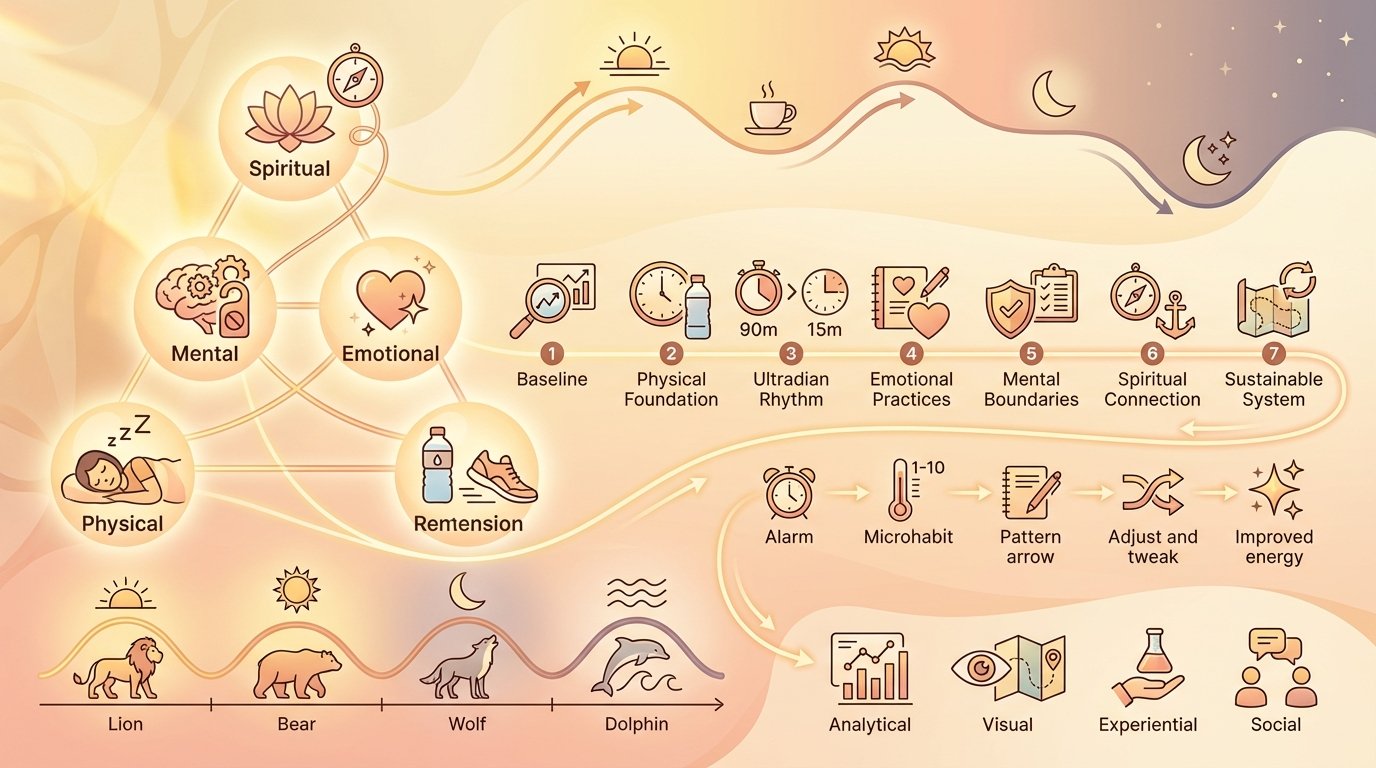
Energy management is the practice of intentionally aligning your activities with your natural energy rhythms while actively building and protecting your physical, mental, emotional, and spiritual reserves. Unlike time management, which treats every hour as equal, energy management recognizes that not all hours are created equal. What if you could complete your most challenging work during your natural peak performance windows? Later in this guide, you'll discover the counterintuitive truth about why pushing through fatigue actually depletes your long-term energy capacity.
Surprising Insight: Surprising Insight: Research from the Energy Project shows that working in 90-minute intervals aligned with your ultradian rhythms can increase productivity by up to 30% compared to continuous work—yet most people fight against these natural cycles rather than working with them.
What Energy Management Means and Why It Matters in 2025
Energy management is fundamentally different from time management. Time is finite and equal—everyone gets 24 hours. Energy is renewable but variable—you can expand your capacity and strategically deploy it. The four dimensions of energy are physical (bodily vitality), emotional (feelings and mood), mental (focus and cognition), and spiritual (purpose and meaning). Each dimension requires different renewal strategies and depletes through different activities.
In 2025, energy management has become critical as remote work blurs boundaries, digital devices fragment attention, and always-on culture normalizes burnout. A 2024 study in the Journal of Occupational Health Psychology found that workers who practice energy management report 40% higher job satisfaction and 35% lower burnout rates compared to those who focus solely on time management. Not medical advice.
Four Dimensions of Energy
How the four energy types interact and influence each other.
🔍 Click to enlarge
Standards and Context: The Science Behind Energy Cycles
Energy management is grounded in chronobiology—the study of biological rhythms. Your circadian rhythm (approximately 24-hour cycle) regulates sleep-wake patterns, hormone release, and body temperature. Within each day, you also experience ultradian rhythms (90-120 minute cycles) that affect alertness and focus. Understanding these rhythms allows you to schedule demanding tasks during natural peaks and rest during natural troughs.
Research by Tony Schwartz and the Energy Project identified that high performers treat energy as their most precious resource. They build rituals around energy renewal, including strategic breaks, physical movement, emotional recovery, mental decompression, and purpose reconnection. The key insight: energy expenditure without renewal leads to diminishing returns and eventual breakdown.
Daily Energy Cycle Pattern
Typical energy fluctuations throughout a 24-hour period.
🔍 Click to enlarge
| Dimension | Primary Sources | Common Drains |
|---|---|---|
| Physical | Sleep, nutrition, exercise, hydration | Poor sleep, processed foods, sedentary lifestyle |
| Emotional | Positive relationships, gratitude, joy | Toxic relationships, suppressed feelings, chronic stress |
| Mental | Deep work blocks, learning, creativity | Constant interruptions, decision fatigue, multitasking |
| Spiritual | Purpose, values alignment, contribution | Meaningless work, value conflicts, disconnection |
Required Tools and Resources
To successfully learn energy management in 30 days, you'll need both tracking tools and implementation resources. The good news: most are free or already available.
- Energy tracking journal or app (simple notebook works perfectly)
- Calendar or scheduling tool to map energy peaks and activities
- Alarm or timer for 90-minute work intervals and breaks
- Water bottle for hydration tracking
- Comfortable walking shoes for movement breaks
- Sleep tracking method (app or manual log)
- List of your top 3-5 core values for spiritual energy alignment
Optional but helpful: fitness tracker, meditation app, standing desk or adjustable workspace, blue-light blocking glasses for evening screen time.
How to Learn Energy Management: Step-by-Step 30-Day Plan
This structured 30-day plan progressively builds your energy management skills through weekly themes. Each week focuses on one energy dimension while maintaining previous practices.
- Step 1: Days 1-3: Establish baseline by tracking your energy levels every 2 hours using a 1-10 scale. Note activities, food, sleep, and mood. Identify your natural high and low energy periods.
- Step 2: Days 4-7: Focus on physical energy foundation. Set a consistent sleep schedule (same bedtime and wake time), aim for 7-9 hours. Add 20-minute morning movement. Drink water first thing and before each meal.
- Step 3: Days 8-14: Implement ultradian rhythm work cycles. Work in focused 90-minute blocks followed by 15-minute breaks. During breaks, move your body—walk, stretch, or do light exercise. No screens during break time.
- Step 4: Days 15-21: Build emotional energy practices. Start each day listing three things you're grateful for. Take a 10-minute midday pause to check in with your feelings without judgment. End workday with a clear shutdown ritual.
- Step 5: Days 22-25: Protect mental energy through boundary setting. Batch similar tasks together. Set specific times for email and messages rather than constant checking. Create a not-to-do list of energy-draining activities to eliminate or delegate.
- Step 6: Days 26-28: Connect to spiritual energy by clarifying your top three values. Review your daily activities and identify which align with these values and which conflict. Adjust your schedule to increase value-aligned time by at least 20%.
- Step 7: Days 29-30: Design your sustainable energy management system. Based on 30 days of data, create your personalized energy map. Schedule your most important work during your peak energy windows. Build in non-negotiable renewal rituals. Review and adjust weekly.
Practice Playbook: From Beginner to Advanced
Energy management skills develop progressively. Start where you are and gradually increase sophistication as practices become automatic.
Energy Management Progression
The path from basic awareness to advanced optimization.
🔍 Click to enlarge
Beginner Practice: Awareness and Basic Rhythm (Weeks 1-2)
Start with 10 minutes daily. Track energy levels three times per day: morning, midday, evening. Notice patterns between sleep, food, movement, and energy. Implement one core habit: consistent sleep schedule. Add one 15-minute renewal break to your day. This foundation creates the data and rhythm needed for everything else.
Intermediate Practice: Alignment and Protection (Weeks 3-4)
Build to 20-30 minutes daily across multiple touchpoints. Match tasks to energy levels—analytical work during peaks, administrative tasks during moderate periods, creative brainstorming during recovery phases. Protect your energy with boundaries: designated focus times, notification limits, strategic no's to energy-draining commitments. Add emotional check-ins and gratitude practice.
Advanced Practice: Optimization and Expansion (Month 2+)
Develop sophisticated energy intelligence. Experiment with variables: different exercise timing, meal composition, work environment changes, social energy management. Track which combinations produce optimal states. Build resilience through strategic stress exposure and recovery. Design weekly energy budgets that balance output with renewal. Mentor others in energy management to deepen your own mastery.
| Time Block | Energy Level | Optimal Activities | Renewal Strategy |
|---|---|---|---|
| 6-9 AM | Rising | Morning routine, light planning, exercise | Sunlight exposure, hydration |
| 9-11 AM | Peak | Deep work, complex problem-solving, creation | 90-min focus block |
| 11 AM-12 PM | Moderate | Meetings, collaboration, communication | 5-min movement break |
| 12-1 PM | Dip | Lunch, social connection, easy tasks | Walk outside, mindful eating |
| 1-3 PM | Low | Administrative work, email, routine tasks | 15-min rest or meditation |
| 3-5 PM | Second Peak | Creative work, strategic thinking, learning | 90-min focus block |
| 5-7 PM | Declining | Wrap-up, planning, transition activities | Shutdown ritual, change environment |
| 7-10 PM | Recovery | Family time, hobbies, relaxation, preparation | No screens 1 hour before bed |
Profiles and Personalization: Energy Management by Type
Your chronotype (natural sleep-wake preference) significantly affects your energy patterns. Understanding your type allows you to work with rather than against your biology.
Lions (morning people, about 15% of population) peak early, feel best from 6-10 AM. Schedule your most demanding work first thing. Protect your evening wind-down starting at 8 PM. Dolphins (light sleepers, 10%) have irregular patterns and often experience insomnia. Focus on consistency and stress reduction rather than rigid scheduling. Bears (50%) follow solar rhythms and do well with traditional 9-5 schedules. Maximize your mid-morning peak. Wolves (evening people, 15%) peak late, performing best from 12 PM-8 PM. Advocate for flexible scheduling if possible and protect morning recovery time.
| Chronotype | Peak Hours | Key Strategy | Common Challenge |
|---|---|---|---|
| Lion (Morning) | 6-10 AM | Front-load demanding work | Afternoon energy crash |
| Bear (Daytime) | 10 AM-2 PM | Follow solar schedule | Post-lunch dip management |
| Wolf (Evening) | 12 PM-8 PM | Delay important tasks to afternoon | Morning grogginess |
| Dolphin (Irregular) | Variable | Prioritize consistency and stress management | Sleep quality |
Learning Styles: How Different People Learn Energy Management
People absorb and implement energy management principles differently based on learning preferences.
Analytical learners thrive with data. Track everything for two weeks, create spreadsheets, identify patterns, test variables systematically. Use apps like HRV (heart rate variability) trackers to quantify recovery. Visual learners benefit from energy maps, color-coded calendars, diagrams, and infographics. Create visual representations of your ideal energy-aligned day. Experiential learners need to feel the difference. Run mini-experiments: one week with consistent sleep versus inconsistent, with movement breaks versus sedentary, with values-aligned work versus meaningless tasks. Social learners implement best with accountability partners, group challenges, or coaching. Find an energy management buddy or join a community.
Science and Studies Supporting Energy Management (2024-2025)
Recent research continues to validate energy management as a critical wellbeing and performance practice. A 2024 meta-analysis in the Journal of Applied Psychology reviewed 83 studies and found that energy management interventions improved work performance by an average of 28% and reduced burnout symptoms by 35% across diverse populations.
Research published in Nature Human Behaviour in 2024 demonstrated that individuals who align cognitively demanding tasks with their personal chronotype-specific peak periods show 20% better performance and report significantly lower perceived effort. The study tracked 847 participants across six weeks, using both subjective reports and objective cognitive testing.
A 2025 longitudinal study from the University of Michigan followed 1,200 knowledge workers over 18 months. Those who implemented structured energy renewal practices (including 90-minute work cycles with breaks, consistent sleep schedules, and weekly reflection) maintained 93% of their baseline performance during high-stress periods, compared to just 67% for the control group. The energy management group also reported 41% higher life satisfaction.
Importantly, a 2024 systematic review in Psychological Bulletin examined the sustainability of energy management practices. Interventions that focused on personalization (matching strategies to individual chronotypes, preferences, and contexts) showed 76% adherence at one-year follow-up, compared to only 34% for one-size-fits-all approaches.
Spiritual and Meaning Lens: Energy as Life Force
Many wisdom traditions view energy not merely as a biological resource but as fundamental life force. In yogic philosophy, prana represents vital energy flowing through the body. Chinese medicine speaks of qi, the animating force that when blocked or depleted causes illness. These traditions offer practices specifically designed to cultivate and balance energy: breathwork, meditation, tai chi, qigong.
From a meaning-making perspective, energy management connects to living a values-aligned life. When you spend energy on activities that reflect your deepest values and purpose, the expenditure feels less draining. This spiritual dimension of energy management involves regularly asking: Does this activity contribute to what matters most? Am I depleting myself for things that don't truly nourish my soul?
Many people find that connecting their daily energy management to a larger sense of purpose or service transforms the practice from self-improvement task to sacred responsibility. You're not just optimizing productivity; you're stewarding your life force so you can contribute your unique gifts to the world.
Positive Stories: Real People Transforming Through Energy Management
Maria, a 38-year-old nonprofit director, described herself as perpetually exhausted despite passion for her work. After implementing a 30-day energy management plan, she discovered her natural peak was 9-11 AM—exactly when she scheduled administrative meetings. She restructured her calendar to protect morning hours for strategic planning and creative work, moving meetings to her moderate-energy afternoon windows. Within six weeks, she reported feeling more energized than she had in five years and her team noticed improved decision-making.
James, a software engineer and self-described night owl, struggled with his company's rigid 9 AM start time. Learning about chronotypes helped him recognize he was a Wolf type with natural peaks from noon to 8 PM. He negotiated a 10:30 AM start time with his manager, protecting his morning for sleep recovery. His afternoon productivity increased so dramatically that his performance reviews improved and he was able to maintain the flexible schedule permanently.
Through tracking her energy over two weeks, Sarah, a teacher and mother of three, realized that her evening exhaustion wasn't inevitable—it correlated directly with skipping lunch and drinking excessive caffeine instead. She began packing nutritious lunches and taking a genuine 30-minute break. The simple change increased her evening presence with her children and reduced her stress-related headaches by 80%.
Microhabit: The Two-Minute Energy Check-In
The smallest sustainable energy management practice is the two-minute energy check-in, performed three times daily: morning, midday, and evening.
Set three daily alarms. When the alarm sounds, pause and rate your energy on a 1-10 scale across all four dimensions: physical (body vitality), emotional (mood), mental (focus), spiritual (sense of meaning). Simply notice the numbers—no judgment. Write them in a notebook or phone note. That's it.
This microhabit builds the foundational skill of energy awareness. Within one week, you'll start noticing patterns. Within two weeks, you'll intuitively begin making small adjustments. Within 30 days, you'll have rich data about your personal energy landscape. The practice takes minimal time and effort but creates the awareness foundation that makes every other energy management strategy more effective.
Microhabit Implementation Cycle
How a small daily habit compounds into lasting change.
🔍 Click to enlarge
Quiz Bridge: Discover Your Energy Profile
Understanding your unique energy patterns is the first step toward effective management. Everyone has different peak times, energy drains, and renewal needs. Your chronotype, work demands, stress tolerance, and recovery capacity all influence your optimal energy management strategy.
The BeMooore Energy Assessment takes 8 minutes and provides personalized insights into your energy patterns, chronotype, primary energy drains, and most effective renewal strategies. You'll receive a customized 30-day plan matched to your specific profile—whether you're a morning person struggling with afternoon crashes, a night owl fighting early schedules, or someone dealing with chronic low energy despite adequate sleep.
Take the assessment now to get your personalized energy management roadmap.
Get personalized recommendations based on your answers.
Take Full Assessment →Next Steps: Building Your Sustainable Energy Management Practice
You now have a comprehensive framework for learning energy management in 30 days. The science is clear: managing your energy rather than just your time dramatically improves performance, wellbeing, and life satisfaction. The practices outlined in this guide—from tracking your energy patterns to aligning activities with your natural rhythms to protecting renewal time—provide a proven path forward.
Start today with the baseline tracking exercise. For three days, simply observe your energy levels every few hours and note what you were doing, eating, and feeling. This data will reveal your personal energy landscape and inform every subsequent practice. Remember that energy management is not about squeezing more productivity from every hour—it's about living in greater alignment with your natural rhythms, protecting your wellbeing, and ensuring you have energy for what truly matters.
As you implement these practices over the next 30 days, be patient with yourself. You're not just changing behaviors; you're rewiring deeply ingrained patterns and building new awareness. Some days will feel effortless; others will require deliberate intention. Both are part of the process. The goal is progress, not perfection—a gradual shift toward living with more energy, presence, and vitality. Your future self will thank you for the investment you're making today.
Author Bio
This article was written by David Miller, an evidence-led wellbeing writer focused on microhabits and behavior design for daily life. David synthesizes research from psychology, neuroscience, and behavior change to create practical guides for sustainable wellbeing. Learn more at his author page.
Research Sources
This article is based on peer-reviewed research and authoritative sources. Below are the key references we consulted:
Related Glossary Articles
Take the Next Step
Ready to improve your wellbeing? Take our free assessment to get personalized recommendations based on your unique situation.
- Discover your strengths and gaps
- Get personalized quick wins
- Track your progress over time
- Evidence-based strategies
About the Author
Keep quitting habit apps after a missed day? BeMooore forgives the slip — your streak survives, and an AI mentor nudges you back the next morning. Free on iOS.