How to Handle Psychological Flexibility Fast
You cannot control every thought that pops into your mind. But you can choose whether to struggle against those thoughts or move forward with purpose. That choice is psychological flexibility, and it transforms how you respond to life's hardest moments. Most people spend years fighting their inner experiences. You can start building mental agility today.
This guide reveals evidence-based ACT strategies you can practice immediately. You'll discover why acceptance beats avoidance, how values guide flexible action, and the surprising neuroscience behind defusion techniques that we'll explore in the Practice Playbook section.
What Psychological Flexibility Means and Why It Matters
Psychological flexibility is your ability to stay present with difficult thoughts and feelings while taking action aligned with your values. Research from 2024 meta-analyses shows ACT produces moderate to large effects on depression, anxiety, and wellbeing by targeting this core process. Instead of eliminating pain, you learn to carry it differently.
Surprising Insight: Surprising Insight: People with high psychological flexibility don't experience fewer negative emotions. They simply don't let those emotions dictate their choices. We'll unpack the six ACT processes that make this possible in the Standards section below.
Three elements define psychological flexibility: present moment awareness, acceptance of internal experiences, and committed action toward values. When these work together, you stop wasting energy on control strategies that don't work. A 2025 study of transitional-age youth found ACT interventions targeting flexibility reduced psychopathology with effect sizes around 0.72 compared to control conditions.
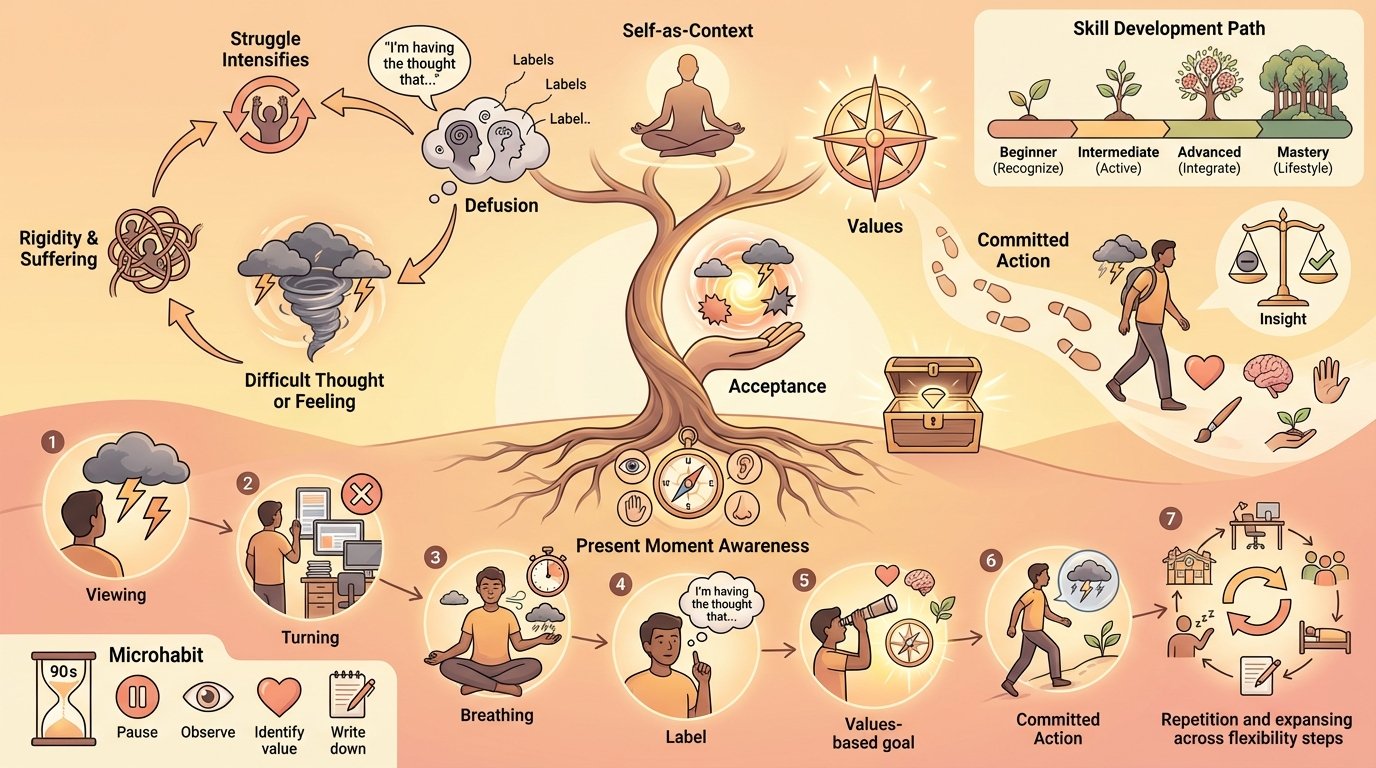
The Psychological Flexibility Model
Core components of psychological flexibility showing how present moment awareness, acceptance, and values-driven action create mental agility
🔍 Click to enlarge
Standards and Context: The ACT Framework
Not medical advice. Acceptance and Commitment Therapy identifies six core processes that build psychological flexibility: acceptance, cognitive defusion, being present, self-as-context, values, and committed action. These processes overlap and reinforce each other.
The Association for Contextual Behavioral Science maintains evidence standards for ACT interventions. Over 1,000 studies support psychological flexibility as a transdiagnostic process relevant across anxiety, depression, chronic pain, workplace stress, and relationship challenges. The framework comes from functional contextualism, which focuses on workability rather than absolute truth.
| Process | Core Question | Quick Practice |
|---|---|---|
| Acceptance | Can I make room for this feeling? | Notice sensation without pushing away |
| Defusion | Am I this thought or having this thought? | Label thoughts as mental events |
| Present Moment | Where is my attention right now? | Notice five things you can see |
| Self-as-Context | Who is observing these experiences? | Take observer perspective for 60 seconds |
| Values | What matters most to me? | Name one value guiding today's choices |
| Committed Action | What small step serves my values? | Take one tiny values-aligned action now |
ACT Hexaflex: Six Processes Working Together
The interconnected processes that create psychological flexibility in Acceptance and Commitment Therapy
🔍 Click to enlarge
Required Tools and Resources for Fast Progress
You need minimal external tools to build psychological flexibility. Most practices use what you already have: your breath, your attention, and daily situations where discomfort arises. A notebook helps track values and committed actions. Timer apps support timed acceptance exercises.
- Notebook or digital notes app for values clarification and action tracking
- Timer (phone app works fine) for 3-5 minute mindfulness practices
- Values card sort (free downloads available from ACT researchers) to identify core values
- Quiet space for 10-minute daily practice sessions
- ACT-based apps like ACT Coach or ACT Companion for guided exercises
- Metaphor collection (leaves on stream, passengers on bus) to aid defusion work
- Support person or group for accountability with committed actions
How to Apply Psychological Flexibility: Step by Step
Dr. Steven Hayes demonstrates core flexibility principles in this accessible talk that connects personal struggle to practical techniques.
- Step 1: Name the struggle: Write down one recurring uncomfortable thought or feeling you typically avoid. Be specific. Example: "I feel anxious before presentations" or "I think I'm not good enough."
- Step 2: Notice the avoidance: Identify how you currently avoid this experience. Common strategies include distraction, substances, overwork, or rumination. Observe without judgment.
- Step 3: Practice acceptance for 5 minutes: Set a timer. Bring the uncomfortable feeling to mind. Notice where you feel it in your body. Breathe normally. Say internally: "I can make room for this."
- Step 4: Defuse from thoughts: When the thought appears, add "I'm having the thought that..." before it. This creates distance. The thought "I'm failing" becomes "I'm having the thought that I'm failing."
- Step 5: Clarify one core value: Ask yourself: "If this struggle disappeared, what would I do with my life?" The answer points to your values. Write down one word: connection, creativity, growth, service, etc.
- Step 6: Take one committed action: Choose the smallest possible action aligned with your value. If you value connection but avoid social events, committed action might be texting one friend today.
- Step 7: Repeat with willingness: Flexibility develops through repeated practice with new situations. Each time discomfort arises, pause and ask: "Can I accept this and still move toward what matters?" Then act.
- Step 8: Track workability: At day's end, note whether acceptance plus action moved you toward your values. Psychological flexibility isn't about feeling better. It's about living better.
- Step 9: Expand to new domains: Once comfortable with one struggle, apply the same process to different areas: work stress, relationship conflict, health anxiety, creative blocks.
- Step 10: Build daily micro-practices: Embed 2-minute acceptance breaks into your routine. Morning coffee becomes a chance to notice thoughts without attachment. Commute time becomes defusion practice.
Practice Playbook: From Beginner to Advanced Flexibility
Skill Development Path
Progressive levels of psychological flexibility practice from basic awareness to integrated lifestyle
🔍 Click to enlarge
Beginner: 10 Minutes Daily for Two Weeks
Start with simple present-moment awareness. Sit comfortably. Notice five things you can see, four you can hear, three you can touch, two you can smell, one you can taste. This grounds you in now. When thoughts arise, label them: "planning thought," "worry thought," "memory." Return to sensory awareness.
Practice acceptance with low-intensity discomfort first. Feel slightly hungry before lunch. Notice the sensation fully. Don't act immediately. Breathe with it for three minutes. This builds your tolerance for sitting with discomfort. Do this with minor annoyances: traffic delays, slow internet, waiting in line.
Intermediate: Skill Building Over Four to Six Weeks
Work with moderate-intensity struggles. Choose one recurring negative thought. Practice defusion techniques: say the thought in a silly voice, sing it to a nursery rhyme melody, write it repeatedly until it loses meaning, thank your mind for the thought. Notice how the thought's impact changes when you change your relationship to it.
Begin values clarification exercises. Complete a values card sort or write your eulogy. What do you want people to say you stood for? Identify three to five core values. For each value, list one behavior you're currently doing and one you're avoiding due to discomfort. The avoidance reveals where flexibility would help most.
Link acceptance to committed action. Each week, choose one values-based action you've been avoiding. Break it into the smallest possible first step. Before taking the step, practice acceptance with whatever fear or discomfort arises. Take the action while carrying the discomfort. This is the core of psychological flexibility.
Advanced: Integrating Flexibility Into Life
Apply the hexaflex to complex situations. During relationship conflicts, notice your emotional reaction (present moment), make room for defensive feelings (acceptance), recognize habitual thought patterns (defusion), remember you're more than this moment's emotions (self-as-context), recall what you value in relationships (values), and choose a response aligned with connection rather than winning (committed action).
Work with high-intensity experiences: grief, trauma responses, chronic pain, deep shame. These require all six processes plus self-compassion. Consider working with an ACT-trained therapist for safe guidance. Advanced flexibility means responding skillfully even when suffering intensifies.
Develop creative hopelessness around control. Notice how efforts to control thoughts and feelings often backfire. Don't try to not think about a white bear for 60 seconds. The paradox reveals why acceptance works better than control. Apply this insight broadly: what if trying to feel different keeps you stuck?
Profiles and Personalization: Flexibility Across Contexts
Psychological flexibility looks different depending on your life situation. Parents might practice acceptance around parenting fears while taking committed action to stay present with children. Entrepreneurs apply defusion to imposter thoughts while pursuing business values. Students use flexibility to handle academic pressure without sacrificing wellbeing.
| Profile | Common Struggle | Flexibility Practice | Committed Action Example |
|---|---|---|---|
| Busy Professional | Work stress and perfectionism | Defuse from "not enough" thoughts | Set one boundary at work this week |
| Parent | Guilt about parenting choices | Accept guilt without overcompensating | Play with child for 15 minutes fully present |
| Student | Test anxiety and comparison | Notice anxiety in body, name it | Study for values (learning) not fear |
| Creative | Fear of judgment blocking expression | Make room for vulnerability | Share one piece of work publicly |
| Someone with chronic pain | Fighting constant discomfort | Accept pain without life stopping | Engage in valued activity despite pain |
| Relationship focused | Fear of rejection in connections | Defuse from rejection thoughts | Initiate vulnerable conversation |
Learning Styles: How Different People Build Flexibility
Visual learners benefit from ACT metaphors and diagrams. Draw the hexaflex. Create visual representations of values. Use the leaves-on-a-stream visualization where thoughts float by on leaves. Auditory learners prefer guided meditations and therapy recordings. Listen to ACT podcasts during commutes.
Kinesthetic learners excel with physical practices. Notice anxiety as body sensation rather than abstract concept. Use movement meditation. Take committed actions that involve your whole body. Analytical learners appreciate the research base. Read original ACT studies. Track your flexibility metrics. Notice patterns in your workability data.
Experiential learners jump straight into practice. Don't overthink the theory. Try each technique with real discomfort. Notice what works through direct experience. Reflective learners journal extensively about values and committed actions. Process the work through writing.
Science and Studies from 2024 to 2025
A 2025 systematic review in ScienceDirect examined ACT efficacy for depression. Findings showed significant effects on depressive symptoms, anxiety symptoms, and psychological flexibility itself. The transdiagnostic nature of flexibility means improvements in this single process benefit multiple conditions simultaneously.
Research published in PMC during early 2025 explored ACT and psychological wellbeing through narrative review. Studies confirm that psychological flexibility predicts life satisfaction, meaning, and adaptive coping across diverse populations. The mechanism appears to be reduced experiential avoidance and increased values-consistent behavior.
A Clinical Child and Family Psychology Review meta-analysis from 2025 focused on transitional-age youth. Based on 65 studies, ACT showed moderate effects compared to controls across psychopathology, ACT-related processes, wellbeing, and coping. Effect sizes were strongest when interventions explicitly targeted all six flexibility processes.
BetterUp's 2024 workplace research demonstrated psychological flexibility predicts resilience, innovation, and leadership effectiveness. Employees with high flexibility adapt better to change, recover faster from setbacks, and report greater job satisfaction. Organizations increasingly incorporate ACT training for these benefits.
Spiritual and Meaning Lens on Psychological Flexibility
Many spiritual traditions cultivated psychological flexibility long before modern psychology named it. Buddhist mindfulness practices train present-moment awareness and acceptance. Christian contemplative prayer develops defusion from thoughts. Stoic philosophy emphasizes values-aligned action regardless of circumstances.
The concept of surrender in multiple faiths parallels ACT acceptance: releasing the struggle to control what cannot be controlled. Judeo-Christian traditions speak of accepting suffering while choosing loving action. Islamic teachings about tawakkul (trust in divine providence) combine acceptance with committed effort.
For those with spiritual or religious frameworks, psychological flexibility connects to deeper purpose. Values clarification might involve prayer or meditation on calling. Committed action becomes sacred practice. Defusion techniques help distinguish between divine voice and ego chatter. You can integrate ACT with your existing meaning-making systems.
Positive Stories: Real People Building Flexibility
Sarah struggled with social anxiety for 15 years. She avoided gatherings and professional networking. Through ACT, she learned to accept anxiety as a physical sensation while attending events anyway. Her anxiety didn't disappear. But she stopped letting it choose her life. Within six months, she reconnected with old friends and changed careers to work she valued.
Marcus experienced chronic back pain after an injury. He spent three years fighting the pain through multiple surgeries and medications. ACT helped him accept pain as part of his current experience while re-engaging with life. He returned to coaching youth soccer, his core value, using modifications. His pain levels didn't change much. His life satisfaction tripled.
Dr. Hayes himself developed ACT partly through his own panic disorder. His TEDx talk describes hitting bottom in a grocery store, terrified and ready to hospitalize himself. The turning point came when he stopped running from his fear. Psychological flexibility emerged from his willingness to feel everything while choosing to move forward. He now helps millions develop the same capacity.
Microhabit: The 90-Second Flexibility Check-In
Build flexibility through a tiny daily practice. Set a phone reminder for the same time each day. When it goes off, pause for 90 seconds. Notice what you're thinking and feeling right now without changing it. Name one value. Identify one small action aligned with that value you can take today. Write it down. Take the action later, regardless of how you feel.
This microhabit trains all six ACT processes in compressed form. Present-moment awareness in noticing current experience. Acceptance in not changing what you find. Defusion through naming rather than fusing with thoughts. Self-as-context through the observer stance. Values in naming what matters. Committed action in choosing the small step.
After two weeks of daily 90-second check-ins, you'll notice increased awareness of the gap between feelings and actions. After a month, values-aligned choices become more automatic. After three months, you've practiced flexibility over 90 times, building genuine mental agility.
Quiz Bridge: Assess Your Current Flexibility
Understanding your baseline psychological flexibility helps you target specific processes for development. Take our comprehensive assessment to discover which of the six ACT processes you're already using well and which need attention. The quiz provides personalized suggestions based on your responses.
Get personalized insights into your psychological flexibility profile and receive custom recommendations for building mental agility in the areas that matter most to you.
Start Full Assessment →Sample Questions
Can you really build psychological flexibility overnight or fast?
You can begin practicing flexibility immediately and notice shifts within days. However, deep flexibility develops over weeks and months of consistent practice. "Fast" means you don't need years of therapy before starting. You can apply acceptance, defusion, and values-based action to today's challenges right now.
Is psychological flexibility the same as emotional suppression?
No, they're opposites. Suppression involves pushing feelings away or pretending they don't exist. Flexibility requires full contact with emotions while choosing behavior independently. You feel the fear completely and act courageously anyway. Suppression creates rigidity. Acceptance creates space for flexible response.
What if my values conflict with each other?
Value conflicts are normal. You might value both career achievement and family time. Flexibility helps you make workable choices in specific contexts rather than rigidly prioritizing one value always. Ask: "In this moment, which value needs attention?" Balance happens over time, not in every single decision.
Do I need a therapist to learn ACT and psychological flexibility?
Many people build basic flexibility through self-guided practice using books, apps, and resources like this guide. However, working with an ACT-trained therapist accelerates learning, especially for complex trauma, severe mental health conditions, or when you feel stuck. Therapy provides personalized guidance and safe space for difficult emotions.
How is psychological flexibility different from just "thinking positive"?
Positive thinking tries to replace negative thoughts with positive ones. Flexibility doesn't require changing thought content at all. You can have the thought "this is terrible" and still act effectively. The shift is in your relationship to thoughts, not their positivity. This makes flexibility more robust because it works even when you can't generate positive thoughts.
What if acceptance makes me passive or resigned to bad situations?
Acceptance in ACT means accepting internal experiences, not external circumstances. You accept the anxiety about confronting your boss while still having the difficult conversation. You accept grief about injustice while taking action for change. Flexibility often requires more courage than avoidance because you face discomfort and act anyway.
Next Steps: Building Your Flexibility Practice
Start with the 90-second daily microhabit described above. Practice for two weeks before adding complexity. Once comfortable with brief check-ins, extend to 5-minute acceptance practices. Then add defusion exercises. Build gradually rather than trying everything at once.
Complete a formal values clarification exercise this week. Use a values card sort or write about what you want your life to stand for. Choose one value and one small committed action. Take that action within 48 hours, noticing whatever discomfort arises and choosing to carry it.
Connect with ACT resources for ongoing learning. Read "The Happiness Trap" by Russ Harris or "Get Out of Your Mind and Into Your Life" by Steven Hayes. Try the ACT Companion app for guided practices. Consider joining an ACT skills group or finding an ACT therapist if you want structured support.
Explore related practices that build mental resilience. Our guides on stress tolerance, coping mechanisms, and adversity management complement psychological flexibility with additional strategies for navigating life's challenges while staying aligned with what matters most.
Research Sources
This article is based on peer-reviewed research and authoritative sources. Below are the key references we consulted:
Related Glossary Articles
Take the Next Step
Ready to improve your wellbeing? Take our free assessment to get personalized recommendations based on your unique situation.
- Discover your strengths and gaps
- Get personalized quick wins
- Track your progress over time
- Evidence-based strategies
About the Author
Keep quitting habit apps after a missed day? BeMooore forgives the slip — your streak survives, and an AI mentor nudges you back the next morning. Free on iOS.