Self-Sabotage
You set a goal. You work hard. Then, just as success nears, something inside pulls you backward. Your mind whispers doubts. You procrastinate. You find reasons why it won't work. This is self-sabotage: the hidden pattern of undermining your own achievements. It happens to high achievers, ambitious dreamers, and even those with tremendous potential. The frustrating truth? You're not broken—you're human. Self-sabotage is a protective mechanism gone wrong, rooted in fear, limiting beliefs, and patterns learned early in life. Understanding why you do it is the first step to breaking free.
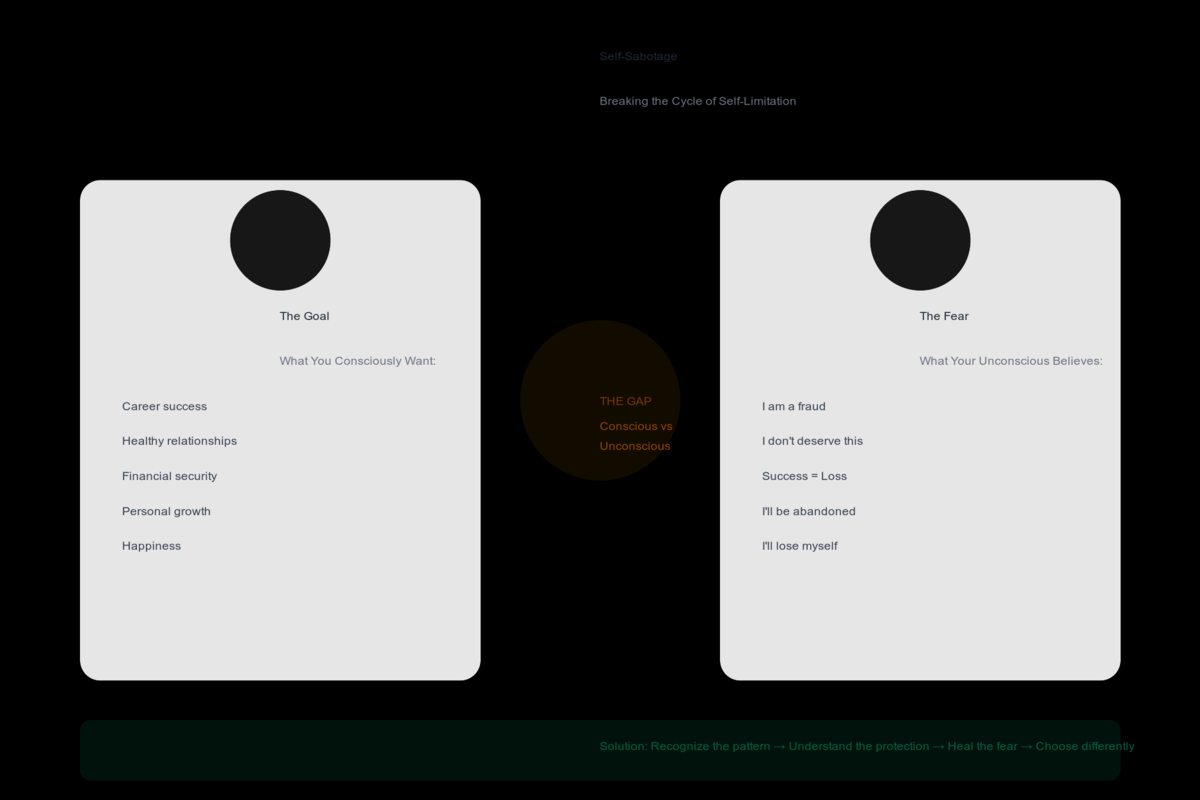
More than 70% of people report experiencing self-sabotaging behaviors at some point, according to psychological research. Whether it's picking fights right before something important, making poor decisions when stakes are high, or convincing yourself you don't deserve success, self-sabotage keeps millions stuck in cycles of disappointment.
The good news? Self-sabotage is not destiny. It's a learned pattern, which means it can be unlearned. This guide explores what drives self-sabotage, why it feels so automatic, and how to interrupt these patterns before they hijack your life.
What Is Self-Sabotage?
Self-sabotage is a conscious or unconscious pattern of behavior designed to undermine your own goals, relationships, or wellbeing. It's different from simple failure—it's active self-undermining. You might procrastinate on a project you're passionate about, start arguments with your partner right before a romantic getaway, or engage in risky behaviors when things are going well. The distinguishing factor is that some part of you seems invested in making sure you don't succeed or feel happy.
Not medical advice.
Self-sabotage operates in the gap between your conscious goals and your unconscious beliefs. Consciously, you want success, health, love, and fulfillment. Unconsciously, you may hold beliefs that these things are dangerous, undeserved, or impossible. That conflict creates the self-defeating behavior. It's not stupidity or weakness—it's a conflict between two parts of your mind fighting for control.
Surprising Insight: Surprising Insight: Self-sabotage is often a sign of courage trying to protect you. Your mind learned that success or visibility was unsafe, so it developed sophisticated methods to keep you hidden and 'safe'—even when you're no longer in danger.
The Self-Sabotage Cycle
Shows how a goal triggers fear, which activates protective behaviors, creating failure, which reinforces limiting beliefs and the cycle repeats.
🔍 Click to enlarge
Why Self-Sabotage Matters in 2026
In 2026, the cost of self-sabotage has never been higher. With remote work, side hustles, and entrepreneurship creating unlimited opportunity, the biggest limiting factor isn't access—it's self-belief. People with identical skills, resources, and opportunities often experience vastly different outcomes. The difference? Self-sabotage. One person pursues their dream. The other finds reasons why now isn't the right time.
Digital connectivity also intensifies self-sabotage. Social media comparison amplifies impostor syndrome. Online visibility triggers the fear of judgment that many learned to associate with being seen. Dating apps make rejection more frequent and visible. The pace of modern life means you have less time to process emotions, and less-processed emotions often leak out as self-defeating behavior.
Mental health awareness is increasing, yet many people with the resources and knowledge to improve still find themselves stuck. Often, this isn't a knowledge problem—it's a belief problem. Understanding self-sabotage helps you move from the frustration of knowing what to do but not doing it, to actually changing the patterns that hold you back. This is no longer a luxury; in a competitive world, emotional mastery is a survival skill.
The Science Behind Self-Sabotage
Neuroscience reveals that self-sabotage isn't a character flaw—it's a survival mechanism. Your brain's primary job is to keep you safe, not happy. If your unconscious mind learned (often in childhood) that success, visibility, or happiness came with punishment, rejection, or loss, it will work overtime to prevent those outcomes. This is the amygdala, your threat-detection center, triggering protective responses that now sabotage you.
Research by psychologist Piers Steel on procrastination (a common form of self-sabotage) shows it's not laziness—it's emotion regulation. You procrastinate to escape the anxiety or discomfort a task triggers. Self-sabotage works the same way. When approaching success triggers deep fear (of abandonment, judgment, or loss of identity), your brain creates a problem (sabotage) to redirect your attention to something more emotionally manageable.
Brain Regions Involved in Self-Sabotage
Illustrates how the amygdala (fear), prefrontal cortex (planning), and hippocampus (memory) interact to create self-sabotaging patterns based on past experiences.
🔍 Click to enlarge
Key Components of Self-Sabotage
Fear of Success
Success can trigger deep fears: fear that you'll be exposed as a fraud, that others will resent you, that you'll lose yourself, or that the pressure to maintain success is unbearable. Children of parents who struggled may develop an unconscious belief that success leads to arrogance and falls. These fears manifest as mysteriously falling apart right before important opportunities.
Loyalty to Family Patterns
If your family of origin normalized struggle, limitation, or 'knowing your place,' success can feel like a betrayal. Your unconscious mind sabotages to stay loyal to family identity. You may think: 'If I succeed, I'm rejecting my family,' or 'Success isn't for people like us.' These beliefs run deep and operate invisibly.
Impostor Syndrome and Unworthiness
Many achievers carry the belief that they don't truly deserve their accomplishments. They were 'just lucky' or 'the bar was low.' This belief drives sabotage when stakes are highest—right when success would prove the impostor belief wrong. Sabotage prevents the cognitive dissonance between 'I'm unworthy' and 'I'm succeeding.'
Identity Protection
Your sense of self is invested in a particular identity: the struggling artist, the caretaker, the loyal friend, the realistic pessimist. Changing that identity feels like death, even when the new identity is healthier. Self-sabotage kicks in to protect the familiar identity, even if it's limiting.
| Domain | Self-Sabotaging Pattern | Underlying Fear |
|---|---|---|
| Career | Missing deadlines, undermining own ideas, staying in dead-end roles despite opportunities | Fear of responsibility, judgment, or outshining others |
| Relationships | Starting fights before intimacy deepens, pushing partner away, attracting unavailable partners | Fear of abandonment, engulfment, or being truly known |
| Health | Starting gym routine then quitting, self-soothing with unhealthy food when stressed | Fear of bodily autonomy, visibility, or having no excuse for other failures |
| Financial | Overspending right after earning money, losing windfalls, avoiding financial planning | Fear of wealth's responsibility or unconscious belief in scarcity |
| Creative | Perfectionism that prevents finishing, sharing work, or receiving critique | Fear of judgment, failure, or becoming 'successful' and losing authenticity |
How to Apply Self-Sabotage Awareness: Step by Step
- Step 1: Notice the pattern: Track where and when you sabotage. Do you always self-undermine at the same success level? Right before commitment? When others acknowledge your abilities? Write it down—awareness breaks the automaticity.
- Step 2: Identify the feared outcome: Behind every sabotage is a fear. Ask yourself: 'If I succeed here, what bad thing might happen?' The answer reveals the protective intention of your sabotage.
- Step 3: Trace the origin: Where did you learn that this outcome was dangerous? What experience taught your nervous system this protective pattern was necessary? This isn't about blame—it's about understanding.
- Step 4: Name the belief: What limiting belief underlies the sabotage? 'I don't deserve this,' 'Success makes me selfish,' 'If I'm visible, I'll be attacked.' Naming it gives you power over it.
- Step 5: Externalize the pattern: Instead of 'I am a self-saboteur,' try 'I have a pattern of self-sabotage.' This small shift moves you from identity to behavior, making change possible.
- Step 6: Test the belief in present day: Is this threat real now? When you're safe, your nervous system can update. Repeatedly expose yourself to the feared outcome in small, manageable doses.
- Step 7: Create a success protocol: Plan specifically how you'll act when fear tries to sabotage. What will you do instead of procrastinate, argue, or self-destruct? Practice these new responses.
- Step 8: Build accountability: Tell someone you trust about your pattern and your commitment to changing it. External accountability activates the part of your brain that cares about promises.
- Step 9: Celebrate small wins: Every time you act against your sabotage pattern, your brain needs to register this as important. Celebrate moving toward the goal despite fear.
- Step 10: Work with nervous system regulation: Self-sabotage often includes nervous system dysregulation. Before high-stakes moments, use breathwork, grounding, or movement to keep your threat response calm.
Self-Sabotage Across Life Stages
Young Adulthood (18-35)
In young adulthood, self-sabotage often centers on identity and autonomy. You're building independence and testing capabilities, but if childhood conveyed that visibility or ambition was dangerous, you may unconsciously limit your scope. Patterns include staying in unsatisfying relationships to avoid the shame of being alone, choosing 'safe' careers over passions, or engaging in risk-taking that cancels out potential. At this stage, the good news is that nervous system patterns are still flexible. Small interventions now prevent decades of limitation.
Middle Adulthood (35-55)
Middle adulthood often brings a reckoning with self-sabotage. You're more aware of time's passage. Regret becomes palpable. Sabotage patterns intensify as you sense the window of opportunity narrowing. However, this stage also brings acceptance, wisdom, and often genuine power. Many middle-aged people finally have enough self-knowledge to interrupt patterns. The motivation to change peaks here, and the capacity for rapid transformation increases with life experience.
Later Adulthood (55+)
Later adulthood often brings freedom from performance pressure. For some, this reduces sabotage—who cares what others think? For others, legacy concerns intensify sabotage. Will I be remembered as a failure? Did I waste my potential? Later adulthood wisdom involves accepting what has passed while still engaging fully with present opportunities. Many discover that letting go of self-sabotage creates space for the most authentic and fulfilling chapter of their lives.
Profiles: Your Self-Sabotage Approach
The Perfectionist Staller
- Permission to do things imperfectly
- Deadlines that force completion over polish
- Reframing 'done' as success, not mediocrity
Common pitfall: Never finishing because it's never good enough, so others never see the work
Best move: Set a launch date in stone. Lower the bar intentionally. Get feedback on 'imperfect' work to realize your fear exceeds reality.
The Loyalty Saboteur
- Recognition that succeeding honors, not betrays, your family
- New relationships with people who embody different possibilities
- Permission to create your own legacy, not repeat your family's
Common pitfall: Creating personal problems or failures right when life is improving, to stay 'loyal' to family struggle
Best move: Have honest conversations with family about your ambitions. Reframe success as honoring their sacrifices, not rejecting them.
The Visibility Avoider
- Gradual exposure to being seen and appreciated
- Evidence that visibility doesn't lead to attack
- Trusted community that celebrates, not punishes, your growth
Common pitfall: Pulling back just when you're gaining recognition, starting drama to regain anonymity
Best move: Stay visible in small, safe contexts. Let yourself be seen by one trusted person, then gradually expand.
The Commitment Phobic
- Exploration of what commitment represents to you emotionally
- Gradual commitment in small doses with trusted partners
- Recognition that commitment offers safety, not captivity
Common pitfall: Sabotaging relationships or projects right before key commitments; creating chaos to avoid intimacy
Best move: Notice the moment before sabotage. Pause. Ask: what would it mean to stay? Often the answer is safety and love, not loss.
Common Self-Sabotage Mistakes
Mistake 1: Thinking you're broken. Self-sabotage isn't pathology—it's adaptation. Your nervous system developed this pattern because at some point, it worked. It kept you safe. Recognizing the adaptive origin removes shame and opens curiosity about changing it.
Mistake 2: Trying to willpower your way past it. Willpower fails because self-sabotage lives in the emotional and nervous system levels, not the rational level. You can know you should succeed, but if your nervous system perceives success as dangerous, willpower loses the fight. Success comes from nervous system healing, not mental discipline.
Mistake 3: Ignoring the protection mechanism. Your sabotage is trying to protect you from something—fear of judgment, abandonment, loss of identity, or overwhelming responsibility. Fighting the sabotage directly creates an internal war. Instead, ask: what is this protecting me from? What would help me feel safe stepping forward anyway?
From Self-Sabotage to Self-Compassion
Shows the shift from viewing sabotage as personal failure to understanding it as protection, which enables change and self-compassion.
🔍 Click to enlarge
Science and Studies
Research in psychology and neuroscience provides strong evidence for why self-sabotage occurs and how it can be addressed. The consistent finding across studies is that self-sabotage is not a weakness or choice—it's an automatic protective response rooted in learning and threat perception.
- Baumeister & Scher (1988): Identified self-sabotage as a public self-presentation strategy where people create obstacles to protect their self-image in case of failure.
- Elliot & Thrash (2004): Demonstrated that avoidance-motivation (driven by fear) is the strongest predictor of procrastination and self-undermining behaviors.
- Dweck (2006): Fixed mindset (belief that abilities are unchangeable) correlates strongly with self-sabotaging behaviors, while growth mindset enables change.
- Van der Kolk (2014): Trauma-informed research shows how early experiences shape threat perception and how nervous system healing enables behavioral change.
- Recent fMRI studies (2023-2024): Confirm that self-sabotage activates the amygdala (threat response) even when the threat is only imagined, not real.
Your First Micro Habit
Start Small Today
Today's action: Notice one sabotage moment this week without judgment. Simply observe: When did I self-undermine? What was I feeling? What did I fear? Write one sentence. That's it.
Awareness without judgment activates the learning centers of your brain. You shift from unconscious automation to conscious observation. This single step breaks the invisibility of self-sabotage.
Keep quitting habit apps after a missed day? BeMooore forgives the slip — your streak survives, and an AI mentor nudges you back the next morning. Free on iOS.
Quick Assessment
How often do you notice yourself undermining your own goals or happiness right when things are going well?
Your answer reveals how conscious you are of self-sabotage patterns. The more frequently you notice it, the more you're already developing awareness—the first step to change.
When you imagine succeeding at something important to you, what fear comes up first?
This reveals whether fear is driving your sabotage. The stronger the fear, the more likely your nervous system is working to 'protect' you from success.
Which resonates most with your self-sabotage pattern?
Your pattern reveals the protective function of your sabotage. Once you understand what it's protecting you from, you can address the real fear instead of fighting the behavior.
Take our full assessment to get personalized recommendations.
Discover Your Style →Next Steps
Breaking self-sabotage isn't a single action—it's a shift in how you relate to fear, success, and your own potential. Start with awareness. Notice where you sabotage. Ask what you're protecting yourself from. Then, gradually expose yourself to the feared outcome in safe, manageable doses. Your nervous system needs evidence that success, visibility, or commitment is safe. Provide that evidence through repeated, small experiences of moving forward despite fear.
Consider working with a therapist or coach who understands nervous system-based change. While self-awareness is powerful, professional guidance can help you identify deep beliefs and trauma patterns faster and with more compassion. This is an investment in decades of freedom from self-limitation.
Get personalized guidance with AI coaching.
Start Your Journey →Research Sources
This article is based on peer-reviewed research and authoritative sources. Below are the key references we consulted:
Related Glossary Articles
Frequently Asked Questions
Is self-sabotage a sign of mental illness?
No. Self-sabotage is a normal psychological pattern that most people experience. It's not a disorder—it's an adaptation your nervous system created for protection. However, if self-sabotage is severe, frequent, or causing significant distress, working with a therapist can help you understand and change it more effectively.
Can you outgrow self-sabotage on your own?
Yes, many people do with awareness and intentional practice. However, if your self-sabotage is rooted in trauma or deeply entrenched patterns, professional support (therapy, coaching) significantly accelerates change. The key is moving from intellectual understanding to nervous system healing.
Why does self-sabotage feel unconscious?
Because it is. Self-sabotaging behaviors were learned (usually in childhood) before you developed conscious awareness. They became automatic neural pathways. Your conscious mind might be screaming, 'Finish the project!' while your nervous system is quietly derailing you to keep you 'safe.' Bringing these patterns to consciousness is the first step.
How do I stop self-sabotage in the moment?
When you feel the urge to sabotage, pause and engage your nervous system: breathe deeply, ground yourself physically (feel your feet on the floor), name the fear you're protecting against. This activates your prefrontal cortex and calms the amygdala. Then, choose one small action toward your goal despite the discomfort. You're teaching your nervous system that success is safe.
What if my self-sabotage protects me from a real problem?
Sometimes self-sabotage seems protective because it prevents a real negative outcome. For example, perfectionism prevents public judgment. But it also prevents progress, visibility, and growth. The key is addressing the real problem (How do I handle judgment?) instead of relying on sabotage. With better coping skills, you don't need the old protection.
Take the Next Step
Ready to improve your wellbeing? Take our free assessment to get personalized recommendations based on your unique situation.
- Discover your strengths and gaps
- Get personalized quick wins
- Track your progress over time
- Evidence-based strategies