Self Alignment
Self alignment is the degree to which your daily actions, choices, and behaviors match your core values, beliefs, and authentic self. It's the felt sense of wholeness that emerges when who you are aligns with how you live. When you're in alignment, decisions feel effortless, relationships feel genuine, and life feels purposeful rather than forced. Most people drift through life with a gap between their real self and their lived experience—between what they believe matters and what they actually prioritize. Self alignment closes that gap. It's not about perfection or achieving some ideal; it's about honest integration of your values with your actions. Carl Rogers called this 'congruence'—the psychological equivalent of being all in one piece. Living in self alignment reduces stress, increases satisfaction, strengthens relationships, and creates the foundation for sustainable achievement across all life domains.
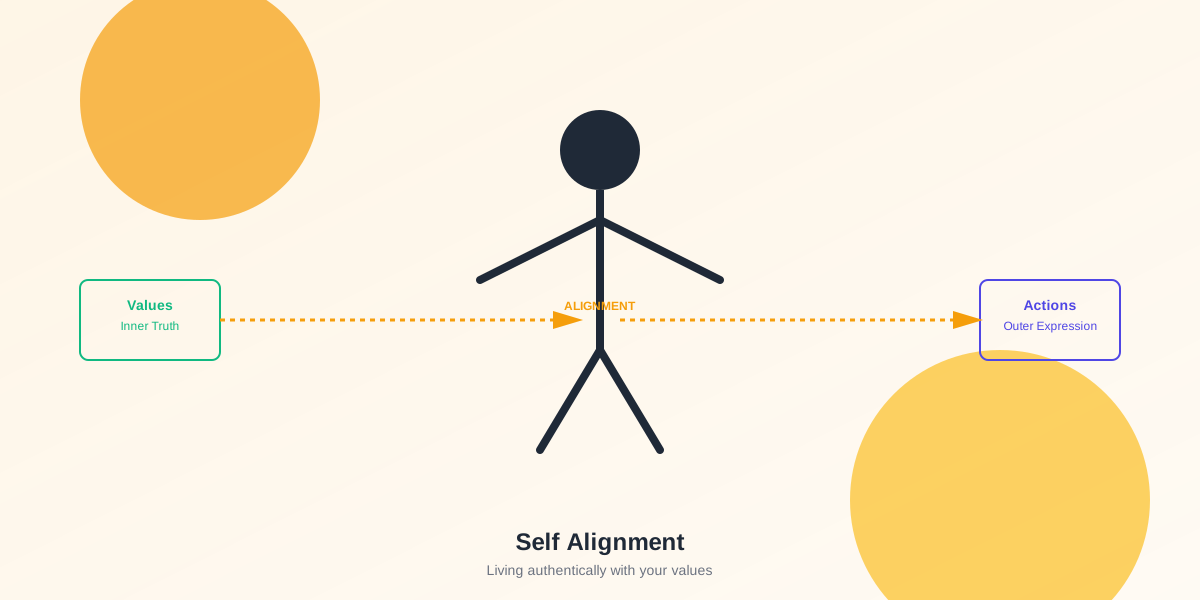
Self alignment isn't a destination you reach and stay at. It's an ongoing practice of noticing where your life has drifted from your values and consciously choosing realignment.
The consequences of misalignment are significant: depression, anxiety, relationship strain, burnout, and a persistent sense that something's missing despite external success. The benefits of alignment are equally profound: psychological ease, authentic relationships, meaningful work, and the ability to make decisions quickly because you're guided by clear values rather than external pressure.
What Is Self Alignment?
Self alignment refers to the harmony between your internal values, beliefs, and authentic self-concept and your external behaviors, choices, and life circumstances. It's the state where what you do reflects what you genuinely believe matters. The word integrity comes from the Latin integritas, meaning wholeness—and that's exactly what self alignment creates: a sense of being whole, integrated, and authentic. When you're aligned, your inner experience and outer expression match. You're not performing a role; you're living your values. You're not suppressing parts of yourself; you're expressing them. This internal-external match is what psychologists call 'state authenticity'—the immediate felt sense of being genuinely yourself in the moment.
Not medical advice.
Self alignment develops through three types of fit: self-concept fit (your behaviors match your self-image), goal fit (your goals align with your values), and social fit (your relationships and environments support your authentic self). When all three are in place, you experience deep psychological wellbeing. When any one is missing, you feel tension, inauthenticity, or conflict. Self alignment is foundational to happiness because it addresses the core human need to be authentic and whole.
Surprising Insight: Surprising Insight: Studies show that people who prioritize intrinsic values like authenticity, personal growth, and meaningful relationships report 50% higher life satisfaction than those focused on extrinsic values like wealth and status—regardless of actual income level.
The Three Dimensions of Self Alignment
Visual showing how self-concept fit, goal fit, and social fit combine to create state authenticity and wellbeing
🔍 Click to enlarge
Why Self Alignment Matters in 2026
In 2026, we face unprecedented pressure to perform multiple identities: professional persona, social media self, family role, friend, creator, leader. This fragmentation makes genuine self alignment harder than ever. The cost of misalignment has never been higher—burnout is epidemic, anxiety and depression are rising, and despite material abundance, life satisfaction is declining. People are exhausted from being inauthentic.
Self alignment is the antidote. When you stop performing and start being, when you stop chasing external validation and start honoring internal values, your nervous system actually settles. Decision fatigue decreases because every choice is filtered through your values rather than external pressure. Relationships improve because people respond to authenticity. Work becomes meaningful because you're not just doing it for approval—you're doing it because it matters to you.
Self alignment is also practical. Research shows that people who live aligned lives make better decisions, stick to goals longer, maintain healthier relationships, and experience less depression and anxiety. In a world of infinite choices and constant comparison, self alignment is the compass that keeps you oriented.
The Science Behind Self Alignment
Carl Rogers, the founder of person-centered psychology, observed that psychological health depends on congruence—the match between your actual self and your ideal self. When there's a large gap between who you are and who you think you should be, you experience anxiety, depression, and low self-esteem. When there's alignment, you experience ease, confidence, and wellbeing. Modern neuroscience has validated this: the brain's default mode network (associated with self-referential thinking) actually settles down when you're acting in alignment with your values. Misalignment keeps your brain in a state of internal conflict, exhausting your prefrontal cortex and depleting your ability to focus, decide, and regulate emotion.
Research on state authenticity shows that feeling authentic in the moment predicts momentary wellbeing, life satisfaction, and relationship quality. A 2025 study in Psychological Bulletin found that people who regularly experience state authenticity (feeling aligned with their true self) report significantly higher happiness, less anxiety, and better physical health outcomes. The mechanism is clear: when you're aligned, your brain isn't spending energy managing the gap between false and true self. You're free to invest that energy in what matters—growth, connection, contribution.
Congruence vs. Incongruence: The Brain's Response
Comparison showing how aligned living settles the nervous system while misalignment creates chronic stress
🔍 Click to enlarge
Key Components of Self Alignment
Values Clarity
You cannot align with values you haven't identified. Values clarity means knowing, explicitly, what matters most to you. Not what should matter or what others say should matter—but what actually activates you, what makes you feel alive, what you'd choose even if no one was watching. This requires brutal honesty. Most people operate on inherited or aspirational values (what they think they should value) rather than authentic values (what they actually value). The gap between these two is a major source of misalignment. Values clarity work is foundational: journaling about peak experiences, noticing what you lose time in, identifying what enrages you (because anger often points to violated values), and asking yourself what you'd do if money and approval weren't factors.
Honest Self-Assessment
Self alignment requires seeing yourself clearly: your actual strengths, not inflated ones; your genuine needs, not ones you think you should have; your authentic preferences, not ones you think make you look good. This is harder than it sounds because we're all subject to cognitive biases, cultural conditioning, and shame. Many people have internalized a false self-image and genuinely believe it's true. Honest self-assessment means examining your life through a lens of curiosity rather than judgment. It means asking: Where do I actually feel energized vs. drained? What am I doing because I genuinely want to vs. what am I doing to prove something? What would I choose if I had permission? The answers to these questions reveal your authentic self.
Behavioral Congruence
Once you know your values and understand yourself, the next step is behavioral alignment—making choices that reflect both. This isn't always easy because aligned choices sometimes require saying no to external validation, economic security, or others' approval. Behavioral congruence means you're willing to take that risk. It means you make decisions based on your values filter, not your approval filter. It means you're authentic in conversations, you set boundaries around your time and energy, you pursue work that matters to you, and you invest in relationships that reciprocate your effort. Behavioral congruence is where self alignment becomes visible and where real change happens.
Environmental Alignment
You cannot stay aligned in a misaligned environment. If your values are connection but your job isolates you, if your values are growth but your relationships stunt you, if your values are authenticity but your community demands conformity, you'll experience constant friction. Environmental alignment means creating or seeking spaces (relationships, workplaces, communities) that support your authentic self. Sometimes this means leaving a situation. Sometimes it means renegotiating the terms. Sometimes it means finding your people—the people who see you, accept you, and bring out your best self. A supportive environment makes alignment possible; a hostile one makes it nearly impossible.
| Life Domain | Signs of Alignment | Signs of Misalignment |
|---|---|---|
| Work | Energized, purposeful, authentic, engaged | Drained, inauthentic, going through motions, resentful |
| Relationships | Genuine, reciprocal, accepting, energizing | Performing, one-sided, conditional, exhausting |
| Health | Self-care feels natural, choices are easy, sustainable | Willpower-dependent, inconsistent, forced |
| Decision-Making | Clear, quick, confident, values-based | Anxious, conflicted, approval-seeking, inconsistent |
| Self-Talk | Honest, compassionate, encouraging | Critical, shaming, comparing, doubting |
How to Apply Self Alignment: Step by Step
- Step 1: Identify your authentic values by journaling about peak moments, moments of flow, and things that make you angry (anger reveals violated values). Write freely without judgment.
- Step 2: Name your actual self-image: How do you honestly see yourself? What are your real strengths, limitations, and needs? Be specific and truthful, not aspirational.
- Step 3: Audit your current life: Map out your relationships, work, health habits, daily choices. Which ones align with your values? Which ones don't?
- Step 4: Notice your resistance: Where are you tolerating misalignment because of fear, obligation, or external pressure? What would it take to realign?
- Step 5: Identify one misalignment you're willing to address: Don't try to change everything at once. Choose one area (relationship, work, habit, belief) and make it a focused practice.
- Step 6: Take one aligned action: Make a choice in this area that honors your values, even if it's uncomfortable. Start small—a honest conversation, a boundary, a change in routine.
- Step 7: Observe the result: Notice how you feel after this action. Does your nervous system settle? Do you feel more authentic? This feedback reinforces alignment.
- Step 8: Address environmental obstacles: Are there people, beliefs, or systems preventing alignment? Which ones can you change? Which ones do you need to exit?
- Step 9: Build aligned habits: Small daily choices (how you spend mornings, who you spend time with, what you say yes to) are where real alignment happens. Prioritize habits that reflect your values.
- Step 10: Review and recalibrate: Quarterly, reflect on whether your life still aligns with your values. As you grow, your values may evolve. Stay honest and willing to realign.
Self Alignment Across Life Stages
Young Adulthood (18-35)
This stage is often about discovering your authentic self underneath the conditioning from family and culture. Young adults are highly susceptible to external pressure—to choose 'respectable' careers, to perform for approval, to follow prescribed paths. The alignment challenge here is claiming your own values rather than operating on inherited ones. Common misalignments: pursuing a career for status rather than fit, choosing partners to prove something, suppressing parts of yourself to belong. The alignment opportunity: experimenting, exploring, noticing what actually activates you, and making choices based on that rather than external pressure. Early adult decisions about career and relationships reverberate for decades, so getting alignment here pays compounding dividends.
Middle Adulthood (35-55)
By midlife, many people have constructed lives based on external metrics rather than internal values. This is when misalignment often becomes unbearable: the successful career that's hollow, the marriage that's disconnected, the social position that feels false. The alignment challenge at this stage is often about reckoning—acknowledging the gaps and being willing to change. Common misalignments: staying in unfulfilling work for security, maintaining relationships out of obligation, ignoring health and wellbeing for achievement. The alignment opportunity: using midlife as a pivot point. You have enough self-knowledge to know what truly matters, enough economic security to take risks (often), and enough years left to make changes that count. Midlife realignment is possible and often necessary.
Later Adulthood (55+)
Later life often brings clarity about what matters. With mortality more visible, the pull toward inauthenticity weakens. The alignment challenge here is sometimes about legacy—making sure your remaining time and energy go toward what truly matters. Common misalignments: continuing patterns out of habit, staying connected to people who don't reciprocate, not pursuing dreams because 'it's too late.' The alignment opportunity: liberation. Freed from some of the approval-seeking that dominates earlier stages, later adults can be remarkably authentic. The goal is to ensure that later adulthood is spent in genuine alignment—with relationships that matter, activities that fulfill, and a sense of having lived authentically.
Profiles: Your Self Alignment Approach
The High-Achiever
- Redefining success by internal metrics, not external ones
- Permission to slow down and question whether goals still align
- Exposure to people living aligned, authentic lives as models
Common pitfall: Building an impressive life that feels empty because it's based on 'should' rather than genuine values
Best move: Pause your achievement treadmill for one week. Notice what brings joy when you're not chasing anything. Start there.
The People-Pleaser
- Practice saying no to requests that don't align with your values
- Understanding that authentic relationships require being authentic
- Permission to disappoint others in service of your values
Common pitfall: Morphing into whatever people need, losing your actual self in the process
Best move: In one relationship, express one authentic preference even if it risks disapproval. Notice you survive it.
The Avoider
- Curiosity about your authentic self beneath the protection
- Support in facing the discomfort of honest self-assessment
- Small opportunities to act aligned in low-stakes situations
Common pitfall: Staying numb or distracted to avoid the vulnerability alignment requires
Best move: Identify one small way you've been inauthentic and correct it. Notice the relief that follows.
The Seeker
- Frameworks for turning values exploration into concrete choices
- Permission to stay in values alignment even when environments push against it
- Community of others committed to authentic living
Common pitfall: Endlessly exploring and questioning without committing to aligned action
Best move: Choose one clear value and commit to one behavior that expresses it this month. Action clarifies more than thinking.
Common Self Alignment Mistakes
A common mistake is confusing self alignment with selfishness. Alignment isn't about getting everything you want; it's about making choices that reflect your actual values, which often include generosity, connection, and contribution. An aligned person can choose sacrifice—but it's a conscious choice based on values, not a resentful obligation.
Another mistake is waiting for perfect clarity before taking action. Many people wait to know their values with certainty before making changes. But values clarify through action. You discover what matters by trying things, noticing what feels right, and adjusting. Start with 70% clarity; the rest will emerge.
A third mistake is trying to achieve alignment alone without addressing the environment. If you're surrounded by people who demand your inauthenticity, who shame your values, or who benefit from your misalignment, you'll face constant friction. Sometimes alignment requires changing your environment, not just changing yourself.
The Alignment Spiral: How Small Aligned Actions Create Momentum
Visual showing how one aligned action builds confidence and creates cascading positive change
🔍 Click to enlarge
Science and Studies
Research across psychology, neuroscience, and organizational behavior consistently shows that self-alignment is foundational to wellbeing, performance, and relationship quality. Here are the key scientific findings:
- Carl Rogers' research on congruence showed that people with higher congruence between actual and ideal self report significantly higher life satisfaction and lower anxiety.
- A 2025 study in Psychological Bulletin found that state authenticity (feeling aligned with your true self) is a strong predictor of momentary happiness and long-term wellbeing.
- Research by Shelly Gable on approach goals (values-aligned) vs. avoidance goals (external-driven) shows that values-aligned goals are more sustainable and satisfying.
- Neuroscience research shows the default mode network (associated with self-referential thinking) becomes more stable when people act in alignment with their values.
- Studies on intrinsic vs. extrinsic motivation show that people pursuing intrinsic values (personal growth, relationships, authenticity) report 50% higher life satisfaction than those pursuing extrinsic values (wealth, status, image).
Your First Micro Habit
Start Small Today
Today's action: Choose one thing you usually say yes to that doesn't align with your values. Today, say no to it or renegotiate it. Notice how it feels.
Self alignment begins with small acts of authenticity. Each time you choose alignment over approval, you strengthen your ability to do it. Your nervous system learns that authenticity is safe. Start so small it's barely noticeable—a single conversation, a single choice—then build from there.
Track your alignment moments and get personalized AI coaching on living your values with our app.
Quick Assessment
Right now, how much of your daily life feels authentically aligned with your values?
Your honest answer reveals where you are on the alignment spectrum. There's no wrong answer; this is baseline awareness.
What's your biggest barrier to self alignment?
Your barrier points to your next growth edge. Clarity about obstacles is the first step to moving through them.
Which life domain feels most misaligned right now?
Start your alignment practice in this domain. One area of realignment creates momentum for others.
Take our full assessment to get personalized recommendations.
Discover Your Style →Next Steps
Self alignment isn't achieved once and then sustained effortlessly. It's an ongoing practice of noticing where your life has drifted from your values and consciously choosing realignment. Begin this week with honest reflection: Where is your life out of alignment with your authentic values? In which relationship, work situation, or personal habit are you not being yourself? Pick one area and take one small authentic action in that area. Notice how it feels. That feeling is your compass. Follow it.
Build community around your alignment. Find people (friends, coaches, mentors, online communities) who are also committed to authenticity. They'll remind you why it matters when external pressure pulls you toward conformity. And remember: every act of alignment, no matter how small, strengthens your capacity for the next one. You're not trying to overhaul your life overnight. You're building a life that gradually, then suddenly, feels like truly yours.
Get personalized guidance with AI coaching.
Start Your Journey →Research Sources
This article is based on peer-reviewed research and authoritative sources. Below are the key references we consulted:
Related Glossary Articles
Frequently Asked Questions
Isn't self alignment just selfishness?
No. Self alignment means making choices that reflect your actual values, which often include generosity, connection, and contribution. An aligned person can choose sacrifice—but it's based on values, not resentment.
What if my values conflict with my current life (job, relationship, etc.)?
This is the core alignment challenge. Some options: renegotiate the terms (tell your partner/boss what matters and reshape the relationship), change your role (different job, different responsibilities), change the environment entirely (leave if necessary), or adjust your approach within the current situation. Start by getting honest about what's truly misaligned and what you're willing to change.
How do I know what my authentic values really are?
Values clarify through reflection and action. Journal about moments when you felt most alive, most yourself, most satisfied. Notice what you'd choose if money and approval weren't factors. Notice what makes you angry (anger points to violated values). Pay attention to how different choices make you feel. Start with 70% clarity; more will emerge as you experiment.
Is it ever too late to realign my life?
Never. Self alignment is possible at any stage of life. Sometimes it requires bigger changes in later life, but many people find that clarity and permission to be authentic actually increase with age. What changes is your willingness and ability to prioritize alignment over other things.
What if realigning means disappointing people I care about?
Authentic relationships can hold your authenticity. If people can only accept a false version of you, that's important information. Start with small acts of authenticity in your closest relationships. Notice who responds with acceptance and who doesn't. Invest in the people who bring out your authentic self.
Take the Next Step
Ready to improve your wellbeing? Take our free assessment to get personalized recommendations based on your unique situation.
- Discover your strengths and gaps
- Get personalized quick wins
- Track your progress over time
- Evidence-based strategies