Morning Pages
What if the most transformative tool for your mental clarity, emotional health, and creative potential was hiding right in your morning routine? Morning pages is a simple yet profound practice: writing three pages by hand first thing after waking up, uncensored and unfiltered. Created by Julia Cameron in the 1980s as part of her Artist's Way program, this daily writing ritual has helped millions of people—from artists to executives, students to retirees—clear mental clutter, process emotions, and unlock creative breakthroughs. Unlike journaling, which often aims for polished reflection, morning pages are raw, stream-of-consciousness writing where perfectionism goes to die. In just 10-15 minutes, you can shift your neurochemistry, reduce anxiety, and set a positive tone for your entire day.
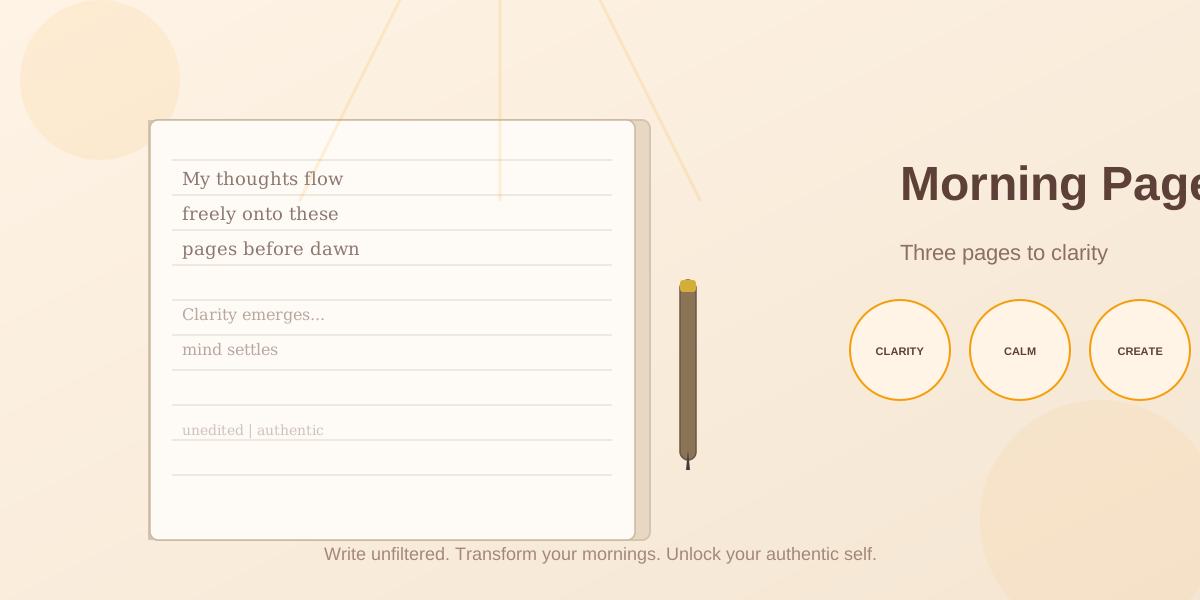
The beauty of morning pages lies in its radical simplicity: no rules, no judgment, no audience. You're not creating literature or building a portfolio—you're creating space in your mind.
Ready to discover how three blank pages could transform your mornings, your creativity, and your resilience? Let's explore this timeless practice together.
What Is Morning Pages?
Morning pages are three handwritten pages of freewriting done immediately upon waking, typically before consuming coffee, email, or social media. The practice involves sitting down with a blank notebook and writing whatever comes to mind—thoughts, worries, gratitude, dreams, frustrations, ideas, or nonsense—without editing, censoring, or planning ahead. The goal is not to create something beautiful or coherent; it's to externalize the mental chatter that clutters your inner space. This unstructured outflow of consciousness creates what psychologists call 'cognitive offloading,' freeing your brain from the burden of holding onto scattered thoughts and allowing it to process emotions more effectively.
Not medical advice.
Morning pages were formally introduced by Julia Cameron in her 1992 book The Artist's Way, though the concept of reflective writing has ancient roots in journaling traditions, letters, and personal diaries. Unlike journaling, which typically focuses on meaningful insights or important events, morning pages embrace all mental noise—the repetitive worries, the random thoughts, the boring details. This permission to be 'bad' at writing, to write poorly, messily, and without purpose, is exactly what makes the practice so powerful. Your pages might start with 'I don't know what to write' repeated fifty times, shift into deep fears about your job, and end with musings about your grocery list. That trajectory is exactly right. Morning pages work because they bypass your internal critic and engage your non-dominant brain hemisphere, which handles creativity, emotion, and intuition.
Surprising Insight: Surprising Insight: Research suggests that 90 seconds of freewriting can reduce cortisol levels and activate the parasympathetic nervous system, shifting your body from stress mode to recovery mode before you even start your day.
The Three Pathways of Morning Pages
How morning pages flow from mental clutter to clarity across three stages of the writing process.
🔍 Click to enlarge
Why Morning Pages Matters in 2026
In 2026, we face unprecedented cognitive overwhelm. The average person encounters 34 gigabytes of information daily—equivalent to reading The New York Times front page 50 times over. Your brain isn't wired to process this volume. Anxiety disorders, decision fatigue, and attention fragmentation have become normalized. Morning pages offer a counterculture practice: analog writing in a digital age, deliberate slowness in a rushing culture, and unstructured time in a schedule-obsessed society. By spending 10-15 minutes writing by hand each morning, you're literally rewiring your nervous system before external demands hijack your attention. You're claiming your mind as your own territory.
Second, morning pages activate your authentic voice. In a world of algorithms that learn your preferences and AI that mirrors your speech patterns back to you, knowing who you actually are—separate from marketing, trends, and social expectations—has become a rare and valuable skill. Morning pages bypass the filter. You're not writing for anyone else; there's no algorithm judging engagement or optimizing your message. This creates space for your genuine thoughts, desires, and creative impulses to emerge. Many people report that morning pages reveal what they truly want versus what they think they should want.
Third, morning pages enhance emotional regulation and decision-making. When you externalizeworries through writing, your prefrontal cortex (responsible for logic and planning) becomes more accessible. You're less reactive, more thoughtful, and better equipped to handle the day's challenges. People with anxiety, depression, and PTSD have reported significant symptom improvements from consistent morning pages practice. The mechanism is simple: writing creates distance between you and your thoughts, transforming them from overwhelming truths into observable patterns.
The Science Behind Morning Pages
The neuroscience of morning pages spans multiple research domains. Writing activates the left hemisphere's language and analytical centers, but freewriting—especially unstructured, non-goal-oriented writing—engages the default mode network (DMN), which is active during daydreaming, introspection, and creative thought. When your DMN is engaged, your brain makes novel connections, retrieves memories, and processes emotions. This is why morning pages often produce unexpected insights or creative ideas that seem to emerge from nowhere. You're not consciously thinking harder; you're accessing a different mode of cognition that supports well-being and creativity.
Expressive writing—where you detail thoughts and feelings about experiences—has been extensively studied by psychologist James Pennebaker and colleagues. Their research consistently shows that 15-20 minutes of expressive writing over several days reduces stress hormones (cortisol), improves immune function, and decreases anxiety and depression symptoms. The effect is robust across populations: cancer patients, trauma survivors, college students, and healthy adults all show improvements in mental health and well-being. The mechanism appears to involve emotional processing and narrative coherence—by writing about experiences, you transform fragmented emotional memories into organized narratives your brain can make sense of. Morning pages leverage this mechanism daily, creating cumulative emotional processing benefits.
Neural Benefits of Morning Pages Practice
The brain regions and neural pathways activated during morning pages and their cognitive benefits.
🔍 Click to enlarge
Key Components of Morning Pages
Stream of Consciousness Writing
This is the heart of morning pages. Stream of consciousness means your hand moves continuously, capturing whatever arises without editing, judgment, or planning. You're not outlining, organizing, or crafting sentences. You're thinking on paper, which is fundamentally different from thinking in your head. Many people report that writing reveals thoughts they didn't know they had—sometimes contradictory beliefs, hidden desires, or unexamined assumptions surface through the act of writing itself. If you get stuck, you write 'I don't know what to write' repeatedly until something else emerges. This permission to be 'bad' at writing, to ramble and repeat and contradict yourself, is crucial. The moment you start editing yourself, you activate the critical mind and lose the raw authenticity that makes the practice transformative.
Handwriting Over Typing
Research shows handwriting engages different neural pathways than typing. Writing by hand activates more sensory and motor neurons, creates stronger memory encoding, and involves slower processing speeds—which actually supports deeper thought and emotional integration. Typing is faster, which can interrupt the organic flow of thought and activate the critical editor-mind. Handwriting's inherent slowness prevents you from outpacing your emotions, allowing you to stay present with what emerges. The physical act of putting pen to paper also creates a tactile connection to the practice, making it feel more embodied and grounded than digital writing. Many morning pages practitioners emphasize that the notebook becomes a sacred object—a container for your innermost thoughts. This ritualistic element shouldn't be minimized; it strengthens your commitment and transforms morning pages from a task into a practice.
No Rereading or Editing
Morning pages are typically written once and then set aside, often not reread for months or years. This separation from the product is essential. You're not creating something to show anyone, refine, or judge by conventional standards. The moment you reread and edit, you activate your critical mind and transform the practice into a productivity task. Some people prefer to lock their pages away or set a rule not to read them until they've filled 30 or 50 pages. This creates psychological safety: the pages are truly private, truly free, truly unfiltered. This permission to let the pages be imperfect, boring, repetitive, or incoherent—without ever having to examine that failure—is liberating. It allows your authentic voice to emerge without the constant surveillance of judgment.
Morning Timing
Morning pages should ideally happen within the first 30 minutes of waking, before consuming media, coffee, or entering work-mode. This is because your brain operates differently in the early morning. Your prefrontal cortex (logical, critical mind) hasn't fully activated yet, while your default mode network (creative, intuitive mind) is still engaged from sleep. This neurochemical window creates ideal conditions for uncensored, intuitive writing. Additionally, doing morning pages before external inputs shape your mind means you're capturing your authentic state before the day's demands begin influencing your thoughts. If you write pages after checking email or social media, you're often reacting to external stimuli rather than accessing your genuine inner voice. The practice loses much of its power.
| Practice | Goal | Style |
|---|---|---|
| Morning Pages | Mental clarity & emotional release | Unstructured, uncensored, raw |
| Journaling | Meaningful reflection & documentation | Intentional, polished, focused |
| Freewriting | Creative exploration without judgment | Time-boxed, sometimes goal-oriented |
| Gratitude Writing | Appreciation & positive focus | Selective, appreciative, conscious |
How to Apply Morning Pages: Step by Step
- Step 1: Prepare your space the night before: Choose a comfortable location where you can write undisturbed. Set out a notebook (blank pages only, no lines necessary) and a pen you enjoy using. Having everything ready removes decision-making friction from your morning.
- Step 2: Wake up and write immediately: Before checking your phone, reading emails, or even making coffee, sit down with your notebook. Your goal is to write within 30 minutes of waking, while your brain is still in that creative, pre-critical state.
- Step 3: Write for three full pages: Don't count words; focus on filling three pages. This typically takes 10-20 minutes depending on your handwriting size. Three pages is long enough to move past surface-level thoughts and reach deeper material, but short enough to fit into most mornings.
- Step 4: Write continuously without stopping: Keep your pen moving. If you get stuck, write 'I don't know what to write' or 'This is boring' until something else surfaces. This continuous flow is key—stopping and thinking disrupts the stream of consciousness.
- Step 5: Don't edit or judge your writing: Ignore grammar, spelling, repetition, or coherence. Your pages might say 'I'm anxious I'm anxious I'm anxious' for a page, then shift to an idea you didn't know you had. That's exactly right. No internal critic allowed.
- Step 6: Write about anything and everything: Morning pages aren't about journaling events or writing about what matters. They're about capturing whatever occupies your mind: worries, tasks, dreams, frustrations, random thoughts, body sensations, people who frustrate you. The mundane and the profound are equally welcome.
- Step 7: Don't reread your pages that day: Once you finish, close the notebook and move into your day. You're not evaluating what you wrote or looking for insights. The writing is done; the work is complete.
- Step 8: Be consistent: The practice's power comes from consistency. Morning pages work best as a daily habit. Even 3-5 times per week provides benefits, but daily practice creates cumulative effects—deeper emotional processing, more reliable clarity, stronger creative breakthroughs.
- Step 9: Create accountability without judgment: If consistency is hard, tell someone about your practice or track your pages on a calendar. The goal is building the habit, not achieving perfection. Missing a day is fine; restarting without shame is key.
- Step 10: Review after 30 days: Once you've completed a month of morning pages, you might notice patterns, recurring themes, or shifts in how you feel. Some people discover what they truly want, what relationships drain them, or what creative projects genuinely excite them. These insights emerge naturally; you don't force them.
Morning Pages Across Life Stages
Young Adulthood (18-35)
Young adults often use morning pages to navigate major life transitions: career decisions, relationship clarity, identity formation, and creative exploration. In this stage, morning pages help you distinguish between your genuine desires and external pressures—what you actually want to study or do versus what parents, peers, or culture expect. Morning pages become a tool for authentic self-discovery and for processing the anxiety that accompanies significant choices. Many young adults report using their pages to vent about work stress, explore relationship dynamics, or work through fear about the future. The practice provides a private space to be vulnerable without worrying about judgment, which is especially valuable when you're still forming your sense of self.
Middle Adulthood (35-55)
Middle-aged adults typically use morning pages to manage complexity and competing demands. This life stage often involves juggling career advancement, family responsibilities, aging parents, and personal goals—often simultaneously. Morning pages provide space to process overwhelm, set boundaries, and reconnect with what matters most beneath the noise. Many people in this stage discover through their pages that they've been living according to others' expectations rather than their own values. Pages become a tool for renegotiating relationships, careers, and life direction. Additionally, middle adults often use morning pages to process grief—aging parents, children leaving home, career shifts—and to maintain mental health amidst significant life transitions.
Later Adulthood (55+)
Older adults often use morning pages for legacy building, meaning-making, and emotional integration. This life stage frequently involves retirement transitions, health changes, mortality awareness, and reflecting on a lifetime of experiences. Morning pages provide space to process these transitions, document family stories, and work through existential questions about purpose and impact. Many older practitioners report that morning pages help them maintain cognitive function, process loss and grief, and stay connected to creative pursuits and personal growth. The practice becomes a way to stay emotionally engaged, mentally active, and psychologically resilient during profound life changes.
Profiles: Your Morning Pages Approach
The Anxious Processor
- Space to externalize racing thoughts and worries before the day accelerates them
- Permission to repeat concerns without judgment—your pages don't need to solve problems
- A structured anchor (morning pages) in an otherwise chaotic mind
Common pitfall: Using morning pages to generate solutions, then frustrating themselves when insights don't immediately fix their anxiety. Remember: pages process emotion, they don't solve problems.
Best move: Let your pages be messy. Write the same worry ten times if needed. The goal is release, not resolution. After weeks of consistent practice, clarity often emerges naturally.
The Blocked Creator
- Permission to write badly without judgment—morning pages bypass perfectionism
- A daily practice that reconnects you with your authentic creative voice beneath internalized criticism
- Non-precious space where failure is impossible because there's no standard to meet
Common pitfall: Using morning pages as another productivity tool—counting pages, tracking completion, expecting immediate creative breakthroughs. This activates the critical mind and defeats the purpose.
Best move: Focus on consistency over quality. Show up daily. Let morning pages be separate from your 'real' creative work. The breakthrough often comes weeks later when the practice has loosened your inner critic's grip.
The Overwhelmed Manager
- A practice that creates psychological safety before the chaos of managing people and projects
- Space to voice frustrations, doubts, and authentic feelings away from professional expectations
- Cognitive offloading to free your brain for strategic thinking and genuine problem-solving
Common pitfall: Trying to make morning pages productive by using them to plan the day or document decisions. This transforms a processing tool into a management tool.
Best move: Keep your pages separate from your work plans. Let them be the place where you acknowledge the overwhelm before you manage it professionally. This separation creates resilience and prevents burnout.
The Reflective Seeker
- A structured container for the constant internal questions about purpose, meaning, and direction you naturally inhabit
- Permission to explore contradictions and unresolved questions without needing answers immediately
- A daily practice that deepens self-knowledge and authenticity
Common pitfall: Using morning pages like a spiritual practice expecting enlightenment, then feeling disappointed when pages are mundane. Remember: the power is in the process, not the content.
Best move: Trust the practice. Some mornings your pages will be profound; others will be boring lists. Both are equally valuable. The consistent practice builds self-knowledge and alignment over time.
Common Morning Pages Mistakes
The most common mistake is using morning pages as a productivity tool—expecting them to generate solutions, fuel your business, or produce publishable writing. Morning pages aren't about output; they're about process. You're not generating content; you're processing the content of your mind. The moment you approach pages with instrumental goals (I'll discover my passion, I'll solve my problem, I'll write something useful), you activate your critical mind and lose the raw authenticity that makes the practice work. Let your pages be useless, redundant, and unremarkable. That's when they're most powerful.
Another common mistake is rereading your pages obsessively, analyzing them for insights, or sharing them for feedback. Morning pages are meant to be private and ephemeral. When you reread pages, you unconsciously start writing for the reader-version of yourself, which triggers self-censorship. When you share pages, you introduce judgment from external perspectives. The pages lose their psychological safety. Some practitioners don't reread their pages for years or ever. Others review them once the notebook is full. The key is: the pages are for writing, not reviewing. The insights emerge over time through the practice, not through analysis of what was written.
A third mistake is perfecting your setup before starting. Some people delay beginning until they find the perfect notebook, the perfect pen, or the perfect quiet space. This is procrastination dressed as preparation. You don't need special materials; a notebook and a pen you enjoy using are sufficient. You don't need silence (though it helps); many people write in coffee shops or while others sleep. You don't need the 'right' time; write when you can. The practice works with imperfect conditions. Starting messy is better than planning perfectly.
Mistakes That Break the Morning Pages Flow
The most common pitfalls and how they disrupt the practice's transformative power.
🔍 Click to enlarge
Science and Studies
Decades of research on expressive writing, journaling, and freewriting consistently support the mental health and well-being benefits of morning pages. While morning pages specifically haven't been studied as thoroughly as journaling, the underlying mechanisms have extensive scientific support. Research in neuroscience, psychology, and health sciences demonstrates that structured writing about thoughts and feelings produces measurable benefits in mood, anxiety, immune function, and cognitive performance.
- Pennebaker & Seagal (1999, Psychological Bulletin): Meta-analysis of 146 expressive writing studies showing consistent benefits including improved immune function, reduced depression and anxiety, and better coping with trauma.
- Smyth (1998, JAMA): Asthma and rheumatoid arthritis patients who engaged in expressive writing showed significant clinical improvements compared to controls, demonstrating writing's effect on physical health.
- Niedenthal (1992, Journal of Personality and Social Psychology): Freewriting about emotional topics increases insight and understanding compared to writing factually about the same events.
- de Manzano et al. (2010, Creativity Research Journal): Creative writing activates the default mode network, the brain's system for introspection, memory, and imaginative thought.
- Ramirez & Brehe (2014, Computers and Education): Handwriting engages more neural pathways and creates stronger memory encoding than typing, supporting deeper cognitive integration.
Your First Micro Habit
Start Small Today
Today's action: Tomorrow morning, before anything else, write one page by hand about whatever comes to mind. No planning, no editing, no rereading. Just one page. If you manage that, you're doing morning pages.
One page is achievable and takes only 3-5 minutes, removing the friction that blocks most people from starting. Completing one page builds confidence and proves the practice works. You can expand to three pages once the habit anchors, but starting tiny makes it sustainable.
If the page never happens because writing by hand is too slow before coffee, say the page instead and read it back later: VoxFlow turns your voice into text on your iPhone, offline, in 99 languages. Free on the App Store.
Keep quitting habit apps after a missed day? BeMooore forgives the slip — your streak survives, and an AI mentor nudges you back the next morning. Free on iOS.
Quick Assessment
How would you describe your typical morning mental state right now?
If you chose Chaotic or Reactive, morning pages could be transformative for your mental health. If you chose Somewhat Clear, morning pages provides structure to your unscheduled time. If you chose Intentional, morning pages might deepen your existing practice.
Which of these barriers might prevent you from starting morning pages?
Each barrier has a solution. Skeptics: try it for just 7 days. Time-pressed: start with one page instead of three. Consistency-challenged: use a calendar or app to track. Avoidant: that fear is exactly why the practice works—safety comes from privacy and no judgment.
What outcome would most excite you about starting morning pages?
All of these outcomes are possible, though research suggests the mental health and emotional clarity benefits emerge first (usually within 2-3 weeks). Creative breakthroughs typically come after consistent practice of several months.
Take our full assessment to get personalized recommendations.
Discover Your Style →Next Steps
Start tomorrow morning. Before checking your phone or making coffee, sit down with a blank notebook and a pen. Write three pages of whatever comes to mind. Don't judge, don't edit, don't reread. Just write. Your goal isn't to create something beautiful or meaningful; your goal is to show up. That's the entire practice. Show up, write, move into your day. The transformation happens through consistency, not through force.
After one week, notice what's shifted. Are you less anxious? More clear? Sleeping better? Do you have creative ideas you didn't expect? Most people notice something within seven days of daily morning pages. After 30 days, your neural pathways have begun to rewire. After 90 days, you'll likely wonder how you ever managed mornings without this practice. The investment is small (10-15 minutes daily), but the returns in mental clarity, emotional resilience, and creative capacity are profound.
Get personalized guidance with AI coaching.
Start Your Journey →Research Sources
This article is based on peer-reviewed research and authoritative sources. Below are the key references we consulted:
Related Glossary Articles
Frequently Asked Questions
What if I don't know what to write about?
This is completely normal and happens to almost everyone. Write 'I don't know what to write about' repeatedly until something else surfaces. Write about how frustrated you are that nothing comes to mind. Describe your room, your body sensations, what you're worried about. The content doesn't matter; the act of continuous writing is what matters. Once you get past the first page, deeper thoughts usually emerge.
Can I type morning pages instead of handwriting?
Research suggests handwriting engages different neural pathways than typing and creates stronger emotional integration. Handwriting also naturally slows your thinking, which gives your emotions time to surface. That said, typing is better than not doing morning pages at all. If you're not a morning person or have mobility challenges, typing is a valid adaptation. The core practice—stream of consciousness writing without editing—is what matters most.
How long does it take to see benefits from morning pages?
Some people notice mood improvements and reduced anxiety within the first week. Others need 2-3 weeks of consistent practice for benefits to become apparent. Creative breakthroughs, deeper self-knowledge, and significant life clarity often emerge after months of consistent practice. The key is consistency; benefits compound over time. Daily practice yields faster results than sporadic writing.
What if I'm sharing a bedroom or can't write in private?
While privacy is ideal, it's not essential. Many people write their morning pages in coffee shops, libraries, or while others are sleeping. Some people use coded language if they're concerned about privacy. What matters most is consistency and uninterrupted writing time—even 10 minutes of focused writing is valuable. If privacy isn't possible, focus on internal safety: the knowledge that your pages are yours alone, no one will read them, and they're perfectly safe.
What should I do with my filled notebooks?
This is personal. Some people keep notebooks as a record of their growth. Others destroy them after filling—some do this ceremonially as a way of releasing what's been processed. Others lock them away and never reread them. There's no right approach. Some practitioners prefer to know they'll never reread their pages, which gives them permission to be completely uncensored. Others find value in reviewing after a year or two to see how much they've evolved. Choose what feels right for you.
Take the Next Step
Ready to improve your wellbeing? Take our free assessment to get personalized recommendations based on your unique situation.
- Discover your strengths and gaps
- Get personalized quick wins
- Track your progress over time
- Evidence-based strategies