Inner Critic
That voice in your head that whispers you're not good enough. The one that magnifies every mistake into a character flaw. Your inner critic is the part of your psyche that's been keeping you "safe" through judgment and self-doubt—but it may actually be holding you back from happiness, success, and genuine self-worth. The good news? This voice didn't form overnight, and it can be transformed. Unlike willpower or talent, managing your inner critic is a learnable skill backed by decades of psychological research. Thousands have used these evidence-based techniques to quiet the self-judgment and discover what happens when they truly listen to themselves.
Your inner critic emerged as a protector. It learned early that self-judgment might prevent you from taking risks that could lead to rejection, failure, or pain. But this protective mechanism has become overactive, creating anxiety, perfectionism, and a persistent sense of inadequacy that no accomplishment ever seems to satisfy.
The science shows us something radical: your inner critic isn't actually you. It's a pattern of thinking you can observe, understand, and gradually reshape through specific practices. Research in cognitive behavioral therapy and self-compassion psychology reveals that silencing your inner critic doesn't mean becoming arrogant or lazy—it means becoming more honest, realistic, and actually more motivated to grow.
What Is Inner Critic?
The inner critic is the internalized voice of judgment and self-doubt that evaluates your thoughts, behaviors, and worth. It's the mental process that creates negative self-talk, perfectionist standards, and a persistent sense that you're somehow failing or inadequate. Unlike intuition or healthy self-reflection, the inner critic operates from fear and shame rather than wisdom and compassion. It's automatic, often harsh, and tends to focus on what's wrong rather than what's possible.
Not medical advice.
The inner critic develops through years of internalized messages—from parents, teachers, culture, and your own interpreted experiences. It becomes so familiar that you might not even notice it's there. You might assume the harsh voice is just "realistic" or "helpful motivation" when actually it's a learned pattern that can be unlearned. Understanding that your inner critic is a pattern rather than truth is the first step toward freedom.
Surprising Insight: Surprising Insight: Research by Kristin Neff at the University of Texas shows that people with strong self-compassion are actually MORE motivated to improve themselves than those with harsh inner critics, contradicting the belief that self-judgment drives achievement.
The Inner Critic Loop
How the inner critic creates a self-perpetuating cycle of self-doubt and avoidance
🔍 Click to enlarge
Why Inner Critic Matters in 2026
In 2026, the inner critic has new fuel. Social media amplifies comparison culture, algorithmic feeds highlight others' highlight reels, and constant connectivity creates endless opportunities for self-judgment. The pressure to optimize every aspect of life—fitness, career, relationships, appearance—has intensified the voice that asks "am I enough?" This digital context makes understanding and managing your inner critic not just a wellness practice, but essential for mental health and sustainable happiness.
The inner critic also intersects with modern work culture. Remote work blurs boundaries between professional and personal life, making it harder to escape performance anxiety. Gig economies and freelancing mean you're constantly evaluating your own worth. The rise of perfectionism as a cultural value means self-judgment has become normalized as productivity. Yet research consistently shows that harsh self-criticism leads to burnout, not breakthrough.
Perhaps most importantly, your inner critic prevents authentic connection and joy. When you're constantly monitoring yourself through a lens of judgment, you can't fully relax, be creative, or experience genuine satisfaction. Managing your inner critic is therefore not selfish—it's essential for showing up authentically in relationships, work, and your own life.
The Science Behind Inner Critic
The inner critic activates in your prefrontal cortex—the same region responsible for self-awareness and planning. When you encounter a threat (real or perceived), the amygdala triggers a fear response, and your prefrontal cortex then creates a story about what that threat means about you. Over time, if that story is "I'm not good enough," it becomes an automatic pattern. Neuroscience shows this pattern literally changes your neural pathways: the more you rehearse self-criticism, the stronger those neural connections become.
Kristin Neff's research on self-compassion reveals that the antidote isn't self-esteem (which is comparative and fragile) but self-compassion (which is unconditional). Brain imaging studies show that when people practice self-compassion, they activate different neural regions—ones associated with emotional regulation and safety rather than threat detection. This isn't positive thinking or denial; it's a measurable shift in how your brain processes difficulty.
Brain Regions in Self-Criticism vs Self-Compassion
How inner critic activation differs from self-compassion in the brain
🔍 Click to enlarge
Key Components of Inner Critic
The Judge
The judge is the part that evaluates. It compares you to others, to your own past performance, or to some internalized standard. The judge points out flaws, mistakes, and gaps between who you are and who you think you should be. It's relentless and often feels like truth because it speaks with such certainty. The judge creates the storyline: "You failed. You're lazy. You're not as smart as everyone thinks."
The Perfectionist
The perfectionist sets impossible standards and demands flawless execution. It believes that if you're not perfect, you're failing. The perfectionist voice says, "It's not good enough yet," or "Everyone else seems to handle this better." This component can feel productive because it drives effort, but it never allows satisfaction—there's always something more to improve, which creates chronic stress and anxiety.
The Catastrophizer
The catastrophizer jumps to worst-case scenarios. A small social awkwardness becomes "I'm socially incompetent." One rejection becomes "I'll never find partnership." A work mistake becomes "I'm going to lose my job." This component hijacks your brain's threat-detection system and creates anxiety about things that haven't happened and likely won't.
The Comparer
The comparer measures your worth against others. It notices how much more successful, attractive, or together everyone else seems. Social media has turbocharged this component—there's an endless stream of comparison material. The comparer always finds someone doing it better, which creates a persistent sense of inadequacy no matter what you accomplish.
| Component | Core Message | Consequence |
|---|---|---|
| The Judge | "You're failing/not good enough" | Shame, self-doubt, reduced risk-taking |
| The Perfectionist | "It's not perfect yet" | Anxiety, procrastination, exhaustion |
| The Catastrophizer | "Disaster is coming" | Chronic worry, avoidance, hypervigilance |
| The Comparer | "Everyone's doing better than you" | Inadequacy, jealousy, decreased motivation |
How to Apply Inner Critic: Step by Step
- Step 1: Notice without judgment. Spend one day simply observing your inner critic's voice without trying to change it. Where does it activate? What triggers it? What does it sound like? Just listen. This awareness is step one.
- Step 2: Name the voice. Give your inner critic a nickname—maybe "The Judge," "Perfectionist Pete," or whatever feels right. This creates distance between you (the observer) and the voice (a pattern). You are not your inner critic.
- Step 3: Identify the origin. Where did this voice come from? What messages did you receive as a child about worthiness, performance, or acceptability? Understanding the source helps you see it's a learned pattern, not truth.
- Step 4: Write a dialogue. Write out what your inner critic is saying, then respond as if you were a wise, compassionate mentor. What would they say back? This externalizes the voice and creates an alternative perspective.
- Step 5: Test the evidence. When your inner critic makes a claim ("I'm not smart enough"), ask: Is that actually true? What evidence contradicts it? Most inner critic statements crumble under gentle questioning.
- Step 6: Practice self-compassion. When difficulty arises, place your hand on your heart and say, "This is hard. Many people struggle with this. I'm doing the best I can." This activates your parasympathetic nervous system and counters the threat response.
- Step 7: Replace the narrative. Instead of "I failed," try "I'm learning." Instead of "I'm not good enough," try "I'm enough, and I'm still growing." The brain believes the stories it rehearses, so deliberately choose more accurate ones.
- Step 8: Set boundaries with the voice. Tell your inner critic: "I hear you, and I don't need that right now." You don't need to believe it or fight it; you just acknowledge it and return to what matters.
- Step 9: Build evidence of worth. Collect moments of competence, connection, and kindness. Write down things you did well, people who value you, ways you've helped others. Your inner critic has a negativity bias; deliberately feed your brain alternative data.
- Step 10: Commit to one micro-practice. Choose one of the above techniques and practice it daily for one week. Small, consistent practices reshape neural pathways faster than occasional intense efforts.
Inner Critic Across Life Stages
Young Adulthood (18-35)
In young adulthood, the inner critic often centers on identity and competence. You're establishing a career, navigating relationships, and figuring out who you are independent of your family of origin. The inner critic questions every choice: Am I choosing the right career? Am I in the right relationship? Why am I not further along? Social media comparison is particularly damaging at this stage because your peer group is visible and constantly updating their achievements. The work here is to distinguish between genuine self-reflection and harsh self-judgment, and to recognize that 18-35 is explicitly a learning phase, not a proven phase.
Middle Adulthood (35-55)
In middle adulthood, the inner critic often shifts toward regret and missed opportunity. "I should have..." becomes a frequent refrain. You're balancing competing demands—career, family, health—and the inner critic points out where you're falling short in each domain. There's often a sense of "I should be more established by now" or "Why haven't I achieved X yet?" The work here is to recognize that life trajectories are non-linear, that your earlier choices made sense with the information and resources you had, and that this phase still offers tremendous possibility for meaningful change and growth.
Later Adulthood (55+)
In later adulthood, the inner critic sometimes transforms from productivity-focused to meaning-focused. "Have I mattered?" "Did I do enough?" "Am I a burden?" As physical capacities shift, there can be grief, and the inner critic can amplify this into shame. However, this life stage also offers unique clarity and freedom. The work here is to separate the voice of loss from the voice of inner critic—one is valid grief, the other is self-judgment. Many people find that managing their inner critic becomes easier with age and perspective, because they've seen that most of what the critic warned about didn't happen.
Profiles: Your Inner Critic Approach
The Perfectionist Achiever
- Permission to be imperfect and still worthy
- Metrics for non-achievement (relationships, growth, joy)
- Regular breaks that don't trigger guilt
Common pitfall: Believing that harsh self-criticism is what drives success, so avoiding self-compassion as a sign of laziness
Best move: One week: do something good-enough instead of perfect. Notice whether your performance actually suffers. (Spoiler: it doesn't.)
The Anxious Catastrophizer
- Reality-checking of worst-case scenarios
- Evidence of your actual resilience
- Grounding in the present moment rather than feared future
Common pitfall: Assuming that worrying about bad outcomes will prevent them, so treating anxiety as protective rather than a symptom
Best move: For one month, track: What bad thing did your inner critic predict? What actually happened? Most predictions won't materialize. Collect this evidence actively.
The Comparison Spiraler
- Awareness of social media curation and highlight reels
- Metrics based on personal values, not others' metrics
- Regular reminders of your own capabilities and progress
Common pitfall: Assuming others' highlight reels represent their full reality, and using that distorted view to judge yourself
Best move: Curate your feed: follow people whose content inspires rather than diminishes you. Unfollow freely. Your mental health is more important than seeming interested in everyone.
The Shame-Based Judge
- Distinction between healthy guilt (I did something bad) and toxic shame (I am bad)
- Understanding of where shame messages came from (often intergenerational)
- Self-compassion practices that don't feel indulgent or false
Common pitfall: Believing shame is warranted and avoiding it rather than healing it, which keeps the inner critic lodged in your system
Best move: Notice: When does shame activate? Trace it back to its origin (whose voice is that, really?). That awareness is the first step toward release.
Common Inner Critic Mistakes
One common mistake is trying to fight your inner critic directly. You tell yourself "Stop being so negative!" but this just creates more internal conflict. The inner critic was born from fear and learned through repetition. Fighting it directly usually strengthens it. Instead, the research supports a different approach: acknowledge it, understand it, and gradually starve it of energy by building alternative thought patterns.
Another mistake is confusing self-compassion with self-indulgence. Many people resist self-compassion because they believe it means giving up, stopping trying, or becoming narcissistic. Actually, research by Kristin Neff shows the opposite: people with self-compassion are MORE resilient, MORE motivated, and MORE willing to learn from failure because they're not paralyzed by shame. Self-compassion is the foundation for healthy striving, not its opposite.
A third mistake is assuming your inner critic's voice is accurate. You take its claims at face value: "I'm not good at relationships," "I'm lazy," "I'll never be successful." But these are stories, not facts. They're patterns of thinking that have been reinforced but not necessarily true. The moment you start questioning them—asking for evidence, considering alternative interpretations—their grip loosens significantly.
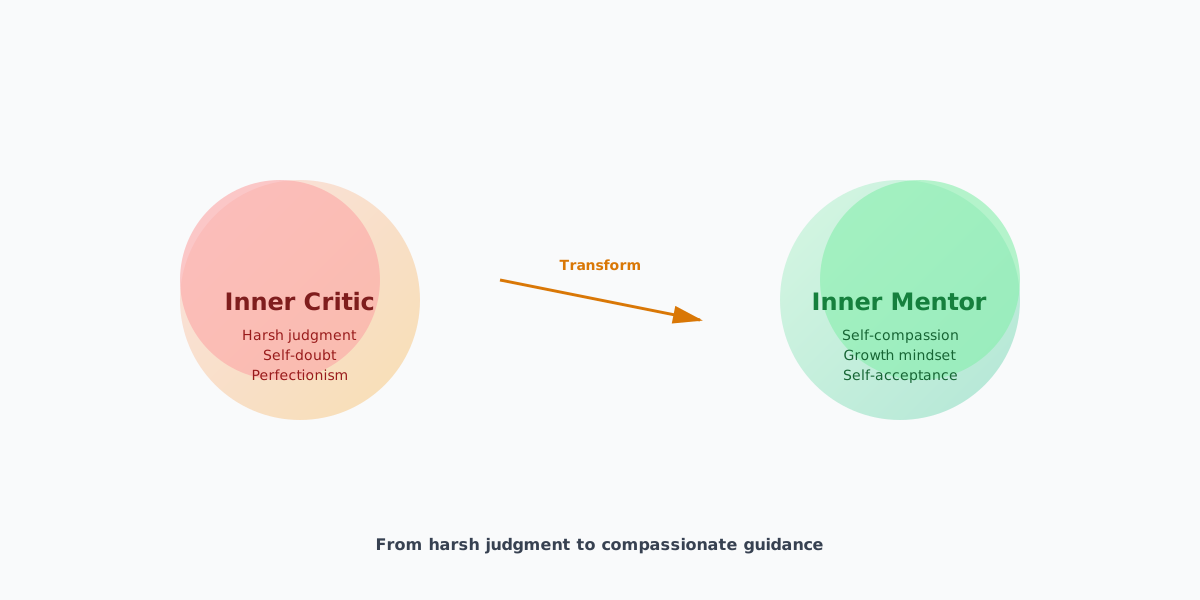
From Inner Critic to Inner Mentor
The progression of transforming your inner critic into a supportive inner voice
🔍 Click to enlarge
Science and Studies
The research on inner critic, self-criticism, and self-compassion is robust and increasingly accessible. Key studies demonstrate that self-compassion predicts resilience, motivation, and well-being better than self-esteem; that harsh self-criticism activates the same brain regions as external threat; and that brief self-compassion interventions produce measurable changes in neural activity and emotional regulation.
- Neff, K. D. (2003). Self-compassion: An alternative conceptualization of a healthy attitude toward oneself. Self and Identity, 2(2), 85-101. Seminal research showing self-compassion as distinct from and superior to self-esteem for psychological resilience.
- Longe, O., et al. (2010). Have you got the blues? Sad mood increases neural response to criticism in the anterior insula. Social Cognitive and Affective Neuroscience, 5(2-3), 194-200. Demonstrates how sadness amplifies the brain's response to self-criticism.
- Gilbert, P., & Procter, S. (2006). Compassionate mind training for people with chronic shame: Overview and pilot study of a group therapy approach. Clinical Psychology & Psychotherapy, 13(6), 353-379. Shows practical applications of self-compassion for shame-based inner critics.
- Barnard, L. K., & Curry, J. F. (2011). Self-compassion: Conceptualizations, correlates, and interventions. Review of General Psychology, 15(4), 289-303. Comprehensive review of research and practical interventions.
- Leary, M. R., et al. (2007). Self-compassion and reactions to unpleasant self-relevant events: The implications of treating oneself kindly. Journal of Personality and Social Psychology, 92(5), 887-904. Research showing self-compassion reduces negative emotional reactions to personal failures.
Your First Micro Habit
Start Small Today
Today's action: When you notice harsh self-talk ("I messed up," "I'm not good enough," "Everyone's doing better"), pause and place your hand on your heart. Say: "This is hard. I'm doing my best. I deserve kindness." 30 seconds. Just once today.
This tiny practice interrupts the automatic shame response and activates your parasympathetic nervous system. The hand on your heart is soothing; the words provide an alternative narrative. One repetition seems small, but it's a seed. Your brain learns that difficulty can be met with kindness, not criticism. Over weeks, this rewires your default response.
Keep quitting habit apps after a missed day? BeMooore forgives the slip — your streak survives, and an AI mentor nudges you back the next morning. Free on iOS.
Quick Assessment
How would you describe your relationship with your inner critic right now?
If you chose option 1 or 2, you're not alone—most people don't realize their inner critic is a pattern rather than fact. That awareness itself is the first step toward freedom. Options 3 and 4 show you already have some capacity; now it's about deepening and refining it.
When you make a mistake, what's your typical internal response?
Options 1-3 suggest an active inner critic operating from fear. Option 4 indicates you've already shifted toward a growth mindset. The goal isn't to never feel options 1-3, but to eventually default to option 4. Your inner critic isn't bad; it just needs retraining.
What would become possible if you could quiet your inner critic by 50%?
Your answer hints at where you'd find the most freedom. The inner critic often disguises itself as protective, but its main effect is restriction. Imagining a quieter inner critic helps you see what's truly possible for you. That's your direction.
Take our full assessment to get personalized recommendations.
Discover Your Style →Next Steps
Your next step is simple: listen. For one week, just notice your inner critic without trying to change it. What triggers it? What does it sound like? What situations make it louder? This awareness is foundational. You can't work with something you don't see clearly. Most people are amazed at how active their inner critic has been once they start paying attention. The critic has been running on autopilot, and you didn't realize how much it was driving your choices, emotions, and sense of possibility.
After that week of awareness, choose one practice from this article—maybe the micro habit, or the self-compassion phrase, or writing a dialogue. Do that one practice consistently for two weeks. Small, consistent practices reshape neural patterns more effectively than rotating through many techniques. Your brain needs repetition to build new pathways. Then, if you want to go deeper, the full assessment at bemooore.com can help you discover your learning style and get personalized recommendations for working with your specific inner critic patterns.
Get personalized guidance with AI coaching.
Start Your Journey →Research Sources
This article is based on peer-reviewed research and authoritative sources. Below are the key references we consulted:
Related Glossary Articles
Frequently Asked Questions
Is my inner critic ever helpful?
Yes, but rarely. Your inner critic's intention is protection through fear and vigilance. A more effective inner mentor would provide feedback with kindness ("You made a mistake; let's learn from it") rather than shame ("You're incompetent"). When your inner voice is genuinely helpful, it sounds more like a wise mentor than a harsh judge. If it's harsh, it's not actually helpful—it's just familiar.
How long does it take to quiet the inner critic?
This varies widely. Some people notice changes in days of consistent practice; others need weeks or months. The key is consistency rather than intensity. Five minutes daily of self-compassion practice will eventually shift your default patterns more effectively than sporadic intense work. Think of it like strengthening a muscle: small, regular practice builds lasting strength. Also, the inner critic doesn't disappear entirely, but it becomes quieter and less believed.
What if self-compassion feels fake or manipulative?
This is actually a sign your inner critic is strong. It's interpreting kindness toward yourself as inauthentic or weak. Start smaller: instead of affirmations, just try acknowledging difficulty without judgment. "This is hard" is more believable than "I'm perfect." You can also try extending compassion to others first, then notice how it feels. Finally, research it: self-compassion is scientifically linked to resilience and motivation, not weakness. Your skepticism is understandable; evidence might help.
Can I ever trust my self-evaluation if I quiet my inner critic?
Yes—actually, better. When your inner critic is active, you're receiving feedback filtered through fear and shame. You can't hear accurate information because it's distorted by anxiety. When you quiet the critic, you can actually assess: Did I do that well or poorly? What worked? What would I change? This is clearer than the critic's harsh generalizations. Self-compassion actually improves self-awareness because you can look at yourself with gentle honesty rather than defensive judgment.
What if my inner critic is based on real limitations or past failures?
Past failures are data, not identity. Your inner critic turns "I failed at X" into "I am a failure." The first is useful feedback; the second is distortion. Real limitations are worth acknowledging—you probably won't be a professional athlete if you're 6'2" and enjoy sitting—but even limitations don't determine worth or possibility. The inner critic uses real limitations as ammunition for shame. Separating what's true (I have certain abilities) from what's distortion (therefore I'm worthless) is the key work here.
Take the Next Step
Ready to improve your wellbeing? Take our free assessment to get personalized recommendations based on your unique situation.
- Discover your strengths and gaps
- Get personalized quick wins
- Track your progress over time
- Evidence-based strategies