Burnout Management
Burnout management is the systematic approach to recognizing, recovering from, and preventing the exhaustion that comes from prolonged stress and overwhelming work demands. Rather than accepting burnout as inevitable, modern research shows that intentional recovery practices, organizational changes, and personal resilience strategies can help you reclaim your energy and reignite your passion. This comprehensive guide explores evidence-based techniques to manage burnout at every stage—from early warning signs to full recovery—so you can build sustainable well-being despite life's demands.
Most people experiencing burnout try to push through it with willpower alone, but research shows that recovery requires a multi-faceted approach combining rest, activity, social connection, and sometimes professional support.
The difference between burnout and ordinary stress is that burnout represents a prolonged, unresolved state of emotional exhaustion tied specifically to work or caregiving roles.
What Is Burnout Management?
Burnout management refers to the set of strategies, practices, and interventions designed to prevent, recognize, and recover from burnout—a psychological syndrome characterized by emotional exhaustion, cynicism, and reduced effectiveness. It combines personal coping strategies with organizational changes to address both the symptoms and root causes of work-related exhaustion. Burnout management acknowledges that while individual actions matter, lasting recovery often requires changes to work environment, workload, and interpersonal dynamics.
Not medical advice.
The World Health Organization recognizes occupational burnout as an occupation-related phenomenon in its international classification of diseases. This recognition signals that burnout is a legitimate health concern requiring structured intervention rather than simply a sign of personal weakness or insufficient resilience. Understanding burnout management means seeing it as both an individual recovery journey and a collective organizational responsibility.
Surprising Insight: Surprising Insight: Research shows that 39% of public health workers experience burnout globally, with rates exceeding 50% in some countries—demonstrating that burnout is a systemic issue, not merely an individual failing.
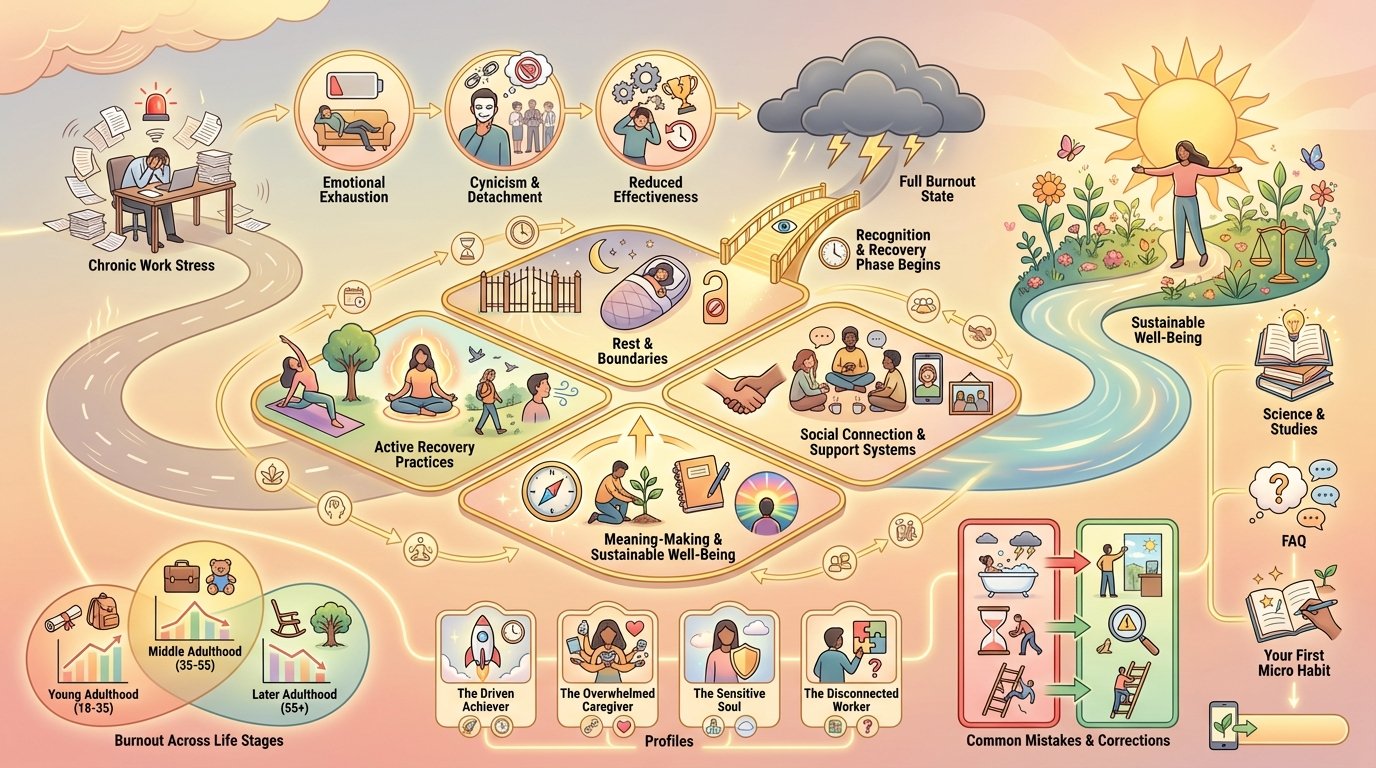
The Burnout Cycle and Recovery Path
Shows progression from work stress through burnout dimensions to recovery strategies
🔍 Click to enlarge
Why Burnout Management Matters in 2026
In 2026, burnout management has become essential because workplace pressures, remote work blurring boundaries, and constant digital connectivity have intensified demands on workers across all sectors. The cost of untreated burnout extends beyond the individual—it impacts organizational productivity, increases healthcare costs, and contributes to mental health crises. Learning burnout management directly improves your quality of life, work performance, and long-term health outcomes.
Modern research demonstrates that burnout is not simply fixed through individual self-care alone. Recent organizational studies show that combined-level interventions—addressing both personal practices and workplace systems—are most effective in preventing exhaustion. This shift in understanding makes burnout management a critical life skill for anyone navigating demanding work environments.
Additionally, the increasing use of AI and technology in workplaces offers new tools for identifying early burnout signs and automating overwhelming tasks, creating fresh opportunities for sustainable work practices. Burnout management in 2026 means leveraging both human wisdom and technological support to create workable life rhythms.
The Science Behind Burnout Management
Burnout develops through a predictable progression of three interconnected dimensions. First comes emotional exhaustion—the feeling of being drained, tired, and unable to recover despite rest. Then develops cynicism and detachment, where you lose enthusiasm and emotional connection to work. Finally comes reduced effectiveness, where you feel unable to accomplish meaningful work despite effort. Understanding this progression helps you intervene at the earliest stage rather than waiting until full burnout sets in.
Neuroscience reveals that chronic stress from unresolved work demands activates the body's threat-response system (sympathetic nervous system) persistently, depleting cortisol reserves and suppressing immune function. Recovery through burnout management involves deliberately activating the parasympathetic nervous system—the relaxation response—through specific practices like meditation, exercise, and safe social connection. This is why passive rest alone is often insufficient; active recovery practices that engage the body and mind are needed to reset the nervous system.
Three Dimensions of Burnout and Recovery
Illustrates emotional exhaustion, cynicism, and ineffectiveness as interconnected burnout dimensions with corresponding recovery strategies
🔍 Click to enlarge
Key Components of Burnout Management
Recognition and Honest Assessment
The first component of burnout management is acknowledging that burnout is occurring rather than trying to push through it. This involves recognizing physical signs (chronic fatigue, frequent illness, sleep problems), emotional signs (cynicism, irritability, emotional numbness), and behavioral signs (reduced productivity, withdrawal from colleagues, cynical humor). Many people delay seeking help because they view burnout as weakness rather than a legitimate stress injury. Honest assessment means checking in with yourself regularly about exhaustion levels, job satisfaction, and whether current demands feel sustainable.
Boundary Setting and Workload Management
Effective burnout management requires establishing clear boundaries between work and personal time, and advocating for manageable workloads. This component includes practices like setting work hour limits, using vacation time fully, declining non-essential commitments, and communicating needs to supervisors. Research shows that employees with clear boundaries experience significantly less burnout. Boundary setting also means protecting recovery time for sleep, exercise, and relationships—treating these as non-negotiable priorities rather than optional luxuries.
Active Recovery Practices
Active recovery practices that engage the body and activate relaxation response include meditation, yoga, deep breathing exercises, and aerobic exercise. Unlike passive rest (watching TV), active recovery deliberately shifts the nervous system from threat-response to relaxation-response. These practices reduce stress hormones, improve immune function, and restore emotional equilibrium. Research on burnout recovery shows that consistent active recovery practices—even brief daily practices—significantly accelerate recovery and prevent relapse.
Social Connection and Support Systems
Social connection is among the most powerful burnout recovery factors yet often overlooked. This component involves maintaining meaningful relationships, building workplace friendships and collegial support, accessing professional help when needed, and sometimes sharing your burnout experience with trusted others. Research consistently shows that strong social support reduces burnout onset and accelerates recovery. Support can come from friends, family, colleagues, support groups, therapists, or mentors—the key is consistent, safe connection.
| Recovery Phase | Typical Duration | Key Characteristics & Actions |
|---|---|---|
| Recognition Phase | 1-2 weeks | Accept burnout reality, assess severity, decide on intervention approach |
| Acute Recovery Phase | 2-8 weeks | Implement boundaries, begin active recovery practices, seek support |
| Rebuilding Phase | 2-4 months | Restore energy, reconnect with purpose, address workplace issues |
| Integration Phase | 4-12 months | Develop sustainable practices, monitor for relapse, build resilience |
How to Apply Burnout Management: Step by Step
- Step 1: Acknowledge the burnout directly. Write down specific signs you're experiencing—physical exhaustion, cynicism, reduced effectiveness—rather than minimizing or ignoring them.
- Step 2: Conduct a burnout source audit. Identify the top 3-5 specific work demands, relationships, or situations fueling your burnout rather than attributing it vaguely to 'stress.'
- Step 3: Establish immediate boundaries. Choose one manageable boundary to implement this week—stopping work at a specific time, taking full lunch breaks, or declining one non-essential commitment.
- Step 4: Begin active recovery with one daily practice. Select one recovery practice (10-minute meditation, 20-minute walk, yoga, breathing exercises) and commit to daily practice for one week.
- Step 5: Communicate your needs. If possible, discuss workload or work conditions with a supervisor, manager, or trusted colleague rather than managing alone.
- Step 6: Build or strengthen support connections. Schedule time with one person who understands you this week—phone call, coffee, or shared activity.
- Step 7: Implement sleep as priority. Establish a consistent sleep schedule and create sleep-supporting habits (consistent bedtime, device-free hour before sleep, cool dark room).
- Step 8: Address accumulated time off. Take genuine vacation time or mental health days—don't let time off pile up unspent.
- Step 9: Seek professional support if needed. Consider therapy, coaching, or counseling if burnout persists beyond 4-8 weeks despite these efforts.
- Step 10: Build sustainable practices. Design weekly rhythms that include rest, activity, connection, and meaning-making to prevent burnout recurrence.
Burnout Management Across Life Stages
Young Adulthood (18-35)
Young adults often experience burnout while building careers, establishing independence, and managing student debt or early family responsibilities. Burnout management at this stage focuses on recognizing that early career intensity is not sustainable long-term, establishing healthy work habits from the start rather than correcting them later, and setting boundaries despite pressure to prove commitment. Young adults benefit from mentorship, peer support, and permission to prioritize well-being alongside achievement.
Middle Adulthood (35-55)
Middle adults frequently face peak burnout risk due to simultaneous demands from career advancement, parenting, caregiving for aging parents, and financial responsibility. Burnout management during this stage means actively protecting recovery time, saying no to some opportunities to preserve capacity for priorities, and seeking support for the specific challenge of managing multiple life roles. Many middle adults discover that their identity is overly tied to work success and benefit from diversifying sources of meaning and identity.
Later Adulthood (55+)
Older adults may experience burnout differently—sometimes from ongoing high-responsibility roles, from feeling stuck in unfulfilling work, or from adapting to changing workplace technology and demands. Burnout management at this stage often involves evaluating whether current work still aligns with values and energy, considering transitions or retirement planning, and leveraging accumulated wisdom and experience. Later adulthood offers freedom to prioritize well-being more than earlier decades.
Profiles: Your Burnout Management Approach
The Driven Achiever
- Permission to slow down without feeling guilty or unmotivated
- Recognition of diminishing returns—overwork reduces long-term effectiveness
- Help redefining success beyond constant productivity
Common pitfall: Tries to 'power through' burnout with more effort and discipline, making exhaustion worse
Best move: Set one non-negotiable recovery boundary and treat it as seriously as a work deadline
The Overwhelmed Caregiver
- Support with delegating or sharing responsibilities
- Guilt reduction around prioritizing their own recovery
- Practical help implementing boundaries with family or professional demands
Common pitfall: Puts everyone else's needs first and views self-care as selfish, preventing recovery
Best move: Identify one small thing to stop doing or one task to delegate this week
The Sensitive Soul
- Permission to honor their emotional capacity limits
- Strategies for managing empathy without taking on others' stress
- Validation that sensitivity is a strength, not a weakness to overcome
Common pitfall: Absorbs others' emotions and stressors, depleting personal reserves without awareness
Best move: Establish one daily practice that replenishes emotional reserves (alone time, nature, creative expression)
The Disconnected Worker
- Reconnection with purpose and meaning in current work
- Exploration of whether role still aligns with values
- Help finding small ways to increase autonomy or impact
Common pitfall: Stays in misaligned work due to inertia or financial concerns, deepening cynicism
Best move: Have one conversation with someone who can help clarify whether staying or transitioning serves you
Common Burnout Management Mistakes
One critical mistake is relying exclusively on self-care while ignoring the work environment or demands driving burnout. While bubble baths and vacations provide temporary relief, if the underlying work situation remains unchanged, burnout will return after the weekend or vacation ends. Sustainable recovery requires addressing both personal practices and external factors.
Another common mistake is waiting too long to seek help. Many people spend months or years managing burnout privately before reaching out to supervisors, therapists, or doctors. Earlier intervention—even when burnout is moderate rather than severe—significantly improves recovery outcomes and prevents progression to depression or anxiety disorders.
A third mistake is treating recovery as a phase to complete rather than an ongoing practice. People often emerge from acute burnout crisis, feel better, then abandon recovery practices—only to experience recurrence. Sustainable well-being requires maintaining boundaries, recovery practices, and support systems long-term, not just during crisis.
Common Burnout Management Mistakes and Corrections
Maps ineffective approaches to burnout management with evidence-based alternatives
🔍 Click to enlarge
Science and Studies
Recent burnout research demonstrates that recovery requires simultaneous attention to personal, interpersonal, and organizational factors. Studies from 2024-2026 confirm that combined-level interventions—addressing both individual coping and workplace systems—significantly outperform individual-only approaches. The global recognition of occupational burnout by the WHO signals the shift from viewing burnout as individual weakness to understanding it as a legitimate occupational health concern.
- The job performance and job burnout relationship: A panel data comparison showing how burnout inversely correlates with academic performance and organizational effectiveness (PMC)
- Passive AI detection of stress and burnout among frontline workers demonstrates emerging technology applications for early intervention and prevention (PMC 2025)
- The effectiveness of stress reduction and burnout prevention programs: A randomized controlled trial confirms that structured organizational interventions significantly reduce burnout symptoms (PMC 2023)
- Global estimate of burnout among the public health workforce: A systematic review documenting 39% burnout prevalence among public health workers internationally (PubMed 2024)
- Mitigating workplace burnout through transformational leadership showing leadership style significantly impacts employee burnout and recovery (PMC 2024)
Your First Micro Habit
Start Small Today
Today's action: Take five minutes this evening to identify one specific work demand or situation driving your burnout. Write it down with one small change you could make this week. This shifts burnout from vague overwhelm to actionable problem-solving.
Specificity transforms abstract burnout into concrete, manageable problems. Writing activates different brain processing, moving you from feeling stuck to taking action. Small changes build momentum without triggering resistance.
Keep quitting habit apps after a missed day? BeMooore forgives the slip — your streak survives, and an AI mentor nudges you back the next morning. Free on iOS.
Quick Assessment
How would you describe your current energy level at work?
Your answer indicates your current burnout phase. Option 1-2 suggests preventive practices; options 3-4 suggest immediate intervention needed.
What recovery approach appeals to you most right now?
Your preference reveals your strongest recovery path. Different people recover through different entry points—honor your authentic preference rather than forcing 'should' practices.
How much support do you currently have for addressing burnout?
Support level directly impacts recovery timeline and success. If you have minimal support, building it (through therapy, support groups, mentorship) accelerates recovery significantly.
Take our full assessment to get personalized recommendations.
Discover Your Style →Next Steps
Start with one concrete action this week that addresses either the source of your burnout or initiates recovery. This might be a conversation with your supervisor, implementing one boundary, beginning one recovery practice, or scheduling time with a therapist. One meaningful action shifts you from overwhelm to agency.
Recognize that burnout management is not a solo journey. The most effective recovery involves accessing support—whether from colleagues, friends, family, healthcare providers, or support communities. Your recovery matters not just to you but to everyone who cares about you and benefits from your presence.
Get personalized guidance with AI coaching.
Start Your Journey →Research Sources
This article is based on peer-reviewed research and authoritative sources. Below are the key references we consulted:
Related Glossary Articles
Frequently Asked Questions
How long does it take to recover from burnout?
Recovery timeline varies significantly based on burnout severity, available support, and intervention choices. Acute recovery often takes 2-8 weeks of intentional practice, but full integration of new patterns and genuine risk reduction typically requires 3-6 months or longer. Some people experience persistent effects for a year or more if underlying work conditions don't change.
Can you recover from burnout without changing your job?
Yes, recovery is possible while staying in the same role if you simultaneously change work conditions (boundaries, workload, relationships) or find new sources of meaning and purpose within the work. However, if the work fundamentally misaligns with your values, burnout risk remains high. Sometimes staying requires deliberate meaning-making; sometimes moving is healthier.
Is burnout the same as depression?
Burnout and depression overlap but aren't identical. Burnout is work-specific and involves exhaustion plus cynicism and ineffectiveness. Depression is broader and involves pervasive low mood, hopelessness, and loss of pleasure in activities you previously enjoyed. You can have burnout without depression, or depression can develop from unresolved burnout. Professional assessment helps distinguish them.
What should I tell my boss about burnout?
Frame the conversation around sustainability and solutions rather than complaints. Example: 'I've noticed my performance and well-being are declining due to current workload. I want to discuss how we can adjust priorities or resources so I can sustain strong work long-term.' Come prepared with specific examples and potential solutions. Not all workplaces respond helpfully—assess your situation's safety first.
When should I seek professional help for burnout?
Consider professional help if burnout persists 4-8 weeks despite personal recovery efforts, if it's affecting your mental or physical health, if you're having thoughts of harming yourself, or if you feel unable to solve the problem alone. Therapists, counselors, and coaches all offer valuable expertise in burnout recovery. Earlier help often means faster recovery.
Take the Next Step
Ready to improve your wellbeing? Take our free assessment to get personalized recommendations based on your unique situation.
- Discover your strengths and gaps
- Get personalized quick wins
- Track your progress over time
- Evidence-based strategies