Second Brain
Imagine having a trusted external system that remembers everything you've learned, captures your thoughts at the moment they matter most, and delivers exactly what you need when you need it. That's your second brain. It's the antidote to mental clutter, the relief from trying to hold everything in your head at once. By externalizing your thoughts and knowledge into an organized system, you free your mind from the exhausting burden of memory management and create space for creative thinking, genuine connection, and lasting peace.
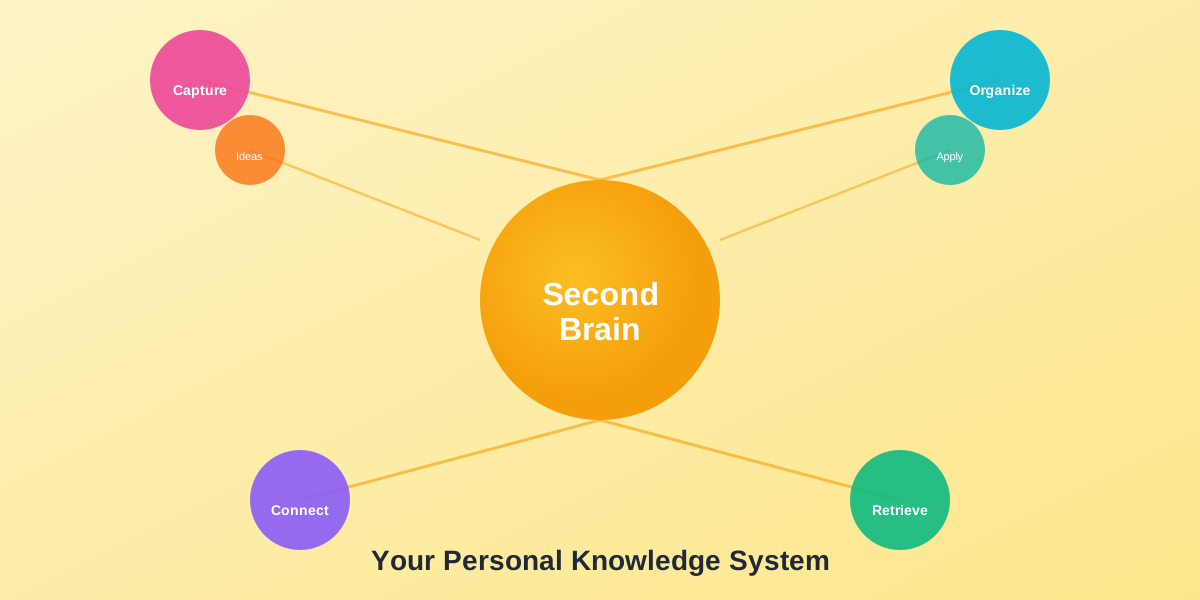
A second brain isn't about having better memory. It's about designing a personal knowledge system that works like your mind—intuitive, interconnected, and always available. When you master this approach, you stop losing good ideas, reduce decision fatigue, and experience the profound relief of knowing that important information is safely stored and easily accessible.
This fundamental shift in how you manage information unlocks a deeper sense of control over your life, reduces anxiety about forgotten tasks, and cultivates the mental clarity that happiness depends on.
What Is Second Brain?
A second brain is a personal knowledge management system—a digital or physical repository where you capture, organize, and retrieve information in a way that mirrors how your biological brain actually works. It's an external system designed to complement your natural thinking processes, not compete with them. The concept extends beyond simple note-taking to create an interconnected web of knowledge where ideas can remix, insights emerge from unexpected connections, and wisdom compounds over time.
Not medical advice.
Your second brain serves three essential functions: capturing new information before it vanishes, connecting ideas so patterns emerge, and retrieving what you need at the moment of action. Whether you use a digital app like Obsidian or Roam Research, a paper-based system, or a hybrid approach, the principle remains identical. The medium matters far less than the system's design and your commitment to using it consistently.
Surprising Insight: Surprising Insight: Studies on working memory show we can typically hold only 3-5 pieces of information simultaneously. A second brain extends your effective memory capacity from hours to a lifetime.
Second Brain Architecture
Shows how information flows from capture through organization to retrieval and application, with feedback loops enabling continuous learning.
🔍 Click to enlarge
Why Second Brain Matters in 2026
In 2026, we're drowning in information. We receive more data in a week than a person in 1950 received in a lifetime. Our inboxes overflow, our browsers have seventeen tabs open, and our minds constantly remind us that we've forgotten something important. This ambient anxiety erodes happiness. Every forgotten idea, every missed connection, every 'I should have remembered that' creates a small wound to your sense of competence.
A second brain becomes essential because it absorbs the cognitive load that would otherwise exhaust your biological brain. When you know that important thoughts are captured safely, you experience genuine relief. The anxiety diminishes. Your mind can rest. This foundation—knowing that nothing important will slip away—creates the psychological stability that happiness requires.
Beyond stress reduction, a second brain accelerates personal growth. Ideas compound when they're captured and connected. You develop deeper insights because you're building on previous learning rather than re-learning the same lessons repeatedly. This sense of progression and deepening understanding brings real satisfaction and purpose.
The Science Behind Second Brain
Cognitive psychology reveals why external memory systems are so powerful. Your biological brain evolved to process patterns and make decisions, not to store vast amounts of information. The prefrontal cortex, responsible for executive function and decision-making, has limited resources. Every item held in working memory consumes neural energy. When you externalize memory to a second brain system, you preserve those neural resources for higher-order thinking.
The concept aligns with what researchers call 'transactive memory'—the phenomenon where couples or team members develop shared memory systems where each person remembers different parts. Your second brain becomes your transactive memory partner, allowing you to offload what to remember and focus on how to think. Research in memory science also demonstrates that retrieval practice strengthens learning far more than passive review, which is why well-designed second brain systems that encourage regular retrieval accelerate both memory and understanding.
Cognitive Load & Performance
Illustrates how externalizing memory reduces cognitive load, allowing peak performance in decision-making and creative thinking.
🔍 Click to enlarge
Key Components of Second Brain
Capture System
Your capture system is the frontline defense against lost ideas. It needs to be frictionless—so easy that you never bypass it. The best systems allow quick input from anywhere: a phone app, a browser extension, a voice recorder, or a simple notebook. Speed matters more than polish at this stage. A rough note captured in fifteen seconds beats a perfectly formatted note that never gets written because the setup was too complex. The capture system should synchronize across your devices so ideas follow you wherever you are.
Organization Framework
Once captured, information needs structure. Some systems use folders and tags. Others use a flat structure with keywords. The most powerful frameworks use what's called 'progressive summarization'—where each note gets reviewed and condensed, with the most important insights highlighted. This review process actually deepens your learning while making future retrieval easier. The organization framework should feel natural to how your mind already works, not impose an alien system on you.
Connection Mechanism
The real power emerges from connection. Notes sitting in isolation are just a fancy filing cabinet. But when notes link to related concepts, unexpected patterns emerge. You spot contradictions between different sources. You notice themes across apparently unrelated domains. These connections accelerate insight generation and make your second brain a genuine thinking partner rather than just a storage device.
Retrieval Interface
How you get information back out determines whether your second brain actually gets used. The best systems offer multiple pathways: search by keyword, browse by category, follow connections through related notes, or serendipitously discover something while looking for something else. Some systems even surface old notes randomly, providing unexpected reminders of forgotten wisdom.
| System Type | Best For | Learning Curve |
|---|---|---|
| Digital Apps (Obsidian, Roam, Notion) | Interconnected knowledge, searchability, cross-device sync | Medium to High |
| Paper-Based (Bullet Journal, Index Cards) | Tangible engagement, reduced distractions, natural organization | Low |
| Hybrid Systems | Flexibility, combining digital and physical strengths | Medium |
How to Apply Second Brain: Step by Step
- Step 1: Choose your platform: Select one tool—Obsidian, Notion, Apple Notes, or a paper system. Don't overthink it. You can migrate later if needed.
- Step 2: Design your capture mechanism: Create a single, easy way to add notes. One inbox, one template, zero decisions. Phone app, email-to-note, or quick paper form.
- Step 3: Define your categories loosely: Start with 4-5 broad categories (learning, ideas, projects, references, goals). You can refine this over weeks.
- Step 4: Capture everything without organizing: For two weeks, just capture. No organizing, no perfecting. Let it accumulate.
- Step 5: Review and process weekly: Set aside 15 minutes weekly to review captured notes. Add tags or move to proper locations.
- Step 6: Create your linking system: Start connecting related ideas with simple references or links. You're building your knowledge web.
- Step 7: Search and retrieve regularly: Deliberately search your system for insights. Get comfortable finding what you've learned.
- Step 8: Review old notes periodically: Set reminders to revisit notes from months ago. Spaced repetition strengthens memory.
- Step 9: Let patterns emerge: Resist over-organizing. Good systems develop natural structure through usage patterns.
- Step 10: Iterate based on what works: After a month, evaluate what's working and adjust. Your perfect system emerges through iteration.
Second Brain Across Life Stages
Young Adulthood (18-35)
In your 20s and early 30s, you're learning rapidly. School, first jobs, relationships, identity exploration—everything is new. A second brain becomes invaluable because you're generating more ideas and insights than any brain can hold. This is when establishing the habit pays dividends. Young adults who build knowledge systems early develop superior learning capabilities and stronger self-understanding that serves them throughout life. Start simple with phone notes. You're building a foundation that will compound for decades.
Middle Adulthood (35-55)
By middle adulthood, you have significant experience and deeper expertise. Your second brain evolves from pure learning tool to wisdom integration system. You're synthesizing decades of knowledge, noticing patterns invisible to younger people, and developing genuine expertise. A well-maintained second brain helps you leverage this accumulated wisdom systematically. You become more valuable professionally, more effective as a mentor, and more satisfied because you're building on a solid foundation of integrated knowledge rather than repeatedly rediscovering lessons.
Later Adulthood (55+)
In later life, a second brain becomes a legacy system. It preserves hard-won wisdom that might otherwise be lost. You become a knowledge elder—someone whose insights others actively seek. Additionally, externalizing memory through a second brain system helps compensate naturally for any age-related changes in working memory while strengthening cognitive engagement. Your system becomes a valued family resource, a gift to younger generations, and a source of continued intellectual vitality.
Profiles: Your Second Brain Approach
The Collector
- Unlimited capture capacity for diverse interests
- Flexible organization that accommodates many topics
- Strong search and retrieval functions
Common pitfall: Collecting without connecting, creating a database that becomes overwhelming rather than useful.
Best move: Focus on connecting existing notes monthly. Create relationship maps showing how ideas relate. Archive old unused notes quarterly to keep the system lean.
The Minimalist
- Minimal setup friction and ongoing maintenance
- Simple, clear structure with fewer options
- Ruthless curation of what gets captured
Common pitfall: Under-capturing due to high selectivity standards, losing valuable ideas that don't meet stringent capture criteria.
Best move: Embrace a 'capture first, filter later' approach. Give yourself permission to capture loosely, then prune during weekly reviews. Quality over quantity applies to what stays, not what gets captured.
The Visual Thinker
- Visual representation of information and relationships
- Ability to create diagrams, mind maps, and visual connections
- Tools supporting multimedia (images, sketches, videos)
Common pitfall: Spending excessive time on pretty formatting rather than actual knowledge work, or choosing tools too focused on aesthetics over functionality.
Best move: Use visual tools for connection and review, but capture content quickly in plain form. Beauty serves understanding, not the reverse. Sketch connections weekly rather than daily.
The Systems Builder
- Clear processes for each stage of knowledge work
- Ability to customize workflows and create templates
- Tools with automation and integration capabilities
Common pitfall: Spending more time optimizing the system than using it, creating processes so complex that they become barriers rather than helpers.
Best move: Build systems gradually, starting with the simplest possible version. Optimize only when friction actually slows you down. Your system should serve your thinking, not dominate your time.
Common Second Brain Mistakes
The most common mistake is over-engineering before capturing anything. People spend weeks designing the perfect system, choosing between seventeen tools, creating elaborate categorization schemes—and never actually fill it with notes. Start with what you have. Phone notes work. Email works. A notebook works. The system matters far less than consistent usage. You learn what you actually need through actual usage, not speculation.
The second major mistake is treating it as an archive rather than a living system. A second brain should be reviewed, searched, and actively used. If you never retrieve what you've captured, it's just busy-work. Schedule weekly reviews. Deliberately search for connections. Surface old notes. Your second brain only comes alive through regular interaction.
Finally, many people confuse a second brain with a task management system. They're different tools serving different purposes. Your second brain captures knowledge, ideas, and insights. Your task manager tracks actions and deadlines. Blending them creates confusion. Keep them separate but synchronized—your second brain informs what gets added to your task manager, but each serves its distinct purpose.
Second Brain Pitfalls & Solutions
Maps common implementation failures to their underlying causes and effective solutions.
🔍 Click to enlarge
Science and Studies
Research in cognitive psychology, knowledge management, and learning science consistently validates the power of external knowledge systems. Studies show that externalizing thought increases problem-solving ability, that organized note-taking improves retention far more than passive reading, and that building connections between ideas accelerates learning and insight generation.
- Princeton University study on laptop vs handwritten notes: Handwritten note-taking forces synthesis, leading to better retention—principles that apply to digital note-taking when done thoughtfully.
- Cognitive Load Theory (Sweller, 1988): Externalizing information to overcome working memory limitations directly improves performance on complex tasks.
- Research on transactive memory systems: Couples and teams with distributed memory systems achieve higher collective intelligence—showing that external knowledge systems genuinely enhance thinking capacity.
- Study on forgetting curves (Ebbinghaus): Regular retrieval practice, enabled by organized second brain systems, maintains knowledge exponentially longer than passive storage.
- Research on knowledge graphs and insight: Complex connections between ideas, visible in visual knowledge systems, trigger insight generation more effectively than isolated information storage.
Your First Micro Habit
Start Small Today
Today's action: Capture three ideas today: One learning you want to remember, one idea you want to explore, one insight about yourself. Write them in phone notes or paper. That's it. Thirty seconds per note. Complete in under two minutes.
You're testing your capture system without pressure. You're proving that capturing is easy. You're generating initial material for your second brain to work with. This micro success builds momentum toward the fuller system.
Capturing is the hard part, so skip the typing: say the note out loud. VoxFlow turns your voice into text on your iPhone, offline, in 99 languages. Free on the App Store.
Most second brains live on a laptop. VoxFlow Pro for Mac: hold a key, talk, and the text lands in the app you are already typing in. Free direct download, runs offline.
Keep quitting habit apps after a missed day? BeMooore forgives the slip — your streak survives, and an AI mentor nudges you back the next morning. Free on iOS.
Quick Assessment
How often do you lose good ideas because you didn't write them down?
Your answer indicates your current memory loss. A second brain system directly addresses this frustration, recovering ideas that fuel happiness and progress.
When you learn something valuable, how often do you remember to apply it later?
Learning compounds only when retrieved and applied. A second brain system dramatically increases application rate by making retrieval automatic and timely.
How would you characterize your current system for managing information?
Your current organization level shows where a second brain system would provide the most benefit. Even well-organized systems gain power through explicit connection mechanisms.
Take our full assessment to get personalized recommendations.
Discover Your Style →Next Steps
Your second brain awaits creation. You don't need to start complicated. Choose one tool—even phone notes count. Create one simple capture mechanism. Start capturing today. Let the system evolve through usage. Trust that your perfect system will emerge through practice, not planning.
Remember that building a second brain is an act of self-care and self-love. You're deciding that your ideas matter enough to capture and preserve them. You're acknowledging that your mind deserves relief from the burden of perfect memory. You're investing in your own learning and growth. Every note captures not just information, but a small affirmation that you're worth the effort.
Get personalized guidance with AI coaching.
Start Your Journey →Research Sources
This article is based on peer-reviewed research and authoritative sources. Below are the key references we consulted:
Related Glossary Articles
Frequently Asked Questions
What's the difference between a second brain and just regular note-taking?
Regular note-taking is linear—you write, then file away and rarely revisit. A second brain system emphasizes connection, regular retrieval, and active synthesis. You're not just recording information; you're creating an interconnected web where ideas interact and combine. It's the difference between a filing cabinet and a thinking partner.
Do I need a fancy app, or will paper and pen work?
Paper absolutely works. Many successful second brain systems use index cards, notebooks, or hybrid approaches. The advantages of digital systems are searchability and synchronization across devices, but the core principles work with any medium. Choose whatever you'll actually use consistently.
How long does it take to see benefits from a second brain?
You'll feel immediate relief within days of starting—the mental ease of knowing ideas are captured. The compounding benefits accelerate over weeks and months as connections emerge and you retrieve what you've learned. After six months of consistent use, most people report dramatically improved learning and decision-making.
Will a second brain system actually improve my happiness?
Indirectly but significantly. By reducing mental clutter, eliminating anxiety about forgotten ideas, accelerating learning, and improving decision-making, a second brain removes friction from your life. These improvements compound into genuine happiness increases. It's not the system itself, but the mental clarity and capability it enables.
Can my second brain become too large and unmanageable?
Yes, if you never archive or prune. Review your system quarterly. Archive notes you no longer reference. Delete what's clearly outdated. A healthy second brain requires seasonal maintenance, much like a garden requires pruning. The goal isn't to keep everything forever, but to maintain a living system of actively useful knowledge.
Take the Next Step
Ready to improve your wellbeing? Take our free assessment to get personalized recommendations based on your unique situation.
- Discover your strengths and gaps
- Get personalized quick wins
- Track your progress over time
- Evidence-based strategies