Atomic Habits Summary
Imagine waking up one year from now and realizing you've become 1% better every single day. That's the power of atomic habits, the revolutionary framework that transforms how we build lasting behavior change. Most of us believe that massive success requires dramatic action, but research in behavioral psychology reveals something counter-intuitive: tiny, consistent improvements compound into extraordinary results. In this guide, we'll explore the science of habit formation and practical strategies to help you build habits that stick, whether your goal is better health, greater happiness, or improved performance in any area of life.
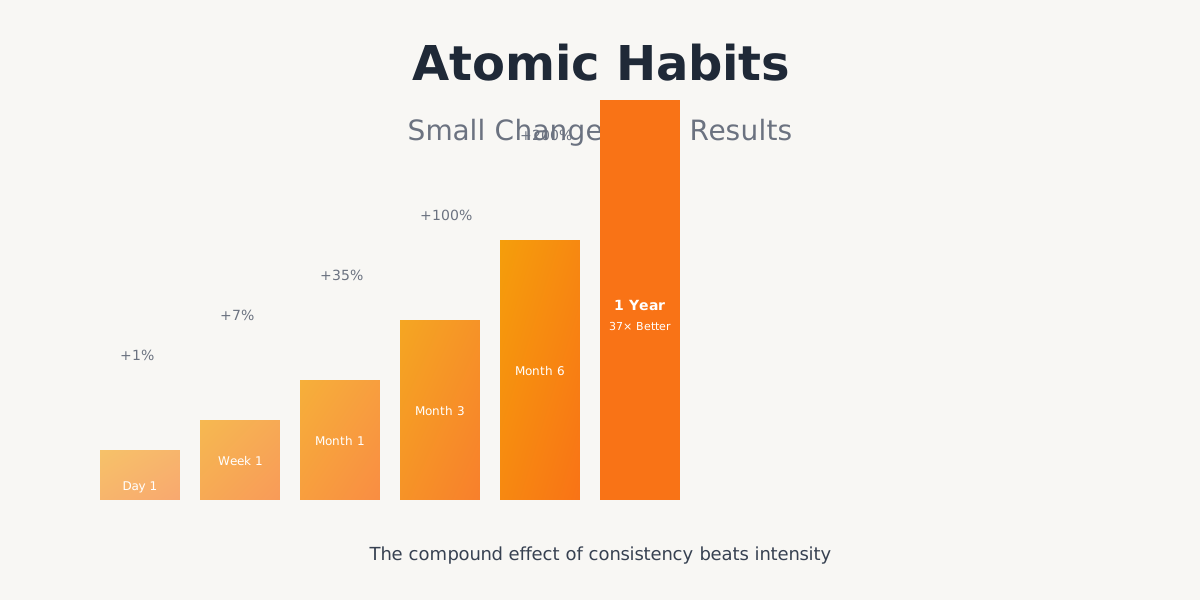
Small habits create momentum. When you focus on improving by just 1% daily, the psychological barriers to change disappear. Instead of overwhelming yourself with ambitious resolutions, you make micro-commitments that feel achievable—and that's where real transformation begins.
This article breaks down the atomic habits framework into practical, actionable insights you can implement today. Whether you're struggling with procrastination, fitness, learning, or any behavioral change, these evidence-based strategies have helped millions of people worldwide build better lives.
What Is Atomic Habits Summary?
Atomic habits refers to the framework developed by behavior change expert James Clear, detailed in his bestselling book of the same name. At its core, it's a system for building extraordinary habits through small, incremental changes. The concept is elegantly simple: atomic habits are tiny, discrete actions that seem insignificant in the moment but compound into remarkable results over time. The 'atomic' label emphasizes how small these habits are—like atoms, they're fundamental units that form larger structures.
Not medical advice.
The framework rests on a mathematical principle: the compound effect. Just as compound interest grows your money exponentially, compound effort grows your results exponentially. The difference between who you are today and who you want to become is measured not in single moments of change but in accumulated daily actions. When you understand this principle, you shift from chasing perfection to celebrating progress, which is far more sustainable for lasting behavior modification.
Surprising Insight: Surprising Insight: Research shows that daily 1% improvements lead to a 37-fold increase in performance over one year (1.01^365 = 37.78). Conversely, 1% daily decline compounds to near-zero in the same timeframe (0.99^365 = 0.03). This mathematical reality is why seemingly tiny habits create outsized life changes.
The Compound Effect: How 1% Daily Change Creates Major Transformation
Exponential growth visualization showing how small daily improvements (1%, 2%, 5%) compound over 365 days compared to daily decline.
🔍 Click to enlarge
Why Atomic Habits Matters in 2026
In our modern world of constant distraction, infinite entertainment, and competing priorities, the atomic habits framework is more relevant than ever. We face unprecedented access to information, technology, and choice, yet paradoxically struggle with focus, discipline, and meaningful behavior change. Our brains are wired for immediate gratification in an environment that rewards long-term thinking. Atomic habits bridge this gap by making sustainable change feel effortless rather than exhausting.
The pandemic fundamentally shifted how we work, socialize, and maintain wellbeing. Many of us discovered that willpower alone doesn't sustain change—we need systems. Atomic habits provides exactly that: a system-based approach rather than relying on motivation, which is notoriously unreliable. This approach aligns perfectly with how our brains actually work, increasing the likelihood that behavior changes persist long-term.
Furthermore, the growing movement toward holistic wellness recognizes that health isn't achieved through dramatic overhauls but through consistent daily practices. Whether managing mental health, building physical fitness, developing professional skills, or deepening relationships, the atomic habits framework provides a proven methodology applicable to any life domain.
The Science Behind Atomic Habits
The scientific foundation of atomic habits rests on well-established principles from neuroscience, behavioral psychology, and habit research. Neuroscientist Wendy Suzuki's research demonstrates that regular physical activity enhances cognitive function and memory, while Stanford behavioral scientist BJ Fogg's work on tiny habits shows that small behaviors can be more sustainable than grand gestures. When we understand the neurochemical processes underlying habit formation, we can design our environment and routines to work with our brain rather than against it.
At the neurological level, habits are encoded in the basal ganglia, a brain region that specializes in storing repetitive behaviors. This is why habits feel automatic once established—they require less conscious effort than novel actions. Research published in cognitive psychology journals shows that repetition strengthens neural pathways, making behaviors progressively more automatic. The atomic habits approach leverages this neural reality by emphasizing consistency over intensity. Small, repeatable actions create stronger neural pathways than occasional intensive efforts.
The Habit Loop: Cue, Routine, Reward
Three-stage neurological process showing how habits form through environmental triggers, behavioral responses, and rewarding outcomes.
🔍 Click to enlarge
Key Components of Atomic Habits
The Habit Loop: Cue, Routine, Reward
Every habit operates within a three-part loop discovered through research in neuroscience and behavioral psychology. First comes the cue—an environmental trigger that signals your brain that a reward is available. This might be your phone buzzing, arriving at a specific location, or experiencing a particular emotion. Second is the routine, the behavior itself—what you actually do in response to the cue. This is the habit in its traditional sense. Finally, there's the reward, the benefit your brain associates with the behavior. Understanding this loop is crucial because changing habits means intercepting one of these three components. To develop better habits, design environments rich with positive cues, make routines easy and enjoyable, and ensure meaningful rewards that your brain genuinely values.
Identity-Based Habits: Becoming vs. Achieving
Most people approach habit change through a goals-based lens: 'I want to run a marathon' or 'I want to save $10,000.' While these outcomes matter, the atomic habits framework emphasizes identity-based habits instead. The distinction is profound. Rather than targeting outcomes, you shift your self-image. Instead of 'I want to become healthy,' you adopt the identity 'I am a healthy person' and act accordingly. This identity-first approach is supported by research in social psychology showing that people's actions align with their self-concept. When habits are rooted in identity rather than outcomes, they become self-reinforcing because maintaining the behavior validates the identity. You're no longer forcing yourself through willpower; you're simply being consistent with who you believe yourself to be.
The Two-Minute Rule: Making Habits Irresistible
One of the most practical insights from atomic habits research is the two-minute rule. The principle is straightforward: when building a new habit, scale it down to a version that takes just two minutes. Don't commit to a one-hour workout; commit to putting on your workout clothes. Don't plan to write a novel; write one paragraph. This strategy addresses the most common barrier to habit formation: getting started. Behavioral research shows that the biggest friction point is initiation, not continuation. Once you begin, momentum naturally carries you forward. The two-minute rule eliminates the resistance by making the initial commitment trivially small. What's fascinating is that most people who commit to two minutes end up doing more. You put on your workout clothes and feel energized to actually exercise. You write one paragraph and find yourself continuing. The rule removes the psychological barrier while maintaining the genuine commitment.
Habit Stacking: Building New Habits on Existing Ones
Habit stacking, formally called 'implementation intentions' in behavioral psychology literature, is a powerful technique for building new habits by anchoring them to existing ones. The formula is simple: 'After [existing habit], I will [new habit].' For example, 'After I pour my morning coffee, I will do ten minutes of stretching' or 'After I sit down at my desk, I will write my daily three gratitudes.' This technique works because you leverage the neural pathway already established by your existing habit. Rather than relying on motivation or willpower to remember the new behavior, you create an automatic trigger. Research on context-dependent memory shows that behavioral cues from one activity can prime the next, making the sequence feel automatic. Over time, the two habits merge into a single routine, requiring minimal cognitive effort.
| Component | Definition | Practical Application |
|---|---|---|
| 1% Rule | Tiny daily improvements compound to remarkable results | Focus on small, consistent progress rather than perfection |
| Habit Loop | Cue → Routine → Reward cycle that encodes behavior | Design your environment to trigger desired cues and establish meaningful rewards |
| Identity-Based | Habits rooted in who you are, not just what you achieve | Say 'I am disciplined' instead of 'I want to be disciplined' |
| Two-Minute Rule | Scale habits to their smallest viable form for easy start | Begin with 2-minute versions: 'Workout' becomes 'put on gym clothes' |
| Habit Stacking | Anchor new habits to existing ones using 'After I X, I will Y' | Chain habits: After coffee, stretch. After breakfast, journal. |
How to Apply Atomic Habits: Step by Step
- Step 1: Conduct a habit audit: List all your current daily habits (what you do automatically). Include both positive habits like morning exercise and negative ones like scrolling social media before bed. This baseline awareness is essential for designing system changes.
- Step 2: Identify your identity: Define who you want to become, not just what you want to achieve. Write it as 'I am a person who [identity statement]' rather than 'I want to [outcome].' This shift from goals to identity creates internal alignment.
- Step 3: Design your habit loop: For your target habit, explicitly define the cue (trigger), routine (behavior), and reward (consequence). Example: Cue = 5 PM alarm on phone. Routine = 10-minute walk. Reward = check off habit tracker and feel energy boost.
- Step 4: Apply the two-minute rule: Break your habit into its two-minute minimum version. Want to read more? Start with reading one page. Want to meditate? Begin with 2 minutes. Get the behavior established first, then expand duration.
- Step 5: Stack your habit: Attach your new habit to an existing daily behavior using the formula 'After I [existing habit], I will [new habit].' Make the transition as automatic as possible.
- Step 6: Modify your environment: Remove friction from desired habits and add friction to unwanted ones. Want to drink more water? Fill a water bottle the night before. Want to reduce phone scrolling? Leave your phone in another room during work time.
- Step 7: Track your progress: Use a habit tracker (simple calendar with X marks or app) to mark each day you complete the habit. The visual accumulation of X marks creates motivation through progress visibility.
- Step 8: Expect plateaus: Understand that motivation fluctuates. Habits typically take 4-8 weeks to feel automatic, but the timeline varies by complexity. Continue even when motivation dips because the neural pathway is still strengthening beneath conscious awareness.
- Step 9: Celebrate small wins: Reward yourself meaningfully when you hit milestones (7 days, 30 days, 100 days). This reinforces the positive association and sustains long-term adherence, leveraging the reward component of the habit loop.
- Step 10: Review and adjust: After 4-6 weeks, assess whether your habit setup is actually working. If not, experiment with different cues, routines, or rewards. The system exists to serve you, not vice versa. Successful habit formation requires iteration.
Atomic Habits Across Life Stages
Young Adulthood (18-35)
This life stage offers unique advantages for habit formation. Young adults typically have greater neuroplasticity (the brain's ability to rewire itself through new behaviors), making this an ideal time to establish foundational habits that will compound throughout life. Common atomic habits for this stage include establishing consistent exercise routines, developing professional skills through daily practice, building financial literacy through small savings habits, and creating healthy sleep patterns. The challenge in young adulthood is competing priorities and the 'I have time' mindset that can delay habit formation. However, recognizing that habits established now will save enormous time and effort later creates powerful motivation. Young adults benefit from identity-based framing: 'I am someone who prioritizes health, learning, and relationships' becomes the organizing principle for daily choices.
Middle Adulthood (35-55)
Middle adulthood presents both challenges and opportunities for atomic habits. Increased professional responsibilities, family obligations, and established life patterns can create resistance to behavior change. However, this stage also brings increased self-awareness and clarity about what actually matters. Middle adults often find atomic habits particularly valuable for managing stress through consistent exercise, maintaining cognitive health through continuous learning, deepening relationships through quality time habits, and sustaining energy through better sleep and nutrition practices. The benefit of middle adulthood is that you've likely experienced the cost of poor habits, creating genuine motivation for change. Common successful habits in this stage include 30-minute morning walks, 15-minute journaling, weekly date nights, and monthly goal review sessions. The two-minute rule is especially valuable here for overcoming initial resistance to adding behaviors into already-packed schedules.
Later Adulthood (55+)
In later adulthood, atomic habits shift toward preservation and optimization of wellbeing. Research in gerontology and behavioral health shows that consistent physical activity, cognitive engagement, and social connection are the strongest predictors of quality of life and longevity in this stage. Effective atomic habits include daily movement (walking, tai chi, or other low-impact exercise), consistent cognitive challenges (learning new skills, puzzles, or reading), regular social engagement (scheduled calls with family, group activities, or volunteering), and maintaining sleep hygiene. The advantage of this stage is often increased time availability as work commitments decrease, making habit consistency more achievable. Older adults often find enormous satisfaction in small consistency victories and appreciate how habits contribute to independence and vitality. Atomic habits framed around maintaining engagement and connection resonate particularly well during this life stage.
Profiles: Your Atomic Habits Approach
The Ambitious Starter
- Smaller habit targets to prevent overwhelm from perfectionism
- Clear identity statements that transcend outcome goals
- Regular progress celebration to counter internal criticism
Common pitfall: Setting habits too ambitious and abandoning them after missing one day, then using that as evidence they lack discipline.
Best move: Choose one 2-minute habit, stack it to an existing behavior, and practice consistently for 4 weeks before adding another. Track completion, not perfection. View missed days as data, not failure.
The Skeptical Realist
- Evidence-based rationale before commitment
- Simple tracking methods with visible proof of results
- Emphasis on practical benefits over motivational language
Common pitfall: Waiting for perfect circumstances or complete understanding before starting, which means never starting.
Best move: Begin with one evidence-backed habit using the two-minute rule. Use a simple checklist or app to track. After 3 weeks, review how the habit feels. Let experience, not belief, drive your conviction.
The Busy Professional
- Integration with existing routines (habit stacking) rather than new time blocks
- Automation of habit tracking to reduce mental load
- Clear ROI connection between habits and professional or personal goals
Common pitfall: Assuming you don't have time for habits, when actually atomic habits saves time by creating efficiency and preventing bigger problems.
Best move: Stack habits to existing routines: after coffee, do stretches; after lunch, walk; after work, journal. Use app-based tracking that requires <30 seconds daily. Track how energy and focus improve.
The Inconsistent Starter
- Environmental design that removes decision-making from daily habit execution
- Accountability through public commitment or tracking group
- Clear connection between daily habit and meaningful identity shift
Common pitfall: Relying on willpower and motivation, which naturally fluctuate, creating an on-off pattern.
Best move: Design your environment to make the habit virtually automatic: lay out workout clothes, prep your water bottle, set phone reminders. Join a tracking community for accountability. Reframe from motivation-dependent to system-dependent.
Common Atomic Habits Mistakes
The most common mistake people make with atomic habits is underestimating how small is 'small enough.' We sabotage ourselves by setting a habit that's still too ambitious—a 20-minute daily meditation instead of two minutes, a five-mile run instead of a 10-minute walk. When we fail this slightly-too-ambitious version, we conclude we lack discipline, when actually the system design was flawed. Remember: the atomic habits framework succeeds through consistency, not intensity. A two-minute daily habit beats an occasional 30-minute effort.
A second critical mistake is neglecting the environmental design component. Habits exist within a context. If you want to eat healthier but keep junk food readily visible in your kitchen, you're fighting your environment every single day. Willpower is a finite resource, but environmental design is permanent. Invest effort in changing the cues and friction levels in your spaces. Make desired behaviors easy and undesired ones difficult. This often requires less willpower than behavior change through motivation alone.
A third mistake is focusing exclusively on behavior without connecting it to identity. You can build a habit of going to the gym, but without the identity shift from 'someone who wants to exercise' to 'I am a healthy person who exercises,' the behavior remains fragile. Identity-based habits are self-sustaining because you're simply being consistent with who you believe yourself to be, rather than constantly overriding your self-image through willpower.
Mistakes vs. Solutions: Why Atomic Habits Fail and How to Fix It
Comparison of common implementation errors and evidence-based corrections for sustaining habit change.
🔍 Click to enlarge
Science and Studies
The atomic habits framework draws from decades of peer-reviewed research across multiple disciplines. Behavioral neuroscience, habit formation research, behavioral economics, and social psychology all converge to support the framework's core principles. Studies consistently show that small, consistent behaviors create lasting change, while motivation-dependent approaches show poor long-term adherence.
- Lally et al. (2009) in the European Journal of Social Psychology tracked 96 participants developing new habits and found average habit formation time was 66 days, with a range of 18-254 days depending on habit complexity. This research established that consistency matters more than intensity.
- Wendy Suzuki's neuroscience research demonstrates that regular physical activity increases BDNF (brain-derived neurotrophic factor), enhancing learning, memory, and mood. Even small daily movement counts, supporting the atomic habits principle of consistency.
- BJ Fogg's Tiny Habits research at Stanford University shows that minimal behavioral interventions (habits requiring <5 minutes) have higher adherence rates than ambitious behavior change programs, supporting the two-minute rule approach.
- Wood et al. (2002) in Consumer Psychology Review found that environmental cues are stronger predictors of repeated behavior than conscious intention, validating atomic habits' emphasis on context design over willpower.
- Clear's compound effect calculations are based on the mathematical principle that 1.01^365 ≈ 37, demonstrating that small daily improvements exponentially outpace inconsistent larger efforts over extended timeframes.
The Habit Tracker Atomic Habits Readers Actually Keep Using
The most quoted rule in Atomic Habits is "never miss twice" — James Clear is explicit that one missed day is an accident and only the second one starts a new identity. Yet the tracker most readers install to apply the book does the exact opposite: the first miss wipes the streak to zero, deleting the visible identity evidence the whole book is about. You cannot practice "never miss twice" inside software that treats missing once as total failure.
If you want a tool that matches the book instead of contradicting it, choose a habit tracker that forgives a missed day, a habit tracker without punitive streak counters, or — if your motivation runs on dopamine spikes rather than schedules — a tracker built for ADHD-style all-or-nothing brains. BeMooore is built around Clear's actual rule: a missed day stays a data point, your progress survives it, and an AI mentor helps you show up the next day so you never miss twice. Free on iOS.
Your First Micro Habit
Start Small Today
Today's action: For the next 7 days, spend 2 minutes immediately after breakfast writing down one thing you're grateful for. Do this right after you finish eating, before moving to the next activity. Use the formula: 'After I finish breakfast, I will write one gratitude.' This tiny habit requires no extra time, creates a psychological anchor to an existing routine, and begins rewiring your brain toward noticing positive experiences.
Gratitude practice is evidence-backed for improving mood and resilience. Starting with just 2 minutes removes all excuses while still creating neural pathway strengthening. Habit stacking to breakfast eliminates decision fatigue. After 7 days, you'll have established the neurological pattern and likely want to continue naturally, demonstrating how tiny consistency creates its own momentum.
Keep quitting habit apps after a missed day? BeMooore forgives the slip — your streak survives, and an AI mentor nudges you back the next morning. Free on iOS.
Quick Assessment
How would you describe your current relationship with habit formation?
Your answer reveals where the atomic habits framework will most benefit you. If you chose 1, focus on the two-minute rule to reduce starting friction. If you chose 2, emphasize environmental design and tracking. If you chose 3, shift toward identity-based habit framing. If you chose 4, explore habit stacking to add depth.
Which area of life would implementing atomic habits most impact?
This identifies your highest-impact opportunity. Choose one area, select one 2-minute habit, stack it to your daily routine, and commit for 4 weeks. Single-focus atomic habit development beats scattered multi-area attempts that dilute attention and effort.
What typically blocks your habit consistency?
This identifies your specific barrier. Forgot the habit? Use phone alarms or habit stacking. Too difficult? Apply the two-minute rule. Motivation problems? Design your environment to reduce decisions. Progress tracking? Use daily marking systems. Your barrier determines your solution.
Take our full assessment to get personalized recommendations.
Discover Your Style →Next Steps
The atomic habits framework isn't theoretical—it's a practical system designed to be implemented immediately. The research is clear: small, consistent actions compound into extraordinary results. Your next step is choosing one area of life where you want change, selecting one 2-minute habit, and committing to 4 weeks of daily practice. Don't aim for perfection or dramatic transformation. Aim for simple consistency. Track your daily completion. Notice how the habit begins shifting your identity—from 'someone trying to change' to 'someone who does this.'
Remember that 1% daily improvement compounds to 37 times better in one year. But 1% daily decline compounds to near-zero. You're not building habits to achieve distant goals—you're building habits because who you become through daily actions is far more important than any outcome. The person who exercises daily isn't distinguished by one workout; they're distinguished by the identity they've developed through consistency. That identity then drives every future choice. Start small. Stay consistent. Let the compound effect do the work.
Get personalized guidance with AI coaching.
Start Your Journey →A routine breaks the week you forget what it was for. Make a lock-screen wallpaper of the outcome, free in your browser, and let your phone do the reminding.
Make my lock screen →Research Sources
This article is based on peer-reviewed research and authoritative sources. Below are the key references we consulted:
Related Glossary Articles
Frequently Asked Questions
How long does it actually take to form a habit?
Research by Lally et al. shows the average is 66 days, but the range is 18-254 days depending on the habit's complexity and your consistency. Simple habits (drinking water) form faster; complex ones (exercise routines) take longer. The key is that timeframe matters less than consistency—daily practice beats occasional intensive efforts.
What if I miss a day? Do I have to start over?
Absolutely not. Missing a single day doesn't reset your progress. Research shows consistency is about frequency, not perfection. Missing occasionally is normal and expected. The danger is missing once and then missing again because you believe you've failed. Instead, view a missed day as data and return to the habit the next day. Most successful people miss days—they simply get back on track quickly.
Can the atomic habits framework apply to habits I want to quit?
Yes, entirely. To eliminate an unwanted habit, use the same framework: identify the cue that triggers it, understand the reward it provides, and design a replacement behavior that provides the same reward with less harm. For example, if you snack when stressed (reward = anxiety relief), replace it with a 2-minute breathing exercise (same reward, healthier behavior). You rarely eliminate habits—you replace them.
Is it better to build one habit at a time or multiple simultaneously?
Research and practical evidence suggest building one habit until it feels automatic (4-8 weeks), then adding another. This focuses your attention, reduces overwhelm, and increases success likelihood. However, if you're stacking habits (new habit triggered by existing habit), you can develop multiple stacks simultaneously. Start with one, become proficient, then expand.
How do I maintain habits once they become automatic?
The beauty of truly automated habits is that they require minimal effort—they feel as natural as brushing your teeth. However, life changes can disrupt even established habits. The solution is periodic reviewing (monthly or quarterly) to ensure your system still fits your life. If a habit lapses, the two-minute rule gets it restarted quickly. Identity-based habits (I am someone who does this) are especially resilient because consistency aligns with self-image.
Take the Next Step
Ready to improve your wellbeing? Take our free assessment to get personalized recommendations based on your unique situation.
- Discover your strengths and gaps
- Get personalized quick wins
- Track your progress over time
- Evidence-based strategies
About the Author
Planning a resolution for 2027?
The date you start decides more than the willpower you bring. A habit begun on 1 October 2026 has 92 days behind it by New Year's Day, more than the median 66 days it takes to feel automatic, while a 1 January start is seven days old on Quitter's Day. Read: New Year's resolutions for 2027, and why October beats January.
Which tracker actually survives a missed day?
We checked what nine iOS habit trackers say in their own App Store listings about streaks and skipped days, and sorted them into four groups. There is also a four-day test, built around deliberately missing a day, that tells you more about an app than any review. Read: habit tracker comparison, what 9 apps do when you miss a day.