Productivity and Purpose
Productivity and purpose represent one of the most powerful combinations for both career success and personal wellbeing. When your daily work aligns with your core values and larger life goals, productivity transforms from a grinding obligation into energizing fulfillment. Research from the University of Oxford shows that employees who feel a strong sense of purpose are 12% more productive while simultaneously experiencing greater happiness, lower stress, and improved overall life satisfaction. This isn't about working harder—it's about working with intention.
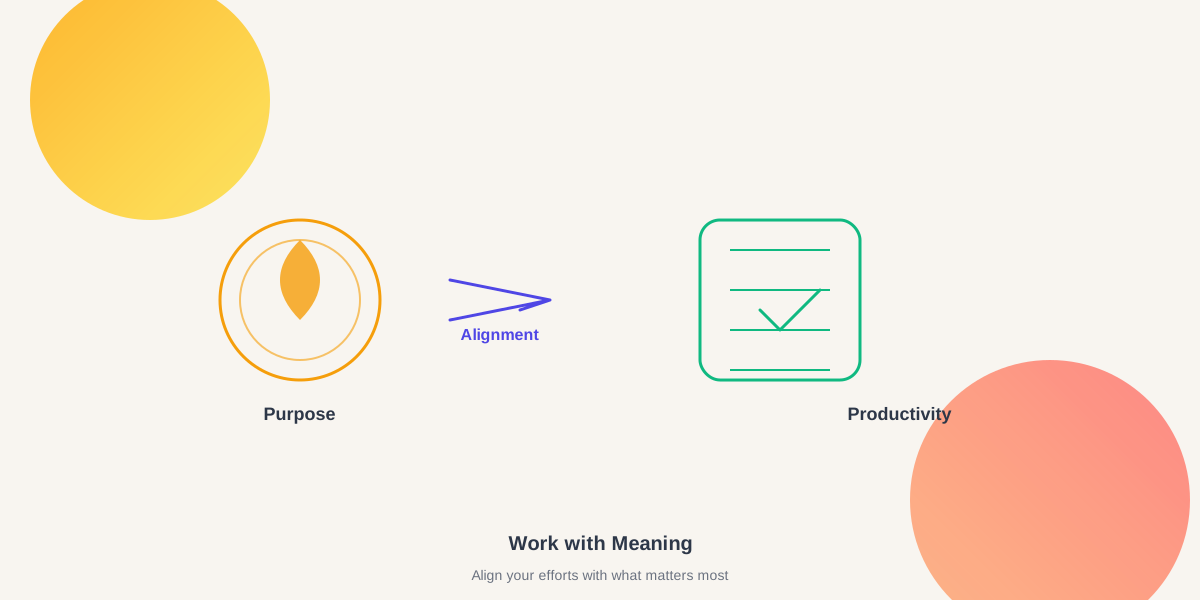
The challenge many face today is that productivity is often pursued without purpose, leading to burnout, disengagement, and hollow achievements that fail to satisfy. Finding the intersection where your productivity meets your deepest values creates a sustainable path forward.
Modern workplaces reveal a troubling gap: while 90% of employees say they want meaningful work, only 30% report feeling connected to their organization's mission. This disconnect costs organizations billions in lost productivity and talented people their wellbeing.
What Is Productivity and Purpose?
Productivity and purpose refers to the alignment between what you accomplish (productivity) and why those accomplishments matter to you (purpose). True productivity isn't simply checking off tasks—it's contributing to outcomes that resonate with your values. Purpose is the deeper 'why' that drives your work: it answers questions like 'How does this matter?' and 'Who does this help?' When these two dimensions work together, you achieve what psychologists call 'purposeful productivity'—work that feels both impactful and personally meaningful.
Not medical advice.
This concept builds on decades of research in organizational psychology, positive psychology, and workplace wellbeing. Viktor Frankl's seminal work 'Man's Search for Meaning' established that humans thrive when they connect their efforts to purpose. Contemporary research from the World Happiness Foundation confirms this, showing that workers who experience purpose report 3x greater life satisfaction and are significantly more likely to stay engaged in their roles long-term.
Surprising Insight: Surprising Insight: Happy employees are not just more content—they're measurably more productive. When positive instead of neutral, workers show 31% higher productivity and 37% better sales performance, according to Harvard research on employee wellbeing.
The Purpose-Productivity Cycle
How purpose fuels sustained productivity and creates positive feedback loops
🔍 Click to enlarge
Why Productivity and Purpose Matters in 2026
In 2026, the disconnect between productivity and purpose has become a primary driver of workplace crisis. Global engagement levels hover at just 21-23% according to Gallup, meaning roughly 4 out of 5 employees feel disengaged despite doing their work. The cost? Lost innovation, turnover, and a human cost in stress and dissatisfaction that ripples into personal relationships and health.
The rise of remote work and AI has intensified this challenge. When your work feels disconnected from human impact, productivity feels hollow. Yet the same technologies create unprecedented opportunity: clearer visibility into how your work contributes, flexibility to align work with values, and tools to measure meaningful impact more directly than ever before.
Personal wellbeing now depends on answering this question early: 'Does my daily work serve something larger than a paycheck?' Organizations that help employees answer 'yes' retain top talent, drive innovation, and outperform competitors. For individuals, connecting work to purpose is no longer optional—it's foundational to sustainable wellbeing.
The Science Behind Productivity and Purpose
The scientific foundation is robust. A 2024 meta-analysis in Management Review Quarterly synthesized decades of research, confirming that purpose-driven workers show measurable improvements across multiple dimensions: higher engagement, better health outcomes, improved relationships, and yes—greater productivity. The mechanisms include: (1) increased mental energy from intrinsic motivation, (2) sharper focus when goals feel meaningful, (3) greater resilience when challenges arise, and (4) improved creativity when you're solving problems you care about.
Neuroscience reveals why: when engaged in purposeful work, your brain shows increased activation in areas associated with reward, attention, and social connection. The stress hormone cortisol decreases while feel-good neurochemicals like dopamine and serotonin increase. This isn't motivation through guilt or external pressure—it's intrinsic activation that sustains itself naturally.
How Purpose Drives Productivity: The Neural Path
The biological mechanisms connecting meaningful work to sustained high performance
🔍 Click to enlarge
Key Components of Productivity and Purpose
Clarity of Purpose
You can't align your work with purpose if you haven't defined what that purpose is. Clarity means answering specific questions: What values matter most to you? What problems do you want to solve? Who do you want to help? How do you want to grow? This isn't a one-time exercise—it's an evolving understanding refined through reflection and experience. Research shows people with clear purpose experience 40% less stress and significantly better job satisfaction.
Goal Alignment
Once you understand your purpose, the next step is aligning your daily goals with it. This creates the bridge between your larger 'why' and concrete 'what.' A software engineer whose purpose is 'creating accessible technology' approaches feature development differently than one just 'shipping code.' They might prioritize accessibility features first, consider user needs for people with disabilities, and measure success by usability across diverse populations. This alignment transforms routine work into purposeful contribution.
Impact Visibility
Purpose becomes powerful when you can see its impact. If you can't perceive how your work helps others or moves you toward your goals, purpose remains theoretical. This is why organizations that create feedback loops—regular communication about customer outcomes, user stories, or mission progress—see higher engagement. You need to regularly ask and answer: 'How did my work today matter?'
Sustainable Pace
Purpose without sustainability leads to burnout—a common trap for passionate people. High productivity must include boundaries: adequate rest, reasonable hours, recovery time, and limits on saying yes. Sustainable pace is the difference between a career and a crisis. Research on workplace burnout shows that even purposeful work becomes toxic without adequate recovery periods.
| Dimension | Productivity Alone | Purposeful Productivity |
|---|---|---|
| Energy Source | External pressure, obligations | Internal drive, meaning |
| Pace | Unsustainable burnout cycle | Energizing and renewable |
| Engagement Level | Disengaged, compliant | Deeply engaged, proactive |
| Work Quality | Meeting minimums | Excellence and innovation |
| Retention | High turnover | Commitment and loyalty |
| Wellbeing | Stress, dissatisfaction | Fulfillment, resilience |
How to Apply Productivity and Purpose: Step by Step
- Step 1: Define your core values: Spend 15 minutes writing down 3-5 values that matter most to you (e.g., helping others, creating beauty, solving problems, building community). Be specific about why these matter.
- Step 2: Clarify your larger purpose: Answer this: 'If my work had maximum positive impact, what would it achieve?' This becomes your North Star.
- Step 3: Map current work to purpose: List your main responsibilities and honestly assess: How does each one connect to your values and purpose? Where is the strongest alignment?
- Step 4: Identify gaps: Notice work activities that feel misaligned. Can you reframe them? Can you minimize them? Can you hand them off?
- Step 5: Set one purpose-aligned goal: Choose one significant goal for the next quarter that directly serves your purpose. Make it concrete and measurable.
- Step 6: Create impact visibility: Establish ways to see your work's impact—customer feedback, metrics that matter, conversations with beneficiaries, or progress tracking toward your larger goals.
- Step 7: Build in reflection: Schedule a weekly 10-minute reflection asking: 'How did this week's work serve my purpose? What impact did I have?'
- Step 8: Adjust your environment: Share your purpose with colleagues and manager. Ask for work assignments and opportunities that align with it.
- Step 9: Track wellbeing, not just productivity: Monitor not just task completion but energy, engagement, and satisfaction. These signal whether your approach is sustainable.
- Step 10: Revisit and evolve: Your purpose may shift as you grow. Schedule quarterly reviews to check if your work still aligns with your evolving values and goals.
Productivity and Purpose Across Life Stages
Young Adulthood (18-35)
In this stage, you're exploring and testing different purposes. You might try different careers, roles, or work styles. The key is intentional exploration: choose opportunities that teach you about what matters to you. Early productivity is less about maximum output and more about building skills and discovering alignment. Seek mentors, ask questions, and give yourself permission to experiment. This is the ideal time to build habits of connecting work to purpose before they crystallize into disconnected patterns.
Middle Adulthood (35-55)
This stage often brings both deepened purpose and significant responsibility. You may have clarity about what matters to you, but face competing demands: family needs, financial obligations, organizational expectations. The challenge is protecting your purpose against dilution through overcommitment. This is when sustainable pace becomes critical. Many find this stage offers an opportunity to mentor others (extending your purpose) and to prioritize quality of contribution over quantity. The most satisfied people at this stage have renegotiated their work to align with mature understanding of their values.
Later Adulthood (55+)
Your purpose may shift toward legacy, wisdom-sharing, and selective impact. Productivity might mean doing fewer things with deeper care and influence. Some find renewed purpose in mentoring, volunteering, or focusing on work that directly reflects their accumulated values. Others discover that stepping back from traditional productivity metrics allows for more authentic purpose. The most vital people in this stage continue meaningful contribution while being intentional about pace and impact.
Profiles: Your Productivity and Purpose Approach
The Driven Achiever
- Challenging goals that stretch you
- Clear metrics showing impact and progress
- Opportunity to lead and influence outcomes
Common pitfall: Achieving goals without pausing to check if they still serve your deeper purpose—leading to success that feels hollow.
Best move: Quarterly purpose audits: Are my biggest wins actually moving me toward what matters most? Permission to redirect ambition when it diverges from values.
The Meaning-Maker
- Work that directly helps others or solves problems you care about
- Regular feedback showing your impact
- Community and shared mission with colleagues
Common pitfall: Sacrificing financial security or sustainability because meaning feels more important than practical wellbeing.
Best move: Find the 'sweet spot' where meaningful work also sustains you. Sometimes this means negotiating role design or changing employers, not self-sacrifice.
The Balancer
- Work that respects boundaries and honors personal life
- Clear separation between roles, with integration where values align
- Flexibility to adjust productivity as life demands shift
Common pitfall: Compartmentalizing work and purpose so much that neither feels integrated—staying small in both domains.
Best move: Find 1-2 areas where purpose naturally spans work and personal life. Build small but meaningful contributions there.
The Experimenter
- Opportunity to try different approaches and learn from them
- Permission to change direction as understanding evolves
- Psychological safety to explore without judgment
Common pitfall: Endless exploration without commitment, changing direction so often that nothing deepens or compounds.
Best move: Set a realistic timeline for each experiment (6 months to 1 year), then commit fully before moving on. Build discipline alongside curiosity.
Common Productivity and Purpose Mistakes
Mistake 1: Assuming purpose must be grandiose. Purpose doesn't require saving the world. It can be teaching well, building things that last, helping your team succeed, or creating beauty. Small, genuine purposes often prove more sustainable than lofty ones disconnected from daily reality.
Mistake 2: Waiting for perfect clarity before acting. Purpose often emerges through doing, not from solitary reflection. You discover what matters through trying things, getting feedback, and refining understanding. Start with your best current answer and adjust as you learn.
Mistake 3: Expecting work to be your only source of purpose. Integrating purpose and productivity is powerful but incomplete. Balance comes from multiple sources: family, creative expression, community, spirituality, learning. Work should express your values, but needn't carry their entire weight.
From Burnout to Sustainable Purpose: The Recovery Path
How to rebuild purposeful productivity after experiencing disconnection or burnout
🔍 Click to enlarge
Science and Studies
Research on productivity and purpose has grown exponentially over the past decade, providing clear evidence that this integration isn't just nice-to-have—it's foundational to both performance and wellbeing. The studies below represent key findings from peer-reviewed research, organizational psychology, and longitudinal studies tracking outcomes over years.
- University of Oxford (2019): Happy employees are 12% more productive and show 30% better performance quality compared to unhappy peers.
- Harvard Business School (2021): Workers who feel positive purpose experience 37% higher sales performance and 31% greater productivity across roles.
- World Happiness Foundation (2024): Only 30% of workers report feeling connected to organizational mission, but those who do show 3x greater life satisfaction.
- Gallup (2024): Global employee engagement remains at 21-23%, with purpose-driven cultures showing 2-4x higher engagement scores.
- American Psychological Association (2024): Workplace burnout is associated with decreased performance, with psychological safety as a key protective factor.
Your First Micro Habit
Start Small Today
Today's action: Write down one way today's work served something you care about. Spend 2 minutes at end-of-day asking: 'Who benefited from what I did today? How did this move me toward something meaningful?' Write one clear answer.
This daily micro-practice builds awareness of purpose already present in your work, often invisible when you're focused on tasks. Over time, it reshapes how you approach work—toward noticing and amplifying meaning rather than assuming none exists. Research shows even 2 minutes of daily reflection increases reported purpose by 40% within 4 weeks.
Keep quitting habit apps after a missed day? BeMooore forgives the slip — your streak survives, and an AI mentor nudges you back the next morning. Free on iOS.
Quick Assessment
How connected do you currently feel between your daily work and your larger life purpose?
Your answer reveals where you are on the spectrum. Those reporting strong connection consistently show higher engagement, better health, and greater career longevity. If you're at 'weakly' or 'not connected,' this is the primary opportunity for transforming both your productivity and wellbeing.
What would need to change for your work to feel more purposeful?
This reveals whether your challenge is external (actual work misalignment) or internal (perspective shifts). Both are solvable, but require different solutions. Understanding which is your primary leverage point focuses your effort.
How sustainable is your current productivity level?
True purposeful productivity is sustainable. If your pace isn't sustainable, adding more purpose won't fix it—you need to also redesign the pace. The healthiest high performers protect sustainability as fiercely as impact.
Take our full assessment to get personalized recommendations.
Discover Your Style →Next Steps
Begin where you are. If your work feels disconnected from purpose, your first step isn't a career change—it's clarity. Spend this week asking yourself the defining questions: What do I actually care about? How does my current work connect to that? What's one small way I could amplify that connection? Write these answers. They're your foundation.
Then experiment. Try the micro habit. Have one conversation with someone whose work feels purposeful—ask how they think about it. Make one small change to how you approach this week's work. Small experiments build momentum toward larger understanding and changes. You're not aiming for perfect purpose from day one; you're building toward it through repeated, small alignments.
Get personalized guidance with AI coaching.
Start Your Journey →Research Sources
This article is based on peer-reviewed research and authoritative sources. Below are the key references we consulted:
Related Glossary Articles
Frequently Asked Questions
How long does it take to feel the benefits of aligning work with purpose?
Research shows awareness begins shifting within 2-4 weeks of consistent reflection (like our micro habit). Deeper shifts in engagement and wellbeing typically emerge over 3-6 months as you make small adjustments. Major career changes may take 6-12 months to fully realize benefits as new patterns establish.
What if I don't know my purpose yet?
Purpose often emerges through experimentation, not introspection alone. Start with your best current answer: What problems do you like solving? Who do you want to help? What have you felt most alive doing? Use these to guide choices, then learn through experience. Purpose develops, it's rarely discovered fully formed.
Can purpose and productivity coexist with financial necessity?
Yes, and this is the most common real-world situation. You don't need your purpose to be your job. Many find deep purpose through volunteer work, family, creative pursuits, or community while working for financial stability. The key is ensuring your job doesn't actively contradict your values—it can be neutral while purpose lives elsewhere.
What if my organization doesn't support purpose-driven work?
You have more agency than you might think. First, look for ways to reframe current work toward purpose. Second, identify one colleague or project where purpose feels more possible. Third, be strategic: would changing roles, teams, or managers help? Finally, if the organization fundamentally conflicts with your values, it might be time for a bigger change.
How do I balance personal purpose with team or organizational goals?
The best situation is alignment—where what you care about overlaps with what your team needs. Seek this actively. Where there's genuine tension, be honest with yourself about whether it's temporary (a season when goals diverge) or permanent (fundamental misalignment). Most careers have both seasons—the sustainable approach is leaving when permanent misalignment becomes clear.
Take the Next Step
Ready to improve your wellbeing? Take our free assessment to get personalized recommendations based on your unique situation.
- Discover your strengths and gaps
- Get personalized quick wins
- Track your progress over time
- Evidence-based strategies