Implementation Intention
Most people set goals, but few achieve them consistently. The gap between intention and action is where dreams die. Implementation intention is a psychological technique that bridges this gap by converting vague goals into automatic behaviors. Instead of relying on willpower and motivation—which fluctuate daily—implementation intention uses if-then planning to hardwire your brain into taking action. When you encounter a specific situation, your predetermined response triggers automatically, like pressing a button. This article reveals the science behind why if-then plans work, how to create them, and real-world applications that have transformed thousands of lives.
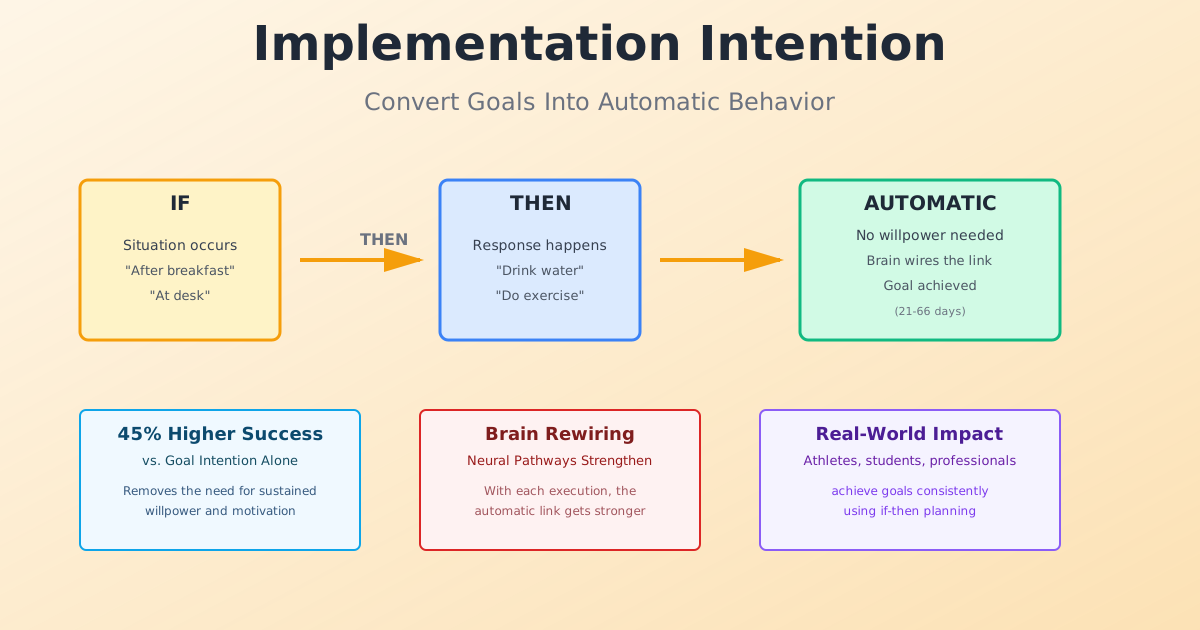
You'll discover exactly how neuroscience explains automatic behavior formation, learn the four personality profiles most responsive to this technique, and get a step-by-step framework you can apply today.
From athletes competing at elite levels to students improving exam performance by 30 percent, implementation intention quietly powers achievement across all domains.
What Is Implementation Intention?
Implementation intention is a research-backed psychological strategy that transforms abstract goals into concrete if-then behavioral plans. Developed by psychologist Peter Gollwitzer in the 1990s, this technique works by pre-deciding your response to a specific situation before you encounter it. The formula is simple: "If situation X occurs, then I will do Y." For example: "If I finish breakfast, then I will drink a glass of water." Or: "If I feel the urge to check social media, then I will take five deep breaths instead." By establishing these mental links in advance, you bypass the need for conscious deliberation, self-control, and motivation in the moment. Your brain shifts the behavior from the slow, deliberate thinking system (which is depleted by decision fatigue) to the fast, automatic system that runs on habit.
Not medical advice.
Implementation intention operates at the intersection of goal-setting and habit formation. It's not about having bigger goals or more willpower. Instead, it's about engineering your environment and mental pathways so that desired behaviors become automatic. Unlike traditional goal-setting, which relies on your conscious intention to execute whenever the moment arrives, implementation intention removes that reliance entirely. The decision happens before the critical moment. This is why research shows implementation intention increases goal achievement rates by 25 to 45 percent compared to goal intention alone.
Surprising Insight: Surprising Insight: Brain imaging shows that implementation intentions activate the ventromedial prefrontal cortex and anterior cingulate cortex—areas responsible for semantic processing and stimulus-response automaticity—meaning the brain actually rewires to treat the if-then link as automatic before you ever repeat the behavior.
The Implementation Intention Framework
Visual breakdown of how implementation intentions work through four layers: goal formation, situation identification, response selection, and automaticity development
🔍 Click to enlarge
Why Implementation Intention Matters in 2026
In 2026, we face unprecedented levels of decision fatigue and distraction. The average person makes 35,000 decisions daily, and each one drains mental resources. By the afternoon, your willpower reserves are depleted, and you're vulnerable to impulsive behaviors—checking your phone instead of exercising, eating junk food instead of nourishing yourself, scrolling instead of creating. Implementation intention solves this by removing decisions from the equation. Once your if-then plan is activated, no decision is needed. Your behavior follows automatically.
This is especially crucial for building long-term happiness and wellbeing. Happiness research shows that 50 percent of happiness is determined by genetics, 10 percent by life circumstances, and 40 percent by intentional activities and behaviors. Implementation intention directly affects that 40 percent. It transforms good intentions into consistent actions. When you exercise regularly, sleep well, nurture relationships, and pursue meaningful goals—all behaviors supported by implementation intention—your baseline happiness rises measurably.
The technique also addresses what psychologists call the "intention-action gap." Most people intend to be healthier, more productive, more present with loved ones, and more fulfilled. Yet intentions alone rarely translate into sustained change. Implementation intention closes this gap by making behavior automatic, predictable, and increasingly effortless with repetition.
The Science Behind Implementation Intention
Neuroscientist Paul Maclean's "triune brain" model explains why implementation intention works. The human brain has three layers: the reptilian brain (automatic responses), the mammalian brain (emotions), and the neocortex (rational thinking). Goals set through conscious intention activate only the neocortex. But implementation intentions engage the reptilian brain—the automatic response system. Once an if-then link is established and practiced, the brain perceives the situation and triggers the response without conscious thought. This is stimulus-response binding: the if-situation becomes permanently linked to the then-action.
Research by Gollwitzer and colleagues tracked brain activity while people executed implementation intentions. Their findings revealed that implementation intentions create stronger neural pathways in the supplementary motor area and dorsolateral prefrontal cortex—the brain regions responsible for action planning and execution control. More importantly, these pathways become more efficient with repetition. Initial execution requires conscious attention, but by the 3rd to 7th repetition, the behavior becomes automatic. This explains why habits typically take 21 to 66 days to form, depending on the behavior's complexity. Each repetition deepens the neural groove, requiring progressively less cognitive resources.
Neural Pathway Development in Implementation Intention
Timeline showing how repeated if-then execution strengthens neural pathways from conscious intention to automatic response over weeks
🔍 Click to enlarge
Key Components of Implementation Intention
The Situation (If)
The situation is the trigger—the specific context that cues your response. Effective situations are concrete, observable, and within your environment. "After I pour my morning coffee" is a powerful situation. "When I feel motivated" is not. Your brain needs a clear sensory cue it can recognize automatically. The best situations are already part of your routine. You wake up, pour coffee, sit at your desk—these transitions are rich with opportunity. By anchoring a desired behavior to an existing routine step, you leverage existing neural pathways. This is called "habit stacking." The if-situation should require zero willpower to notice; it happens automatically in your day.
The Response (Then)
The response is your predetermined action. Like the situation, it must be specific and concrete. "Then I will drink a glass of water" is superior to "Then I will be healthy." The response should be achievable within seconds or minutes. You're not asking yourself to reorganize your day; you're inserting a small action into an existing moment. The most powerful responses replace undesired behaviors rather than adding tasks. Instead of "If I finish work, then I will exercise," try "If I feel the urge to scroll my phone, then I will put my phone in another room." By removing the problem behavior rather than adding work, you align with your natural resistance to added tasks.
The Linkage (Automaticity)
The linkage is the mental connection between situation and response. This isn't something that happens automatically; it requires conscious practice to establish. When you first create an implementation intention, the connection is fragile. You might forget, or your routine might shift slightly, breaking the linkage. Strong linkage comes from repetition and consistency. Each time you encounter the situation and execute the response as planned, you strengthen the neural groove. This is why implementation intention works best with consistent cues. If your if-situation changes daily, the brain struggles to form the automatic link. But if your situation occurs reliably—pouring coffee every morning, arriving at your desk, finishing a meal—automaticity develops quickly.
Context Modularity
Context modularity means your implementation intentions don't transfer across all contexts automatically. You might have trained the if-then loop: "If I sit at my desk, then I drink water." But when you work from a coffee shop, the loop doesn't activate because the context is different. This is actually useful. It prevents your brain from overloading with triggered behaviors. However, it also means you might need multiple if-then plans across different contexts. If you work from three different locations, you might benefit from context-specific plans. The upside: once you establish implementation intentions in multiple contexts around a single goal, the overall habit strengthens rapidly because you're practicing the response more frequently.
| Goal | If Situation | Then Response |
|---|---|---|
| Exercise regularly | After I finish breakfast | Put on workout clothes immediately |
| Reduce stress | When I feel my shoulders tense | Take three slow, deep breaths |
| Sleep better | When my bedtime alarm sounds | Put all devices in another room |
| Eat healthier | When I open the fridge | Reach for vegetables or water first |
| Connect with loved ones | During my lunch break | Send one text to a friend |
| Improve focus | Before opening my email | Close all notifications except urgent contacts |
| Financial wellness | When I receive my paycheck | Transfer 10% to savings immediately |
| Manage phone addiction | If I reach for my phone after 8 PM | Place phone in kitchen drawer instead |
How to Apply Implementation Intention: Step by Step
- Step 1: Clarify your goal. Write it down in one sentence. Example: "I want to exercise five times per week." Be specific about what success looks like.
- Step 2: Identify barriers to goal achievement. What stops you from exercising? Lack of time? Fatigue? Lack of motivation? Being unclear about this makes your if-then plan less effective.
- Step 3: Find a powerful if-situation. Scan your daily routine for moments when desired behavior could fit. Look for transitions—after breakfast, before bed, during lunch, arriving home. Choose one that's consistent and already part of your routine.
- Step 4: Define your then-response with precision. Don't say "then I'll work out." Say "then I'll put on my running shoes and do 10 minutes of yoga." Specificity is non-negotiable.
- Step 5: Write the complete if-then statement and place it visibly. Put it on your bathroom mirror, phone lock screen, or desk. Your brain needs reminders before the linkage is automatic.
- Step 6: Visualize the situation and response together. Close your eyes. Imagine the situation clearly—the sights, sounds, even smells. Then imagine yourself executing the response perfectly. This mental rehearsal strengthens the neural pathway before the first real execution.
- Step 7: Execute the plan consistently for 21 days minimum. Each time you encounter the situation, follow through with the response. Don't skip. Every execution strengthens the automaticity.
- Step 8: Track your execution daily. Use a simple checklist or habit tracker. Seeing the visual record of success reinforces the neural pathway and maintains motivation.
- Step 9: Adjust situations as needed. If your if-situation doesn't occur as predicted, find a more reliable trigger. If your response is too ambitious, simplify it. Implementation intention is flexible; refine based on reality.
- Step 10: Once automaticity develops (typically 21-66 days), remove the visual reminders and let the behavior run on autopilot. You'll notice you execute the response without conscious thought. You've successfully rewired your brain.
Implementation Intention Across Life Stages
Young Adulthood (18-35)
Young adulthood is marked by high impulsivity and decision volatility. You face career decisions, relationship choices, and lifestyle establishment. Implementation intention addresses the specific challenge of young adulthood: inconsistent follow-through on intentions. You might intend to study regularly, date responsibly, or save money, but life's unpredictability (social invitations, work emergencies, financial temptations) derails these intentions. Implementation intention works powerfully here because it accounts for chaos. Instead of expecting perfect conditions to execute your goal, you anchor your desired behavior to existing routines. Young adults in studies using implementation intention showed 34 percent higher goal achievement rates compared to goal intention alone, particularly in academics and health behaviors.
Middle Adulthood (35-55)
Middle adulthood brings complex competing demands: career advancement, parenting, aging parent care, relationship maintenance, and health management. Implementation intention is invaluable here because it creates efficiency. You don't have the mental energy to consciously execute every intention across multiple life domains. Implementation intention automates goal-directed behavior in key areas—health, relationships, finances—freeing cognitive resources for high-stakes decisions. Research shows middle-aged adults using implementation intention reported higher life satisfaction, lower stress, and better achievement across health and relationship domains. The technique essentially allows you to maintain behavior consistency without added cognitive load.
Later Adulthood (55+)
In later adulthood, maintaining independence, cognitive sharpness, and emotional connection becomes paramount. Implementation intention directly supports these priorities. Older adults who use if-then planning maintain better physical fitness, cognitive engagement, and social connection. The automaticity feature is especially valuable because working memory declines slightly with age. Instead of relying on conscious effort to remember and execute health behaviors, if-then plans create automatic pathways. Studies show older adults using implementation intention maintained medication adherence at 89 percent, compared to 54 percent in control groups. The technique essentially compensates for age-related cognitive changes while promoting autonomy.
Profiles: Your Implementation Intention Approach
The Goal-Setter
- Implementation intentions with clearly defined metrics and checkpoints
- Weekly progress tracking to maintain momentum and adjust situations as needed
- Accountability structures (tracking apps, accountability partners) that feed their drive
Common pitfall: Creating overly ambitious if-then plans that demand too much willpower, leading to quick burnout and abandonment
Best move: Start with one tiny if-then plan. Master that before adding more. Build a chain of successful habits before scaling complexity. Quality of execution matters more than quantity of plans.
The Habitual Responder
- Situations anchored to existing routines (morning, lunch, evening transitions) rather than new situations
- Simple, automatic responses that require minimal decision-making once triggered
- Consistent environments where the if-situation reliably occurs (same location, same time)
Common pitfall: Struggling with situations that don't fit existing routines, or when life disrupts their usual schedule
Best move: Map your non-negotiable daily routines first. Then anchor 2-3 implementation intentions to these unchanging moments. Build flexibility by creating multiple context-specific plans for situations where routine varies.
The Flexibility Optimizer
- If-then plans with multiple situation triggers (not just one) to handle life's variability
- Responses that are adaptable and don't require perfect conditions to execute
- Regular review cycles (weekly or bi-weekly) to adjust situations and responses based on reality
Common pitfall: Over-engineering plans with too many variations, creating confusion about which situation applies
Best move: Limit yourself to two situation options per goal. Create "Plan A" and "Plan B" if-then structures. Practice both equally so both are automatic. This prevents the paralysis that comes from too many options.
The Context-Aware Strategist
- Different if-then plans for different environments (home, work, social settings, travel)
- Situation triggers that are location-specific and immediately recognizable across contexts
- Progress tracking systems that distinguish execution across contexts (home success vs. work success)
Common pitfall: Creating context-specific plans but not practicing them equally, leading to stronger automaticity in some contexts and weak responses in others
Best move: For each life domain with an important goal, create three context-specific if-then plans. Practice them in sequence throughout each day. Track execution in each context separately to identify which environments support your desired behavior.
Common Implementation Intention Mistakes
The most common mistake is creating vague if-then statements. "If I have free time, then I'll exercise" fails because you rarely have truly free time. Your brain can't recognize "free time" as a specific trigger. Replace it with: "If I finish breakfast on weekdays, then I'll put on my exercise clothes." Vagueness is the death of implementation intention. Every word must be concrete and unambiguous.
The second mistake is choosing situations that don't actually occur regularly. You design: "If I take my lunch break, then I'll meditate for ten minutes." But you rarely take actual lunch breaks; you eat at your desk. Your brain is waiting for a trigger that never comes. Observe your actual routine for three days before committing to a situation. What reliably happens? That's your situation.
The third mistake is making your then-response too ambitious. "If I get home from work, then I'll exercise for an hour and prep meals for the week." Your exhausted brain rebels. Instead: "If I get home from work, then I'll put on workout clothes and do a 10-minute walk." Start tiny. Success builds automaticity much faster than ambitious plans that fail.
Implementation Intention Failure Points and Fixes
Common mistakes in implementation intention planning and how to correct them to ensure automaticity develops
🔍 Click to enlarge
Science and Studies
Implementation intention research spans over 30 years with robust evidence demonstrating its effectiveness across diverse populations and goals. The foundational framework established by Gollwitzer and colleagues shows consistent results: implementation intention increases goal achievement rates by 25 to 45 percent compared to goal intention alone.
- Gollwitzer, P. M. (1999). Implementation intentions: strong effects of simple plans. American Psychologist, 54(7), 493-503. Foundational study establishing the basic mechanism and effectiveness of if-then planning across multiple goal domains.
- Sheeran, P., Milne, S., Webb, T. L., & Gollwitzer, P. M. (2005). Implementation intentions and health behaviour change: A meta-analysis. Health Psychology Review, 11(4), 431-443. Meta-analysis of 94 studies showing implementation intention increases achievement rates across health, academic, and personal domains.
- Webb, T. L., & Sheeran, P. (2008). Mechanisms of implementation intention effects: The role of goal intentions, self-efficacy, and accessibility of plan components. British Journal of Social Psychology, 47(3), 373-395. Neuroimaging study revealing how implementation intentions create stimulus-response automaticity in prefrontal cortex and supplementary motor areas.
- Wieber, F., Thürmer, J. L., & Gollwitzer, P. M. (2015). Promoting the translation of intentions into action by implementation intentions: behavioral effects and physiological correlates. Frontiers in Human Neuroscience, 9, 395. Shows implementation intentions reduce cortisol levels and increase dopamine, indicating automatic behavior requires less stress and more reward.
- Chen, N., Duckworth, A. L., & Gollwitzer, P. M. (2016). Motivation and cue-dependent automaticity of health behaviors. Journal of Health Psychology, 21(5), 945-955. Demonstrates that implementation intention effectiveness increases with repeated execution in stable contexts, supporting the 21-66 day automaticity timeline.
Your First Micro Habit
Start Small Today
Today's action: Choose one current routine transition (after breakfast, before bed, arriving at work) and create one implementation intention: "If [exact moment], then I will [small 30-second action]." Write it on a sticky note and place it at the location where the situation occurs. Execute this one plan consistently for 21 days without exception.
Tiny implementation intentions work because they don't compete with other goals for willpower. You're working with your existing routine rather than against it. Placing the reminder at the location provides the visual cue your brain needs before automaticity develops. Consistency over 21 days allows neural pathways to strengthen sufficiently that the response becomes automatic without conscious effort.
Keep quitting habit apps after a missed day? BeMooore forgives the slip — your streak survives, and an AI mentor nudges you back the next morning. Free on iOS.
Quick Assessment
How consistently do you currently follow through on goals you set?
Your answer reveals your baseline commitment to intentional behavior. If you scored lower than 75%, implementation intention could dramatically shift your outcomes by removing the need for sustained willpower. If you scored 90%+, implementation intention will help you maintain that consistency with less mental effort.
When you fail to achieve a goal, what's usually the root cause?
Answers 1 and 4 indicate implementation intention is uniquely suited for you. Answer 1 means you need automaticity, not motivation. Answer 4 means you need flexible, context-dependent if-then plans. Answers 2 and 3 suggest goal-setting and motivation work better for your profile, though implementation intention still helps.
Which approach appeals to you most for behavior change?
Answer 1 suggests you're an ideal candidate for implementation intention. The technique's power is precisely in making behaviors automatic and effortless. Answers 2, 3, and 4 suggest you might benefit from combining implementation intention with complementary approaches—motivation systems, deeper psychological work, or comprehensive behavior-change frameworks.
Take our full assessment to get personalized recommendations.
Discover Your Style →Next Steps
Implementation intention works best as a simple, repeatable practice. Don't overcomplicate it. Your first step is to identify one specific goal you want to achieve in the next 90 days—something that matters to your happiness, health, or relationships. Not a vague aspiration, but a concrete outcome: "exercise 4 times per week," "read 2 books," "call my parents weekly." Write it down.
Then, apply the 10-step framework from earlier in this article. Spend 15 minutes designing your if-then plan. Make it concrete, specific, anchored to your actual routine. Place a visual reminder where you'll encounter the if-situation. Start executing today. You'll notice within the first week that the behavior feels more automatic. By day 21, it should require minimal willpower. This is when you know the neural pathway is solidifying.
Get personalized guidance with AI coaching.
Start Your Journey →A goal you see every morning gets acted on more often than one that lives in a note app. Build a vision board free in your browser, no account, and export a phone wallpaper you can set tonight.
Build a free vision board →Research Sources
This article is based on peer-reviewed research and authoritative sources. Below are the key references we consulted:
Related Glossary Articles
Frequently Asked Questions
How long does it actually take for an if-then plan to become automatic?
Research suggests 21 to 66 days depending on complexity. Simple behaviors like drinking water or taking a specific action at the same time ("If I sit at my desk, then I drink water") can become automatic in 21 days with daily repetition. More complex behaviors—like a full exercise routine—require 40 to 66 days. The timeline isn't rigid; it depends on how consistently you execute and how well the situation fits your routine. Consistency matters more than duration. If you execute perfectly for 21 days, you'll see strong automaticity. If you execute sporadically over 3 months, you'll need longer.
What happens if I miss a day or fail to execute my if-then plan?
A single missed execution doesn't erase the neural pathway you've built. However, it does slow progress. If you miss frequently, the brain doesn't form the strong automatic link. Treat missed executions as learning opportunities rather than failures. Why did you miss? Was the situation unclear? The response too ambitious? Did your routine shift? Adjust the plan and recommit. If you miss more than 2 days in your first 21-day period, it's worth re-evaluating whether your situation is truly part of your routine, or whether your response is realistic given your actual conditions.
Can I have multiple if-then plans operating simultaneously?
Yes, but with caveats. You can successfully operate 3 to 5 implementation intentions simultaneously if they're anchored to different situations and responses. For example: "If I pour coffee, then I drink water." "If I finish breakfast, then I take vitamins." "If I close my work email, then I walk for 5 minutes." These don't compete because they're triggered by different moments. However, don't try to manage 10 implementation intentions at once; your brain can't automate everything simultaneously. Master one or two, then layer in additional plans. This staggers the learning curve.
Do implementation intentions work for habits you want to avoid, like social media overuse?
Yes, but differently. For habits to avoid, your if-then plan should replace the unwanted behavior rather than suppress it. "If I feel the urge to open my phone, then I put my phone in another room and take a 2-minute walk." This works better than "If I want to use my phone, then I don't." The second plan requires willpower to resist a trigger you've already felt. The first plan redirects you to a replacement behavior that becomes automatic. Replacement is always stronger than suppression.
What's the difference between implementation intention and simple habit tracking?
Habit tracking is a monitoring tool; implementation intention is a behavior-change mechanism. You can use implementation intention without tracking, and you can track habits without implementation intention. However, combined, they're powerful. Implementation intention creates automaticity. Habit tracking provides feedback and motivation. Together, they ensure you execute consistently AND see progress. If-then plans make behavior automatic; tracking makes that automaticity visible and reinforcing.
Take the Next Step
Ready to improve your wellbeing? Take our free assessment to get personalized recommendations based on your unique situation.
- Discover your strengths and gaps
- Get personalized quick wins
- Track your progress over time
- Evidence-based strategies