Growth and Scaling
Growth and scaling are the cornerstones of business success, yet they're often misunderstood. Many entrepreneurs confuse growth (expanding revenue) with scaling (expanding efficiently without proportional cost increases). True growth and scaling requires intentional systems, strategic planning, and disciplined execution. Whether you're running a startup, freelance business, or established company, mastering these principles determines whether you'll survive market pressures, outpace competitors, and build sustainable wealth.
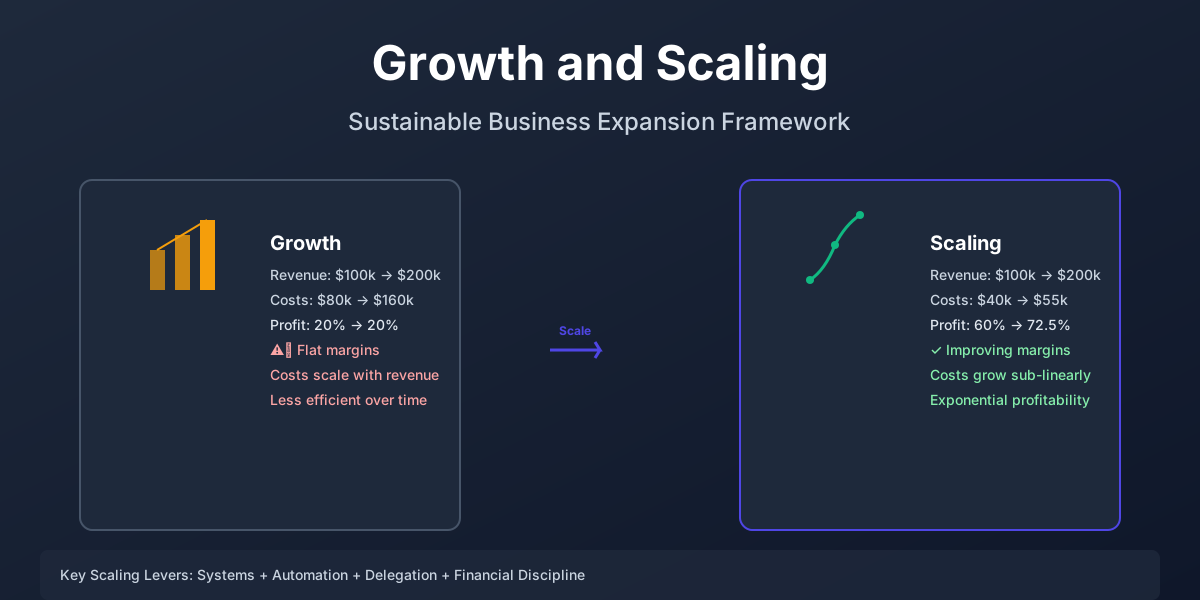
Scaling isn't just about making more money—it's about creating repeatable systems that generate exponential returns while your operational costs grow linearly or sub-linearly. The difference between a founder working 80-hour weeks with flat revenue and one generating 10x revenue with fewer hours? Systems, delegation, and process optimization.
This guide reveals the science behind sustainable scaling, the psychological patterns that hold businesses back, and practical frameworks proven by thousands of successful companies across industries.
What Is Growth and Scaling?
Growth and scaling are distinct but interconnected concepts. Growth refers to increasing revenue, customer base, or market share. You can achieve growth through increased marketing spend, hiring more salespeople, or expanding into new markets. Scaling, however, means achieving growth with improved efficiency—your business generates significantly more revenue without proportionally increasing operational costs.
Not medical advice.
The mathematical difference matters strategically. If your business grows 50% year-over-year but your costs grow 45%, you're experiencing profitable growth. But if your costs grow 50% or more, you're simply expanding overhead without improving margins. True scaling means your gross margin improves, your unit economics become stronger, and your profitability accelerates—the hallmark of sustainable, repeatable business models.
Surprising Insight: Surprising Insight: Most business failures aren't caused by lack of sales—they're caused by poor cash flow management and scaling too fast without foundational systems. 82% of businesses fail because of poor cash flow, not lack of customer demand.
Growth vs. Scaling: The Cost Structure Difference
Compares traditional growth (linear cost increases) with true scaling (sub-linear cost growth creating exponential profitability)
🔍 Click to enlarge
Why Growth and Scaling Matters in 2026
In 2026, growth and scaling have become non-negotiable competitive advantages. Market dynamics have accelerated: AI automation reduces traditional scaling costs, remote work enables global talent access, and digital-first business models create inherent scalability. Companies that fail to scale systematically get disrupted by those that do. Meanwhile, economic uncertainty makes efficient scaling essential—investors now prioritize unit economics and profitability over vanity metrics like customer acquisition at any cost.
The personal wealth implications are profound. If you own a business that grows but doesn't scale, you become trapped in operational overhead and manual work. If you've built a scalable system, you create passive or semi-passive income streams. The difference between a founder earning $200k for 60 hours/week of work versus $2M for 20 hours/week comes down entirely to scaling systems and delegation decisions made years earlier.
For employees and freelancers, understanding scaling principles matters because they determine which companies have strong growth potential (better equity value, job security) and which are struggling operationally despite high revenue. For entrepreneurs, scaling literacy becomes the difference between building a sustainable asset versus a time-intensive job.
The Science Behind Growth and Scaling
Business scaling follows predictable patterns documented in organizational research. Geoffrey Moore's "Crossing the Chasm" identifies distinct scaling phases: early market adoption, mainstream adoption, and mature market saturation. Each phase requires different operational structures, messaging, and team compositions. Companies that fail typically try to apply early-stage tactics to mainstream markets or vice versa—a misalignment between growth stage and operational strategy.
The scaling science also reveals critical leverage points: unit economics (how much profit each customer generates), customer acquisition cost (CAC), lifetime value (LTV), and churn rate. These metrics determine scalability math. A business with $100 CAC and $500 LTV (5:1 ratio) scales profitably. One with $100 CAC and $120 LTV (1.2:1 ratio) collapses under scaling pressure. This fundamental ratio calculation predicts success or failure better than any qualitative assessment.
The Five Scaling Leverage Points
Identifies primary drivers of sustainable business scaling: operational efficiency, systems leverage, pricing, product optimization, and market expansion
🔍 Click to enlarge
Key Components of Growth and Scaling
Product-Market Fit
Before scaling anything, you need product-market fit: clear evidence that real customers want your solution enough to pay for it and recommend it. Without product-market fit, scaling amplifies failure—you're simply reaching more people who don't want your product. Product-market fit manifests as strong unit economics, organic word-of-mouth growth, and customers who actively advocate for your solution. Premature scaling before achieving product-market fit kills more startups than any other factor.
Repeatable Sales and Marketing Process
Growth requires systematic customer acquisition, not hero sales efforts or one-off marketing campaigns. Repeatable processes mean: documented sales playbooks, standardized pitch decks, conversion funnel metrics, and measurable CAC. When your top salesperson can hand off their techniques to three junior salespeople and get similar results, you have a repeatable process. When your marketing team can predict that $10k spend generates $45k revenue, you have scalable marketing. These systems are the foundation of predictable growth.
Operational Systems and Processes
Scaling fails when operations break under volume. Operational systems mean: documented standard operating procedures, clear decision-making authority, performance metrics for every function, and automation of repetitive work. When doubling customer volume doubles your workload but doesn't slow you down, you have solid operational systems. When a key person leaving destabilizes the company, your systems are inadequate. Strong operations allow you to scale 5-10x before needing proportional cost increases.
Financial Discipline and Unit Economics
Scaling without financial discipline leads to the 'growth death trap'—high revenue with losses. Financial discipline means: understanding exactly how much profit each customer generates, monitoring cash flow obsessively, and maintaining healthy gross and net margins. You need real-time visibility into CAC, LTV, churn rate, and runway. Many scaling companies spend too much acquiring customers and too little retaining them, creating negative unit economics. Companies like Slack and Zoom achieved massive scale because they maintained 80%+ gross margins and strong retention from day one.
| Metric | Healthy Range | Warning Signs |
|---|---|---|
| CAC Payback Period | 3-8 months | Over 12 months |
| Gross Margin | 60-80%+ | Below 40% |
| Monthly Churn Rate | 0-5% for B2B, 2-8% for B2C | Over 8% for B2B, 15%+ for B2C |
| CAC:LTV Ratio | 1:5 or better | Below 1:3 |
| Cash Runway | 18+ months | Under 9 months |
How to Apply Growth and Scaling: Step by Step
- Step 1: Validate product-market fit: Ensure you have strong evidence (user testimonials, repeat purchases, organic growth, retention data) that customers genuinely want your solution. If growth is forced through heavy marketing spend, you don't have product-market fit yet. Stop and iterate.
- Step 2: Establish your baseline metrics: Document current CAC, LTV, churn rate, gross margin, and conversion rates. These numbers are your scaling roadmap—they show which levers to pull first for maximum return.
- Step 3: Systemize your sales process: Document exactly how your best salesperson closes deals. Create pitch decks, proposal templates, and objection-handling scripts. Train others to follow the system until results become predictable.
- Step 4: Build your operational playbook: Write standard operating procedures for every critical function—customer onboarding, support, billing, fulfillment. When a new person can follow the playbook and execute at 80% your quality, it's scalable.
- Step 5: Hire your first specialist: Before hiring, identify which bottleneck blocks growth most. Is it sales? Operations? Customer success? Hire a specialist to fix that bottleneck. One great hire often unlocks 50%+ growth.
- Step 6: Optimize for unit economics: Ruthlessly track profit per customer. If CAC is too high, reduce it through better positioning or lower-cost channels. If LTV is too low, increase it through better retention, upsells, or higher prices.
- Step 7: Implement financial systems: Use accounting software (Xero, QuickBooks) and business intelligence tools (Looker, Tableau) to get real-time visibility into metrics. You can't manage what you don't measure.
- Step 8: Test and measure before scaling: Never scale before validating. If you double marketing spend, test at 20% first. If you hire a new team, pilot with one person. Data beats intuition.
- Step 9: Build your management structure: As you scale, create clear reporting lines, decision-making authority, and communication systems. Lack of organizational clarity kills more scaling efforts than any other factor.
- Step 10: Create feedback loops: Implement customer feedback systems, employee engagement surveys, and financial reviews. Scaling is a learning process—listen to data and adjust quickly.
Growth and Scaling Across Life Stages
Young Adulthood (18-35)
Young founders should focus on scaling learning, not necessarily revenue. This is the time to build foundational skills: understanding unit economics, learning sales, mastering product development. Work in scaling companies (Stripe, Figma, OpenAI) to see systems in action. Start side projects and aim for 1-10 customers initially, focusing entirely on product-market fit and retention. The goal isn't revenue—it's learning what works. Those who master scaling principles at this stage can apply them to any venture later.
Middle Adulthood (35-55)
This stage often brings peak scaling opportunity. You have capital, credibility, professional networks, and experience. Middle-aged entrepreneurs typically scale faster because they avoid early-stage mistakes and have access to funding. Focus on scaling businesses with product-market fit, establishing operational systems, and building management teams. This is the decade to move from owner-operator to builder-leader—where you work through others rather than yourself. The investments made here (in systems, talent, and brand) compound into significant wealth creation.
Later Adulthood (55+)
Later-career scaling typically involves scaling within organizational structures or portfolios. Focus on: acquisitions and consolidation of existing businesses, mentoring next-generation leaders, creating sustainable passive income from scaling systems built earlier. Many successful later-life entrepreneurs scale through acquisitions or buying existing businesses with proven models, applying scaling expertise to accelerate growth. This is also when you should transition to semi-passive income—systems that generate wealth with minimal ongoing effort.
Profiles: Your Growth and Scaling Approach
The Systems Builder
- Framework for documenting processes
- Tools for automation and delegation
- Team members who follow systems precisely
Common pitfall: Over-systemizing too early, creating bureaucracy that kills innovation and speed
Best move: Build systems that evolve. Start minimal (documented playbooks), expand only when they create bottlenecks. Use automation strategically to replace repetition, not creativity.
The Growth Marketer
- Testing framework and budget for experimentation
- Analytics platform to measure conversion funnels
- Customer feedback loops for optimization
Common pitfall: Optimizing for vanity metrics (traffic, followers) rather than metrics that drive profitability (CAC, LTV, conversion)
Best move: Focus obsessively on unit economics. Every marketing dollar should generate clear ROI. Test one channel deeply rather than spreading across many.
The Operator
- Clear KPIs and performance dashboards
- Hiring and training framework
- Financial visibility (real-time P&L)
Common pitfall: Managing for efficiency rather than growth, creating cost-cutting culture when scaling requires investment
Best move: Balance efficiency with growth investment. Build teams that scale capability. Make hiring decisions based on growth constraints, not current profitability.
The Visionary Founder
- Operational co-founder or COO to handle execution
- Board/advisor oversight to prevent overambitious pivots
- Clear focus on your zone of genius (product, vision)
Common pitfall: Trying to scale without building operational discipline, leading to chaos and lost opportunity
Best move: Know your strengths and find complementary co-founders. Your job is vision and strategy—hire ruthlessly for execution. Many iconic founders succeeded because they partnered with operations-focused co-founders.
Common Growth and Scaling Mistakes
Mistake 1: Scaling without product-market fit. The most common failure pattern is founders feeling pressure to scale quickly, so they increase marketing spend or expand teams before customers actually want the product. Scaling amplifies this mistake—now you're reaching more people who don't want your solution. Red flag: Your growth slows significantly after increasing marketing spend, or churn rates are high. Fix it by pausing growth and proving product-market fit with retention, referral rates, and unit economics first.
Mistake 2: Neglecting unit economics. Many scaling companies focus on revenue growth while margins collapse. They celebrate '100% year-over-year growth' while losing money on every customer. This path leads to venture capital dependence, founder dilution, and eventual failure. Track CAC, LTV, and churn religiously. If your unit economics are weak, fix them before scaling. A business with $100 CAC and $150 LTV cannot scale profitably—no amount of volume fixes it.
Mistake 3: Hiring too many people too fast. Growth-obsessed founders often over-hire, assuming more people equals more output. This creates chaos: unclear roles, communication breakdowns, cultural dilution. Studies show teams larger than 8-10 people need formal management structure—without it, productivity actually declines. Hire specifically to remove bottlenecks, not to fill headcount targets. One great salesperson often outperforms three mediocre ones.
Scaling Failure Patterns: Three Most Common Paths to Collapse
Shows the three most frequent failure modes in scaling: unsustainable unit economics, premature scaling, and organizational chaos
🔍 Click to enlarge
Science and Studies
Business scaling has been extensively researched. Key findings show that companies achieving sustainable scale share common patterns: they maintain focus (avoid excessive pivoting), optimize for unit economics (not just revenue), and build management depth (not relying on founder heroics).
- McKinsey & Company research on scaling shows companies that hit $100M revenue typically have 3-4 key operational disciplines: customer focus, financial discipline, execution excellence, and adaptive learning. Companies lacking any one of these fail to scale beyond $10-20M.
- Harvard Business School case studies of 200 rapidly scaling companies (2015-2025) found that CEOs spending more than 30% of time on hiring and talent management had 2.3x better scaling outcomes than those focused solely on revenue.
- Sapien Labs research on entrepreneurial psychology shows founders under 35 are 60% more likely to scale too fast (over-hiring, market expansion before proven unit economics), while founders 40-55 take more measured approaches with better capital efficiency.
- Guidepoint analysis of SaaS company scaling found that companies maintaining CAC payback under 8 months achieve 5x faster scaling and 3.2x better profitability at scale compared to those with longer payback periods.
- Zuora subscription economics research (2024) showed that companies focusing on churn reduction achieve same growth as those spending heavily on acquisition, but with 60% lower CAC and 3x better lifetime value.
Your First Micro Habit
Start Small Today
Today's action: Document one critical business process: Choose your biggest bottleneck (sales, operations, or support). Write down exactly how it works today, who does it, how long it takes, and where failures happen. Share this single-page document with your team. This is your scaling foundation.
Documentation forces clarity and exposes bottlenecks. Most founders operate on instinct and muscle memory—they don't realize how inefficient their processes are until they write them down. One documented process often reveals 20-30% efficiency gains immediately. This micro-habit, repeated systematically, becomes your operational playbook that enables scaling.
Keep quitting habit apps after a missed day? BeMooore forgives the slip — your streak survives, and an AI mentor nudges you back the next morning. Free on iOS.
Quick Assessment
Where is your business currently in the scaling journey?
Your answer reveals your scaling stage. If you're in stages 1-2, focus entirely on product-market fit and retention—scaling too early here is fatal. Stages 3-4 require different strategies: operational systems, team building, and financial optimization.
What's your unit economics health?
Unit economics are your scaling ceiling. If your answer is stage 1-2, fix this immediately—you cannot scale profitably without understanding these metrics. Stage 3-4 indicates you're positioned for sustainable scaling.
How dependent is your business on you personally?
Founder dependence is the biggest scaling bottleneck. If stages 1-2, you cannot scale beyond your personal capacity—systems and delegation are your next priority. Stage 3-4 indicates you've built scalable infrastructure beyond yourself.
Take our full assessment to get personalized recommendations.
Discover Your Style →Next Steps
Growth and scaling mastery compounds over years. Your next action depends on where you are: If you're pre-product-market fit, focus entirely on retention and early customer feedback—ignore growth levers. If you've achieved product-market fit, document and systematize your sales and operations processes today. If you're scaling, implement unit economics dashboards and hire your next specialist to remove your biggest bottleneck. Each decision compounds into the trajectory of your business and wealth.
The founders building the most valuable companies in 2025-2026 are those who think long-term about sustainability, focus obsessively on unit economics, and build teams that scale beyond themselves. This is not a sprint—it's a compound strategy played over years and decades. Each quarter, each hiring decision, each process improvement moves you either toward sustainable scaling or toward failure. Choose growth focused on sustainability over growth for vanity. The difference compounds into many millions.
Get personalized guidance with AI coaching.
Start Your Journey →A goal you see every morning gets acted on more often than one that lives in a note app. Build a vision board free in your browser, no account, and export a phone wallpaper you can set tonight.
Build a free vision board →Research Sources
This article is based on peer-reviewed research and authoritative sources. Below are the key references we consulted:
Related Glossary Articles
Frequently Asked Questions
How much revenue do I need before I can start scaling?
You don't need a specific revenue threshold—you need proof that your product works (strong retention and word-of-mouth growth). Some companies scale from $5k/month revenue if unit economics are solid. Others fail despite $100k/month if CAC is too high or churn is problematic. Focus on metrics, not absolute revenue.
Should I hire employees or outsource to contractors when scaling?
Hire employees for core functions that directly impact unit economics (sales, product, customer success). Outsource for functions that don't require deep company knowledge (accounting, basic support, design). Hybrid approaches work best: contractors for variable work, employees for scaling core.
How do I avoid losing company culture as I scale?
Document your values and hiring criteria explicitly. Hire people who embody your culture, not just people with relevant skills. As you grow past 20-30 people, implement regular culture assessments and surveys. Many scaling companies fail because they prioritized growth speed over culture fit.
What if my initial business model doesn't scale well?
Some business models have inherent scaling limitations (services with low leverage, high CAC to low LTV ratios). If your model isn't scaling despite optimization, consider: changing pricing, expanding to higher-margin products, or shifting to a more scalable model entirely. Don't force a business model to scale if fundamentals are wrong.
How fast should I aim to scale?
Speed should match sustainability. Scaling at 200% YoY with deteriorating unit economics is failure disguised as success. Aim for profitable growth: 30-50% YoY with maintained or improving margins. This pace is sustainable and lets you build systems without chaos.
Take the Next Step
Ready to improve your wellbeing? Take our free assessment to get personalized recommendations based on your unique situation.
- Discover your strengths and gaps
- Get personalized quick wins
- Track your progress over time
- Evidence-based strategies