Brand Development
Brand development is the strategic process of creating and cultivating a distinctive identity that sets your business apart from competitors while building meaningful connections with your target audience. In today's competitive marketplace, a strong brand isn't just a logo or name—it's the foundation of customer loyalty, premium pricing, and sustainable revenue growth. When you invest in brand development, you're creating an intangible asset that can be worth significantly more than your physical products or services. Companies with powerful brands command 20-30% price premiums and enjoy customer retention rates three times higher than their underdeveloped competitors. This guide explores how strategic brand development transforms your business value and creates lasting wealth-building opportunities.
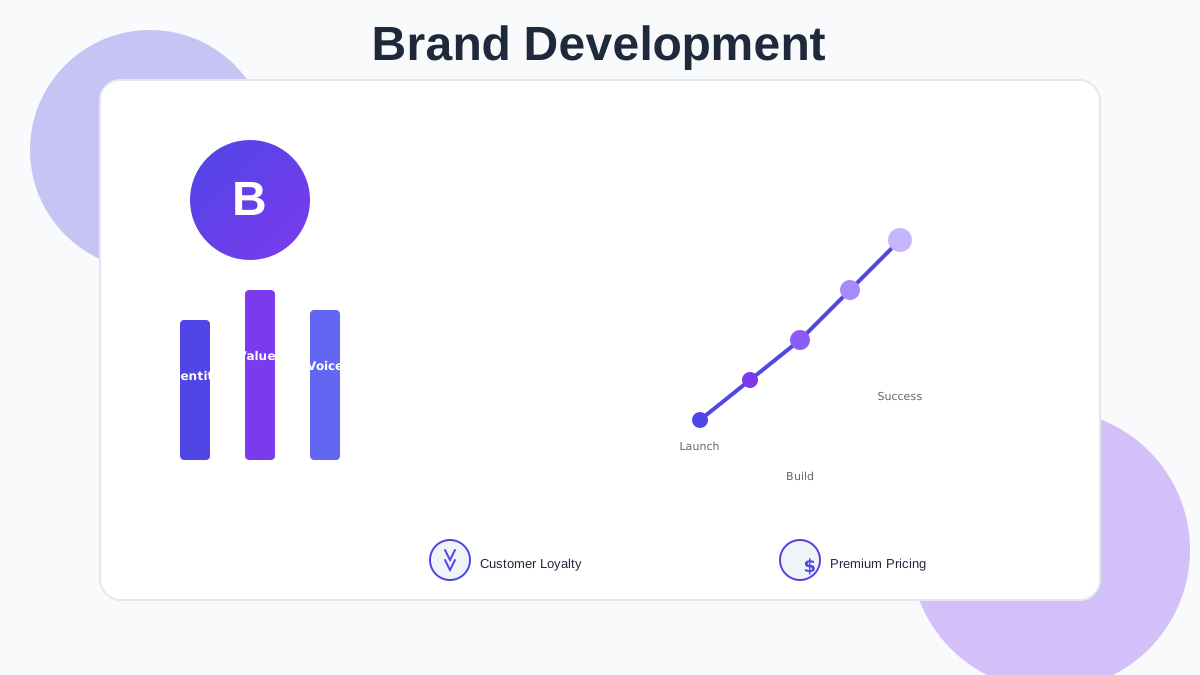
Whether you're launching a startup, repositioning an established business, or building a personal brand for financial independence, understanding brand development fundamentals is essential for long-term financial success.
The strongest brands are built on authenticity, consistency, and clear value delivery—not flashy marketing alone.
What Is Brand Development?
Brand development is the comprehensive process of strategically building and evolving your brand identity through deliberate actions across positioning, messaging, visual identity, customer experience, and market presence. It encompasses everything from defining your unique value proposition and target audience to crafting brand personality, designing visual elements, creating consistent communication, and ultimately building the emotional connections that drive customer loyalty and premium pricing.
Not medical advice.
Brand development differs fundamentally from marketing. While marketing promotes existing brands, brand development creates the foundation that marketing amplifies. It's the strategic architecture underlying all customer interactions, ensuring consistency across every touchpoint—from your website and social media to customer service and product quality. A well-developed brand guides internal decision-making, attracts the right customers, justifies premium positioning, and creates defensible competitive advantages that competitors cannot easily replicate.
Surprising Insight: Surprising Insight: Brand equity—the premium customers will pay for your brand versus generic alternatives—can represent 20-80% of a company's total market value. Apple's brand accounts for roughly 40% of its enterprise value, making brand development among the highest-ROI investments in business.
The Brand Development Ecosystem
How brand components interconnect to create customer perception and loyalty
🔍 Click to enlarge
Why Brand Development Matters in 2026
In 2026, brand development has become essential for financial success across all business types. The digital economy makes brand visibility both more important and more achievable than ever. Consumers have endless choices, yet they gravitate toward brands they trust and emotionally connect with. Companies investing in authentic brand development see measurable results: increased customer lifetime value, reduced marketing costs through organic advocacy, expanded pricing flexibility, and easier access to partnerships and investment capital.
Furthermore, personal branding has democratized wealth-building opportunities. Individual entrepreneurs, consultants, and specialists can now build multimillion-dollar personal brands without traditional gatekeepers. A strong personal brand attracts premium clients, speaking engagements, partnership opportunities, and scalable income streams. In the attention economy, your reputation functions as currency—opening doors that capital alone cannot unlock.
Recent research shows that 94% of consumers are more likely to remain loyal to brands offering complete transparency, while 76% of consumers research brand values before purchasing. This shift toward purpose-driven, authentic branding means that companies with well-developed brand identities aligned with customer values capture disproportionate market share and enjoy superior profitability.
The Science Behind Brand Development
Neuroscience reveals that brand development works through emotional and cognitive pathways. When customers encounter consistent brand messaging, visual identity, and positive experiences, their brains form neural associations linking your brand to specific emotions and values. This process, called brand conditioning, makes customers choose your brand more quickly and confidently than competitors' brands. The amygdala (emotion center) processes brand information much faster than the prefrontal cortex (logic center), meaning emotional brand connections drive purchasing decisions faster than rational product comparisons.
Research in behavioral economics demonstrates that strong brands reduce customer decision-making friction. When customers trust a brand, they require less information before purchasing, pay price premiums without resistance, and become advocates who drive organic growth. Studies show that customer recommendations (influenced by brand loyalty) drive 30-50% of new customer acquisition while costing 50-80% less than traditional marketing. This creates a self-reinforcing cycle where brand development investment yields compounding returns over time.
How Brand Development Drives Financial Growth
The self-reinforcing cycle from brand strength to increased business value
🔍 Click to enlarge
Key Components of Brand Development
Brand Strategy & Positioning
Your brand strategy defines what you stand for, who you serve, and why customers should choose you. Effective positioning occupies a distinct, defensible space in customers' minds. This requires deep market research, competitive analysis, and clarity about your unique value proposition. Your positioning statement should clearly articulate what makes you different, why that difference matters to your target customers, and what you promise to deliver. Strong positioning enables premium pricing because customers understand exactly what they're paying for and why it's superior to alternatives.
Visual Identity & Design System
Visual identity encompasses your logo, color palette, typography, imagery style, and overall design aesthetic. These elements work together to create instant brand recognition and communicate your brand personality. Research shows that consistent visual branding increases brand recognition by 80%, yet most companies lack documented design systems ensuring consistency. A comprehensive visual identity system includes detailed guidelines for logo usage, color specifications, approved fonts, imagery standards, and application examples. This consistency builds subconscious brand associations that accumulate into powerful brand equity over time.
Brand Voice & Messaging
Brand voice is how you communicate—the personality, tone, and values expressed through every written and spoken word. Developing a distinctive voice requires identifying your brand personality (professional vs. casual, authoritative vs. approachable, etc.), core messages you want customers to remember, and communication guidelines for consistency. Your voice should reflect authentic brand values while resonating emotionally with your target audience. Consistent messaging across all channels—website, social media, customer service, advertising—reinforces brand identity and builds familiarity.
Customer Experience & Delivery
Your brand is ultimately delivered through customer experiences. Every interaction—from first website visit to post-purchase support—either strengthens or weakens brand perception. Brands like Apple and Zappos have built iconic status through exceptional customer experiences aligned with brand promises. This requires mapping all customer touchpoints and deliberately designing experiences that deliver on brand promises. When employees embody brand values and customers consistently experience excellent service, brand loyalty deepens and becomes resistant to competitor challenges.
| Component | Focus Area | Business Impact |
|---|---|---|
| Strategy & Positioning | Market differentiation | Premium pricing power |
| Visual Identity | Brand recognition | Faster customer decisions |
| Voice & Messaging | Emotional connection | Customer loyalty increase |
| Customer Experience | Promise delivery | Advocacy and retention |
How to Apply Brand Development: Step by Step
- Step 1: Conduct thorough market research: Survey competitors, analyze customer needs, identify market gaps, and research industry trends. Use surveys, interviews, and competitive analysis tools.
- Step 2: Define your target audience clearly: Create detailed customer personas including demographics, values, pain points, purchasing behaviors, and preferred communication channels.
- Step 3: Articulate your unique value proposition: Identify what makes you different, why that difference matters to customers, and what specific problems you solve better than competitors.
- Step 4: Develop your brand positioning statement: Craft a clear statement (2-3 sentences) that defines your brand's essence, primary benefit, and competitive differentiation.
- Step 5: Create your brand personality: Decide whether your brand is professional or casual, innovative or traditional, premium or accessible. Identify 3-5 personality traits that guide communication.
- Step 6: Design your visual identity system: Develop logo, color palette, typography, and imagery guidelines. Create a brand style guide documenting specifications for all visual elements.
- Step 7: Establish your brand voice and messaging: Define your communication style, core messages, key themes, and communication guidelines for consistency across all channels.
- Step 8: Build your brand narrative: Create compelling origin story, mission statement, and values that emotionally resonate with your target audience.
- Step 9: Implement across all touchpoints: Apply brand identity consistently to website, social media, packaging, customer service, and all customer-facing materials.
- Step 10: Monitor and evolve: Track brand perception through customer feedback, market research, and brand metrics. Refine strategy based on results while maintaining core identity.
Brand Development Across Life Stages
Young Adulthood (18-35)
Young adults often lack established professional brands but have significant opportunity to build them. This is the ideal time to develop strong personal brands that establish expertise, build social proof, and create visibility in your industry. Focus on authentic storytelling, consistent content creation, and genuine relationship building. A well-developed personal brand in your 20s and 30s can create exponential opportunities by your 40s and 50s. Young adults with strong personal brands attract better job offers, clients, mentorship, and partnership opportunities that compound throughout their careers.
Middle Adulthood (35-55)
This is when brand development delivers maximum financial impact. Middle-aged professionals with strong personal brands often transition into premium consulting, speaking, advisory roles, or business ownership—typically commanding 2-5x higher income than those without developed brands. Companies also leverage executive personal brands for marketing and customer acquisition. If brand development hasn't occurred earlier, this is the time to accelerate it. Your experience and established credibility provide foundation for rapid brand growth in this phase.
Later Adulthood (55+)
Strong personal brands become invaluable assets for consulting opportunities, board positions, advisory roles, and legacy projects. Many executives in this phase monetize decades of experience through well-developed personal brands, creating scalable income independent of traditional employment. A strong brand also facilitates smooth business transitions, mergers, or succession planning by attracting premium valuation. Even in later career stages, brand development strengthens market positioning and enables continued financial growth.
Profiles: Your Brand Development Approach
The Ambitious Entrepreneur
- Clear differentiation in crowded markets
- Scalable brand-building systems
- Authentic storytelling that attracts ideal customers
Common pitfall: Trying to appeal to everyone and ending up memorable to no one
Best move: Narrow your target audience ruthlessly, then dominate that niche completely before expanding
The Corporate Professional
- Executive personal brand visibility
- Thought leadership positioning
- Internal and external credibility building
Common pitfall: Staying invisible internally while competitors build prominent profiles
Best move: Create consistent thought leadership content, speak at industry events, and mentor emerging talent
The Freelancer/Consultant
- Premium positioning over competition
- Trust signals and social proof
- Specialized expertise clarity
Common pitfall: Competing on price instead of unique value, attracting low-profit clients
Best move: Document expertise, showcase results, target specific high-value niches where you command premium fees
The Business Owner
- Strong brand equity for business valuation
- Customer loyalty for resilience
- Differentiation from growing competition
Common pitfall: Confusing company success with strong brand—then struggling to sell at premium valuation
Best move: Build systematic brand awareness, document your unique approach, create customer loyalty programs
Common Brand Development Mistakes
The first major mistake is inconsistency. Many businesses create beautiful brand guidelines then fail to implement them consistently. Your logo appears in different variations across platforms, your messaging tone shifts randomly, your visual identity lacks coherence. Inconsistency weakens brand recognition and suggests unprofessionalism. Successful brand development requires treating your guidelines as non-negotiable standards, not suggestions, across every channel.
The second mistake is chasing trends instead of building lasting positioning. Brands that constantly rebrand, chase viral moments, or shift positioning to whatever's trending rarely build deep customer loyalty. Your brand should evolve thoughtfully but maintain core identity consistency. Customers develop stronger attachments to brands that feel stable and trustworthy, not constantly changing. Companies that resist trend-chasing while delivering consistent value typically outlast competitors obsessed with novelty.
The third mistake is developing brand identity without customer insight. Too many businesses build brands based on what founders like rather than what customers value. This disconnect undermines positioning, messaging, and customer loyalty. Effective brand development starts with deep customer research—understanding their values, preferences, pain points, and aspirations—then building identity that resonates authentically with those insights.
Brand Development Pitfalls & Solutions
Common mistakes and how to avoid them
🔍 Click to enlarge
Science and Studies
Recent research demonstrates that strategic brand development directly impacts financial performance and customer behavior. Studies from leading business institutions consistently show that well-developed brands outperform competitors on key financial metrics, customer retention, and market valuation. The following research provides evidence-based foundation for brand development investment.
- Canva research (2025): Companies with consistent brand identity saw 20-80% increases in revenue depending on industry, while 94% of consumers are more loyal to transparent brands.
- Financial Planning Association: Personal brand development directly impacts financial advisory fees—specialists with strong personal brands command 20-30% fee premiums over unbranded competitors.
- InMoment Brand Equity Study (2024): Brand loyalty reduces customer acquisition costs by 50-80% while increasing customer lifetime value by 3-5x compared to competing brands.
- Entrepreneur.com Analysis (2024): Companies investing in systematic brand development experienced 2.5x faster growth and 40% higher profit margins than competitors with minimal brand investment.
- Brand Wisdom Solutions (2024): Emerging brand development strategies emphasizing authenticity and purpose-driven positioning captured disproportionate market share in competitive industries.
Your First Micro Habit
Start Small Today
Today's action: Define one unique thing about your brand in one sentence, then practice explaining it to three people. Notice how clearly you communicate what makes you different.
Brand development starts with clarity. Most businesses can't articulate their unique value in one sentence, yet customers need this clarity to differentiate you from competitors. Daily practice crystallizing your positioning makes it easier to communicate consistently across all channels, accelerating brand recognition and customer loyalty.
Keep quitting habit apps after a missed day? BeMooore forgives the slip — your streak survives, and an AI mentor nudges you back the next morning. Free on iOS.
Quick Assessment
How clearly can you articulate your unique value proposition in one sentence?
Clear positioning is the foundation of effective brand development. If you struggle articulating your differentiation, your customers likely do too. This clarity gap directly impacts your ability to command premium pricing and attract ideal customers.
How consistently is your brand identity applied across all customer touchpoints?
Consistency is how brand identity becomes powerful. Each consistent touchpoint reinforces your brand in customers' minds. Inconsistency weakens recognition and suggests unprofessionalism, costing you premium pricing power and customer loyalty.
How much of your brand development is based on customer research versus your preferences?
The strongest brands are built on deep customer understanding, not founder preferences. If your brand development hasn't centered on customer research, you risk building identity that fails to resonate emotionally with target customers, limiting loyalty and pricing power.
Take our full assessment to get personalized recommendations.
Discover Your Style →Next Steps
Brand development is among the highest-ROI investments in business. Companies that systematically develop strong brands outperform competitors on financial metrics, customer loyalty, and long-term valuation. Your brand is ultimately a wealth-building asset—the stronger it becomes, the more valuable your business becomes to customers, partners, and potential acquirers.
Start by clearly defining what makes you different and why customers should care. Then systematically build and reinforce this positioning across every customer touchpoint. This consistency, combined with genuine delivery on brand promises, creates the loyalty and premium positioning that drives sustainable wealth creation.
Get personalized guidance with AI coaching.
Start Your Journey →Research Sources
This article is based on peer-reviewed research and authoritative sources. Below are the key references we consulted:
Related Glossary Articles
Frequently Asked Questions
How long does brand development typically take?
Effective brand development requires 3-6 months of strategic work: market research, positioning development, visual identity creation, and messaging development. However, brand building itself—establishing recognition and loyalty—continues for years or decades. Most companies see measurable benefits within 6-12 months of consistent brand implementation.
Can I do brand development myself or should I hire professionals?
That depends on your resources and expertise. For clear positioning and messaging, many founders can do excellent work with proper frameworks and research. For visual identity design, most businesses benefit from professional design expertise. Many successful brands use hybrid approaches: founders lead strategy, professionals handle design and implementation.
How much should I invest in brand development?
Typical investments range from $5,000-$50,000 for comprehensive brand development depending on complexity and professional involvement. For smaller businesses, starting with $2,000-$5,000 for positioning, basic visual identity, and messaging is reasonable. The ROI typically justifies investment within 1-2 years through premium pricing and customer retention benefits.
Should I completely rebrand my existing business?
Complete rebranding is rarely necessary. Most businesses benefit more from brand evolution—refining positioning, updating visual identity, improving consistency. Radical rebranding risks confusing existing customers and wasting brand equity you've already built. Reserve rebranding for significant strategic shifts or severe market repositioning needs.
How do I measure whether my brand development is working?
Track metrics like brand awareness (aided/unaided recall), customer perception research, pricing power improvements, customer retention rates, organic referral rates, and business valuation multiples. Monitor whether you're attracting ideal customers at premium prices versus before brand development efforts began.
Take the Next Step
Ready to improve your wellbeing? Take our free assessment to get personalized recommendations based on your unique situation.
- Discover your strengths and gaps
- Get personalized quick wins
- Track your progress over time
- Evidence-based strategies